
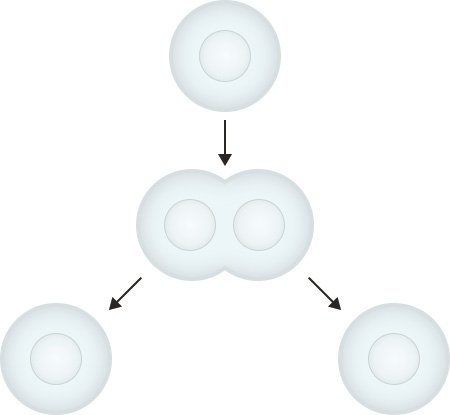
During cell division, the contents of the parent cell are copied and divided between the two daughter cells. Before this can happen, the nucleus of the parent cell needs to divide. The division of the nucleus is an important part of normal cell division: It ensures that the daughter cells have the same genetic information as the parent cell.
Cells need to divide for your body to grow and for body tissue such as skin to continuously renew itself. When a cell divides, the outer membrane increasingly pinches inward until the new cells that are forming separate from each other. This process typically produces two new (daughter) cells from one (parent) cell.
What happens during the division of the cell and the nucleus (mitosis)?
|
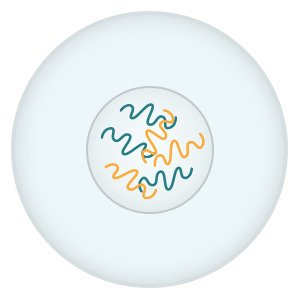
The genetic information is stored in the DNA in the nucleus of the cell. You can picture the DNA as strands inside the nucleus. The strands of DNA are called chromosomes. |

|
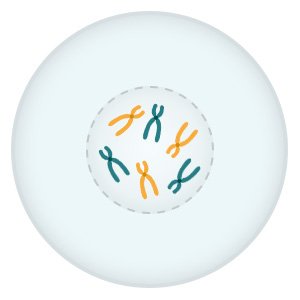
Before a cell divides, its entire genetic information is replicated: An identical copy of each chromosome is made. |
|
The chromosomes are now tightly coiled and are firmly attached to their own copy at one point. |
|
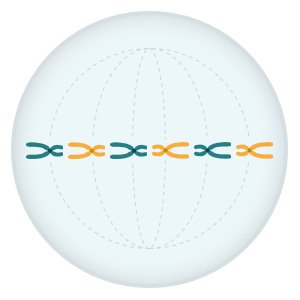
After that, the membrane surrounding the nucleus breaks down and the chromosomes line up along the center of the cell. |
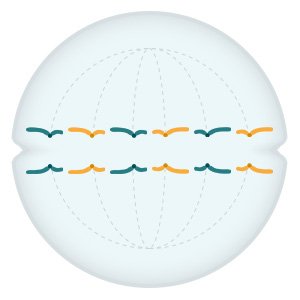
|
That's where they separate. The chromosomes then move to opposite sides of the cell, together with their attached copy. The cell membrane starts pinching inward. |
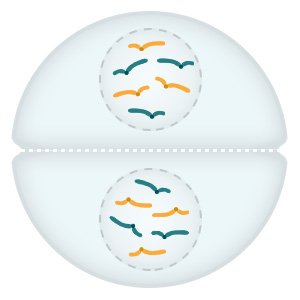
|
The chromosomes are enclosed by two new nuclear membranes. The cell membrane continues to pinch inward, separating the two daughter cells. |
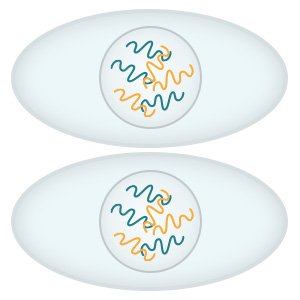
|
Each of the two daughter cells now contain the same genetic information as the parent cell. Both cells often assume the same function as the parent cell. But sometimes one of the two daughter cells develops into a cell that performs a different job. |
Alberts B. Lehrbuch der Molekularen Zellbiologie. Weinheim: Wiley-VCH; 2021.
Brandes R, Lang F, Schmidt R. Physiologie des Menschen: mit Pathophysiologie. Berlin: Springer; 2019.
IQWiG health information is written with the aim of helping people understand the advantages and disadvantages of the main treatment options and health care services.
Because IQWiG is a German institute, some of the information provided here is specific to the German health care system. The suitability of any of the described options in an individual case can be determined by talking to a doctor. informedhealth.org can provide support for talks with doctors and other medical professionals, but cannot replace them. We do not offer individual consultations.
Our information is based on the results of good-quality studies. It is written by a team of health care professionals, scientists and editors, and reviewed by external experts. You can find a detailed description of how our health information is produced and updated in our methods.
Über diese Seite

Stay informed
Subscribe to our newsletter or newsfeed. You can find our growing collection of films on YouTube.