Alzheimer's disease: What is the CDR scale?

The CDR ("Clinical Dementia Rating") scale is a questionnaire that doctors use to assess the degree of Alzheimer's disease in patients. It was developed with the aim of monitoring Alzheimer’s-related changes over time.

Categories covered by the CDR scale

Doctors use the CDR scale to find out whether a patient's memory and thinking skills have got worse and how that affects their independence in everyday life. The doctor asks the questions in a personal interview with the patient and someone the patient is close to. This can be a relative, a good friend or a caregiver, for example.

The interview takes about 30 minutes.

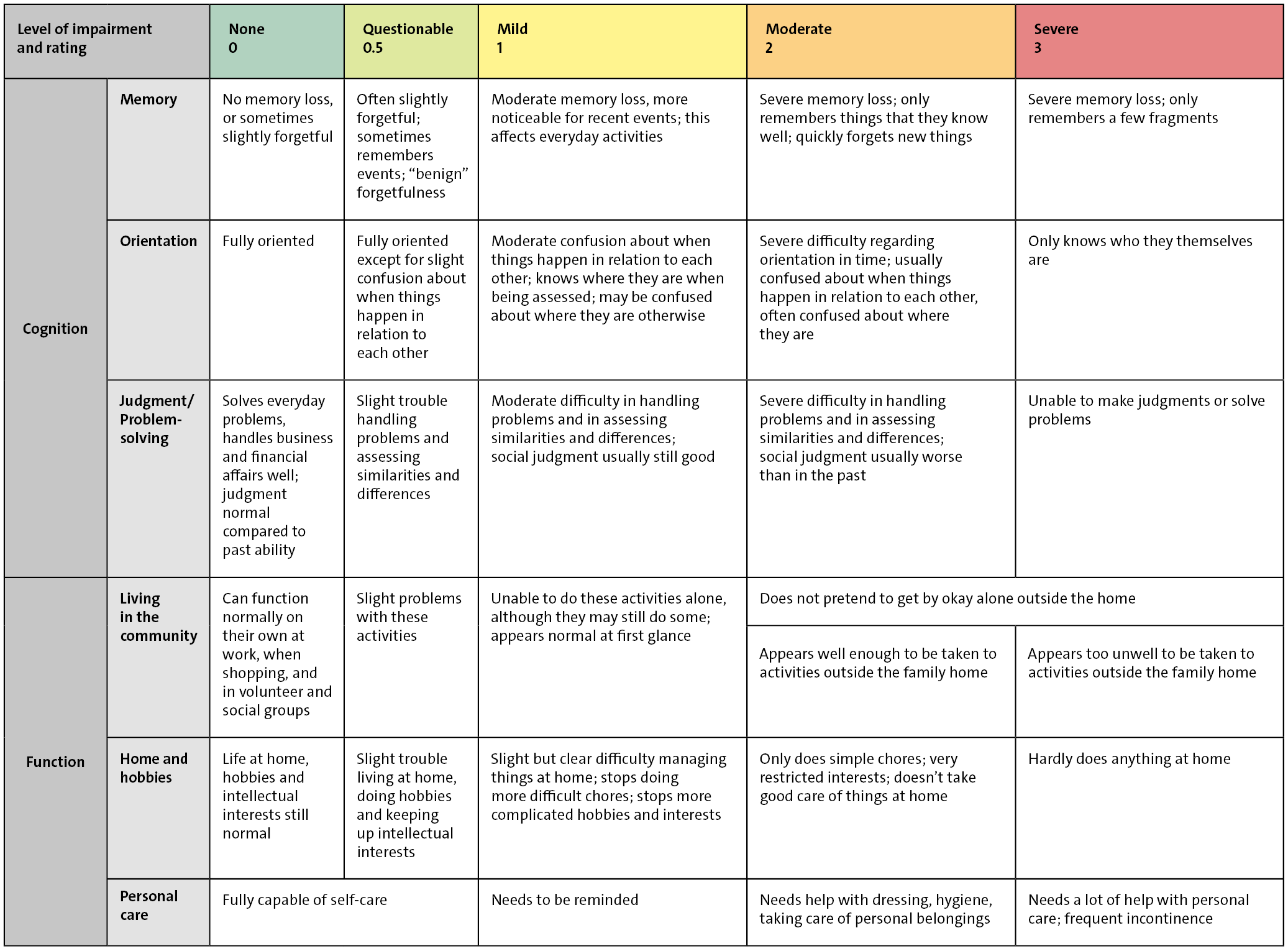
To assess the effects of Alzheimer's disease, the CDR scale contains various questions about the patient's thinking and memory skills (cognition) and their ability to cope in everyday life (function).

The questions on cognition relate to these three categories:

  • Memory
  • Orientation
  • Judgment and problem-solving

The questions on function in everyday life relate to these three categories:

  • Living in the community
  • Home and hobbies
  • Personal care

CDR scores

Based on the interview and answers, the doctor gives a score for each category: Is there no impairment or a questionable, mild, moderate or severe impairment? The score for no impairment ("none") is 0, and the score for a severe impairment is 3.

The higher the score, the more the patient's daily life is affected. The following overview can help you understand how the loss of skills in the various categories can affect everyday life.

Interpreting the results

The scores determined in the interview provide information about the degree of Alzheimer's disease.

One common evaluation approach is known as the “CDR-Sum of Boxes” (CDR-SB). Here, all of the scores are added together to arrive at an overall CDR-SB score. Because the highest score for each of the six categories is 3, the total CDR-SB score ranges between 0 and 18.

This means: The higher the score, the more the disease is causing problems and impairments.

The degree of Alzheimer's disease severity is usually assessed based on the CDR-SB score, like this:

  • A score of 0: No impairment
  • 0.5 to 4: Mild cognitive impairment
  • 4.5 to 9: Mild dementia
  • 9.5 to 15.5: Moderate dementia
  • 16 to 18: Severe dementia

Institute for Quality and Efficiency in Health Care (IQWiG, Germany). General Methods; Version 7.0 [online]. 2023.

Institute for Quality and Efficiency in Health Care (IQWiG, Germany). Lecanemab (early Alzheimer’s disease) – Benefit assessment according to §35a Social Code Book V. Dossier assessment; Commission A25-111 [online]. 2025.

O'Bryant SE, Waring SC, Cullum CM et al. Staging dementia using Clinical Dementia Rating Scale Sum of Boxes scores: a Texas Alzheimer's research consortium study. Arch Neurol 2008; 65(8): 1091-1095.

IQWiG health information is written with the aim of helping people understand the advantages and disadvantages of the main treatment options and health care services.

Because IQWiG is a German institute, some of the information provided here is specific to the German health care system. The suitability of any of the described options in an individual case can be determined by talking to a doctor. informedhealth.org can provide support for talks with doctors and other medical professionals, but cannot replace them. We do not offer individual consultations.

Our information is based on the results of good-quality studies. It is written by a team of health care professionals, scientists and editors, and reviewed by external experts. You can find a detailed description of how our health information is produced and updated in our methods.

Comment on this page

What would you like to share with us?

We welcome any feedback and ideas - either via our form or by gi-kontakt@iqwig.de. We will review, but not publish, your ratings and comments. Your information will of course be treated confidentially. Fields marked with an asterisk (*) are required fields.

Please note that we do not provide individual advice on matters of health. You can read about where to find help and support in Germany in our information “How can I find self-help groups and information centers?

Über diese Seite

Created on December 8, 2025

Next planned update: 2028

Publisher:

Institute for Quality and Efficiency in Health Care (IQWiG, Germany)

Stay informed

Subscribe to our newsletter or newsfeed. You can find our growing collection of films on YouTube.