
Crowns, bridges, implants: What types of replacement teeth are there?

Anyone who has lost one or more teeth usually wants a suitable replacement as soon as possible. There are fixed and removable types of replacement teeth (dental prostheses). Crowns and bridges, for example, are fixed in place, but dentures can often be taken out.

Replacement teeth can be attached to remaining teeth or dental implants. Dental implants are artificial tooth roots that are anchored into the jawbone. The various types of replacement teeth can also be combined in different ways: For example, a crown might be fixed on top of a dental implant, and then a partial denture could be fixed on top of the crown.

Whether or not replacement teeth are needed – and which type is most suitable – depends on a number of different factors. The following play a role, for example:

  • whether there are still teeth on both sides of the gap left by a missing tooth
  • how healthy those neighboring teeth are
  • whether there are still teeth opposite the gap
  • how healthy and clean your mouth is overall
  • how old you are
  • your way of life
  • personal preferences and expectations regarding your appearance, your ability to speak clearly, and your ability to chew properly
  • the costs

What happens before the treatment?

Before suggesting a suitable type of dental prosthesis, your dentist will first examine your teeth to see how large the gap in the teeth is, where it is located, and whether there are still teeth next to it. The dentist will also check how healthy your jaw and any neighboring teeth are.

In Germany, your doctor puts together a treatment plan and cost estimate overview (called a Heil- und Kostenplan) which is submitted to your health insurer before the treatment can begin. Public health insurers cover some of the costs of replacement teeth, but patients generally have to pay a part of it themselves. If your health insurer approves your request, they will send you a written reply and let you know how much of the treatment costs they will cover.

If you have questions about the different treatment options and costs in the plan your dentist suggested, it may be a good idea to get a second opinion from another dentist. For more advice about replacement teeth in Germany, you can contact your public health insurer or one of the patient information centers run by the German dental associations.
What kinds of fixed replacement teeth are there?

There are two main types of fixed dental prostheses: crowns and bridges.

Crowns are used to replace individual teeth that are severely damaged or weakened. They are made of metal, ceramic, porcelain or resin (a synthetic material). Crowns are placed on natural teeth to stabilize and preserve them. Full crowns cover the entire tooth, and partial crowns only cover part of the tooth. In order to create a well-fitting crown, the dentist first trims the tooth and makes a mold of it.

The photorealistic illustrations show, in three steps, how a full crown is placed on a prepared, damaged tooth.

Bridges can completely replace one or several teeth, and are typically used for smaller gaps. They are only an option if there are enough remaining stable teeth or if dental implants are put in first. These can be used as abutments to secure the artificial (false) tooth, which fills in the space between them.

The two photorealistic illustrations show how a bridge is fixed in place with two abutment teeth.

Depending on the location and size of the gap, different types of bridges may be needed. For example, a traditional bridge is used to close a gap between two teeth. It is fixed to two abutment teeth – one on either side of the gap. These provide support for the bridge. Cantilever bridges are used when the molar tooth right at the back of the mouth needs to be replaced, for example. Because the row of teeth ends there, the bridge can only be supported by neighboring teeth on one side. These kinds of bridges are supported by at least two teeth on that side, to keep them stable.

Bridges can be fixed in place in various ways. The abutment teeth can be filed down and reshaped, and then fitted with crowns. After that, the artificial tooth is fixed to the crowns on either side, forming a bridge. In inlay (or onlay) bridges, fillings are put in the abutment teeth that the bridge is anchored to. In resin-bonded bridges (also called Maryland bridges), the artificial tooth is glued to the backs of neighboring teeth using short metal “wings.”

What are dental implants?

Dental implants are artificial tooth roots made of metal (titanium) or ceramic. The dentist can attach various types of replacement teeth to them, like crowns, bridges or dentures.

Dental implants are anchored in the jawbone, much like screw anchors in a wall. The bone tissue there fuses with the surface of the dental implant to provide a stable foundation for the artificial tooth.

Artificial teeth that are supported by dental implants are also referred to as superstructures.

The photorealistic illustration shows an implant with an artificial tooth (superstructure) attached at the top, and how it is anchored in the jawbone.

What types of removable dentures are there?

Dentures can be divided into two categories: partial dentures and complete (full) dentures. As well as being brushed regularly along with the rest of your teeth, both types should be removed and cleaned separately at least once a day.

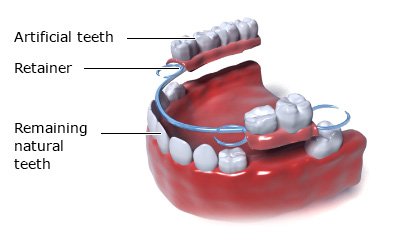
Partial dentures made of plastic and metal can be used if several teeth are missing, but there are still remaining teeth nearby. They are fixed to natural teeth or implants – for instance, using metal clasps.

The photorealistic illustration shows how a partial denture for the lower jaw is attached to the remaining natural teeth.

Complete dentures replace all of the natural teeth in the upper jaw, lower jaw or both. Ideally, they look just like natural teeth and allow you to chew and speak normally again. Complete dentures are usually made entirely of plastic. The key to properly fitted complete dentures is a good match to the jaw. This creates a slight vacuum between the jaw and the denture, which holds the denture in place. Dentures can also be fixed to the roots of teeth or dental implants – and are then called hybrid dentures.

IQWiG health information is written with the aim of helping people understand the advantages and disadvantages of the main treatment options and health care services.

Because IQWiG is a German institute, some of the information provided here is specific to the German health care system. The suitability of any of the described options in an individual case can be determined by talking to a doctor. informedhealth.org can provide support for talks with doctors and other medical professionals, but cannot replace them. We do not offer individual consultations.

Our information is based on the results of good-quality studies. It is written by a team of health care professionals, scientists and editors, and reviewed by external experts. You can find a detailed description of how our health information is produced and updated in our methods.

Comment on this page

What would you like to share with us?

We welcome any feedback and ideas - either via our form or by gi-kontakt@iqwig.de. We will review, but not publish, your ratings and comments. Your information will of course be treated confidentially. Fields marked with an asterisk (*) are required fields.

Please note that we do not provide individual advice on matters of health. You can read about where to find help and support in Germany in our information “How can I find self-help groups and information centers?

Über diese Seite

Updated on July 20, 2026

Next planned update: 2029

Publisher:

Institute for Quality and Efficiency in Health Care (IQWiG, Germany)

Stay informed

Subscribe to our newsletter or newsfeed. You can find our growing collection of films on YouTube.