
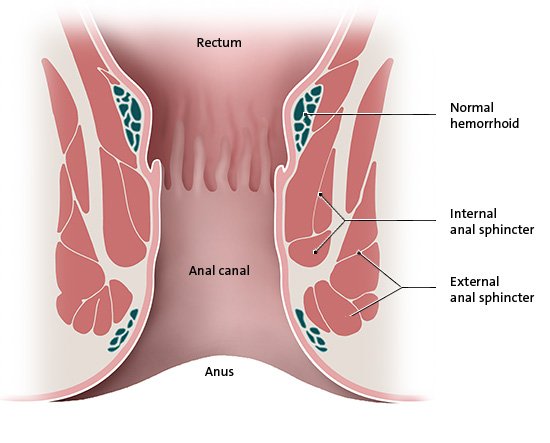
A bowel movement moves parts of food that can't be digested out of the body. It is usually possible to control bowel movements with the help of several parts of the end of the gastrointestinal tract: The medical term for the ability to voluntarily hold back stool is “fecal continence.” the rectum and anal canal, the sphincters (circular muscles), and hemorrhoids. These are embedded in the pelvic floor muscles.
What are the rectum and the anal canal?
The rectum, which is about 20 centimeters long, is the final section of the large intestine (colon). This is where the indigestible parts of our food collect until the bowel is emptied. The anal canal, situated between the rectum and anus, is closed off by sphincter muscles and hemorrhoids. It is between three and six centimeters long, and has a mucous membrane lining (anoderm). It contains many nerve fibers and transmits nerve signals. These help the body to detect the consistency of stool, for instance. They also help you know when your bowel needs to be emptied.
How do the sphincter muscles work?
There is an inner (internal) and outer (external) sphincter at the end of the anal canal. They close off the opening of the intestine to the outside (anus). The inner sphincter makes sure that the rectum does not open when you are sleeping, for example. It is ring-like in shape and made up of smooth muscle.
The outer sphincter supports the inner sphincter, helping it perform its function. Unlike the inner sphincter, the outer sphincter can be controlled voluntarily. This makes it possible to empty your bowels or hold back your stool when you want to. But the outer sphincter can also act involuntarily, for instance to help or prevent the passage of stool.
What do hemorrhoids do?
Hemorrhoids are “cushions” of tissue filled with blood vessels, found at the end of the rectum, just inside the anus. Together with the anal sphincters, they close off the bowel, preventing stool from leaving the body. Enlarged hemorrhoids can cause unpleasant symptoms. This is what most people mean when they talk about having hemorrhoids, also known as “piles.”
What does the pelvic floor do?
The pelvic floor is made up of muscles, ligaments and connective tissue. It physically supports the pelvic organs, and closes off the lower part of the pelvic cavity. Openings in this strong sheet of muscular tissue allow the rectum, urethra and vagina to pass through.
The pelvic floor relaxes when you have a bowel movement, and contracts (squeezes) when you hold stool back.
What makes you feel the urge to “go”?
When the rectum fills up, stretch receptors in the wall of the anus are activated. Signals are sent along nerves to the part of the brain known as the cerebrum. There they are processed, and signals are sent back to the lining of the anus. The inner sphincter opens, making you feel like you need to empty your bowels. The pelvic floor relaxes and drops down a little, allowing the muscles in the rectum to push the stool out.
If you follow the urge to empty your bowels, and go to the toilet, you voluntarily relax your outer sphincter muscle as well. You can hold back stool for some time by tensing the muscles in your pelvic floor and abdomen, as well as your outer anal sphincter. After a bowel movement, the inner sphincter closes again too and you no longer feel the urge to go to the toilet for a while.
Brandes R, Lang F, Schmidt R. Physiologie des Menschen: mit Pathophysiologie. Berlin: Springer; 2019.
Butt S, Eberhard-Metzger C, Federspiel K et al. Der Gesundheitsbrockhaus. Kursbuch Mensch: Aufbau, Funktion, Entwicklung, Krankheit und Heilung. Mannheim: F.A. Brockhaus; 2001.
Menche N. Biologie Anatomie Physiologie. Munich: Urban und Fischer; 2023.
Pschyrembel online. 2026.
IQWiG health information is written with the aim of helping people understand the advantages and disadvantages of the main treatment options and health care services.
Because IQWiG is a German institute, some of the information provided here is specific to the German health care system. The suitability of any of the described options in an individual case can be determined by talking to a doctor. informedhealth.org can provide support for talks with doctors and other medical professionals, but cannot replace them. We do not offer individual consultations.
Our information is based on the results of good-quality studies. It is written by a team of health care professionals, scientists and editors, and reviewed by external experts. You can find a detailed description of how our health information is produced and updated in our methods.
Über diese Seite

Stay informed
Subscribe to our newsletter or newsfeed. You can find our growing collection of films on YouTube.