Tennis elbow and golfer’s elbow

At a glance

  • If your elbow hurts when you move it and you have difficulty grasping objects, you might have tennis elbow or golfer's elbow.
  • Tennis elbow makes the outside of your elbow hurt, whereas golfer’s elbow affects the inner side of your elbow.
  • Both are usually caused by repetitive movements or too much strain, often during sports.
  • At first, it’s a good idea to stop doing the things that are causing the pain.
  • After that, specific strengthening exercises can help.
  • The symptoms often last for several months.

Introduction

Photo of a woman at a cash register

You might be familiar with these kinds of symptoms: When you unscrew the cap of a bottle or write on paper, your elbow hurts. Sometimes just lifting up a cup of coffee or grasping something tightly can be difficult. Often, tennis elbow or golfer’s elbow is the cause. They are typically the result of repetitive or heavy strain – the kind that might arise when playing tennis, doing manual work or typing at a computer.

The main treatment for both golfer’s elbow and tennis elbow consists of stretching and strengthening exercises. It often takes a few months for the symptoms to go away – so you’ll need a little patience. It makes sense to start by avoiding the activities that are causing the pain.

Symptoms

Tennis elbow and golfer’s elbow are easy to distinguish: If you have tennis elbow, it’s the outside of your elbow that hurts. If you have golfer’s elbow, the inside of your elbow is painful.

What they do have in common is that the pain mostly occurs when you move or touch your elbow. It can spread into your upper arm and forearm, or even to your hand. Pain that occurs when your wrist is stretched outwards and away from your forearm (tennis elbow) or bent inwards towards your forearm (golfer’s elbow) is also a typical symptom. The range of motion in your arm might be limited. The pain may go away a little when your arm is in a resting position, but sometimes it also comes back at night and makes it difficult to sleep.

Causes and risk factors

The tendons involved in the movements that move your wrist forwards and backwards start at the elbow. Doctors believe that small injuries and wear and tear at the base of the tendons that attach to the muscles are what cause the pain.

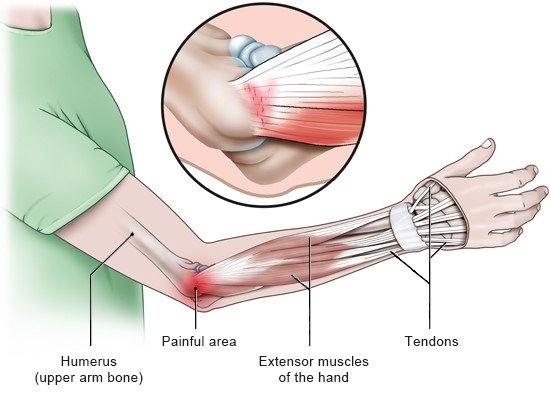
This illustration shows the outside of the elbow – where tennis elbow causes pain – and where the tendons attach to the elbow (in detail).
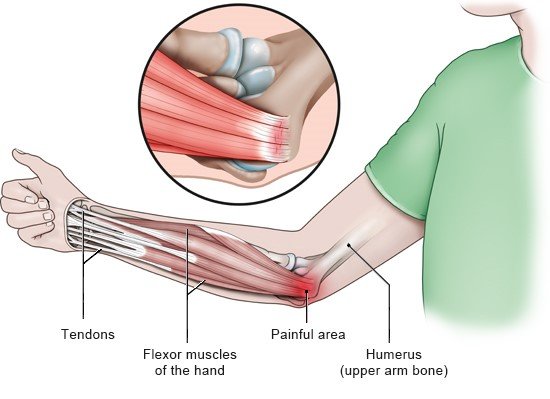
This illustration shows the inside of the elbow – where golfer’s elbow causes pain – and where the tendons attach to the elbow (in detail).

These symptoms often develop in people who suddenly put very heavy strain on their forearm muscles. but also after long-term frequent repetitive use. Possible causes include:

  • Sports like tennis or rowing (tennis elbow), golf or ball games (golfer’s elbow), strength training
  • Manual labor like painting, carpentry or chopping wood
  • Heavy lifting
  • Playing musical instruments, such as the piano
  • Working at a computer or a supermarket cash register
  • Cooking, for instance chopping or peeling

So although tennis elbow or golfer’s elbow can in fact be caused by playing tennis or golf, the symptoms most often have other causes.

Prevalence

About 2% of people get tennis elbow, and less than 1% have golfer’s elbow. The symptoms are most common in people between the ages of 40 and 60 – probably because the muscles are more susceptible to overuse in middle and older age. These conditions are equally common in men and women.

Outlook

Sometimes the symptoms go away after just a few weeks, but they often last several months. The pain goes away within one year about 80% of the time. It will take longer otherwise.

Diagnosis

The doctor will first ask you what sort of activities make the pain noticeable and whether you have any other medical conditions. They will then examine the arm and see which movements hurt. This might involve extending your arm with the palm of your hand facing down, and then pressing the same hand up and down against a certain amount of . Pain in the elbow when you’re pressing upwards is a sign of tennis elbow, and pain caused by pressing downwards is a sign of golfer's elbow.

This kind of physical examination is usually enough to make a . X-rays, ultrasound scans or MRI () are only considered if doctors think that you might have something else.

Treatment

It can take several months for the symptoms to go away – usually this happens without any major treatment. It is a good idea to avoid the activities that are causing pain as much as possible at the start, or at least to reduce the strain so that the pain is less.

Special exercises to strengthen the forearm and wrist, called “eccentric exercises,” can help to relieve the pain. The goal of treatment is to relieve the pain and to improve the mobility and strength of your arm and wrist. You can do these exercises as treatment for tennis and golfer’s elbow on your own at home. Manual therapy by a can help too.

NSAID (non-steroidal anti-inflammatory drug) painkillers like ibuprofen can offer temporary pain relief. Steroid injections can also relieve pain, but they may disrupt the healing process. A few studies suggest that ultrasound therapy can somewhat improve the pain caused by tennis elbow.

Surgery may be considered if the symptoms last for a long time despite treatment. There has hardly been any research on its benefits, though.

Many other treatments are available, but they haven’t been proven to help. These include various injections (e.g. autologous blood or Botox), laser therapy, electrotherapy, massages, shock wave therapy and . Public health insurers in Germany usually don't cover the costs of these treatments.

Further information

When people are ill or need medical advice, they usually go to see their family doctor first. Information about health care in Germany can help you to navigate the German healthcare system and find a suitable doctor. You can use this list of questions to prepare for your appointment.

Ahmad Z, Siddiqui N, Malik SS et al. Lateral epicondylitis: a review of pathology and management. Bone Joint J 2013; 95-B(9): 1158-1164.

Amin NH, Kumar NS, Schickendantz MS. Medial epicondylitis: evaluation and management. J Am Acad Orthop Surg 2015; 23(6): 348-355.

Barreto ES, Antunes Junior CR, Alencar VB et al. The efficacy of Botulinum Toxin in Tennis Elbow: a meta-analysis of randomized clinical trials. Int Orthop 2024; 48(12): 3139-3149.

Bisset L, Coombes B, Vicenzino B. Tennis elbow. Clin Evid 2011: 1117.

Buchbinder R, Johnston RV, Barnsley L et al. Surgery for lateral elbow pain. Cochrane Database Syst Rev 2011; (3): CD003525.

Dingemanse R, Randsdorp M, Koes BW et al. Evidence for the effectiveness of electrophysical modalities for treatment of medial and lateral epicondylitis: a systematic review. Br J Sports Med 2014; 48(12): 957-965.

Donaldson O, Vannet N, Gosens T et al. Tendinopathies Around the Elbow Part 2: Medial Elbow, Distal Biceps and Triceps Tendinopathies. Shoulder Elbow 2014; 6(1): 47-56.

Dong W, Goost H, Lin XB et al. Injection therapies for lateral epicondylalgia: a systematic review and Bayesian network meta-analysis. Br J Sports Med 2016; 50(15): 900-908.

Hegmann KT, Hoffman HE, Belcourt RM et al. ACOEM practice guidelines: elbow disorders. J Occup Environ Med 2013; 55(11): 1365-1374.

Karanasios S, Tsamasiotis GK, Michopoulos K et al. Clinical effectiveness of shockwave therapy in lateral elbow tendinopathy: systematic review and meta-analysis. Clin Rehabil 2021; 35(10): 1383-1398.

Kim YJ, Wood SM, Yoon AP et al. Efficacy of Nonoperative Treatments for Lateral Epicondylitis: A Systematic Review and Meta-Analysis. Plast Reconstr Surg 2021; 147(1): 112-125.

Loew LM, Brosseau L, Tugwell P et al. Deep transverse friction massage for treating lateral elbow or lateral knee tendinitis. Cochrane Database Syst Rev 2014; (11): CD003528.

Mattie R, Wong J, McCormick Z et al. Percutaneous Needle Tenotomy for the Treatment of Lateral Epicondylitis: A Systematic Review of the Literature. PM R 2017; 9(6): 603-611.

Navarro-Santana MJ, Sanchez-Infante J, Gomez-Chiguano GF et al. Effects of manual acupuncture and electroacupuncture for lateral epicondylalgia of musculoskeletal origin: a systematic review and meta-analysis. Acupunct Med 2021; 39(5): 405-422.

Orchard J, Kountouris A. The management of tennis elbow. BMJ 2011; 342: d2687.

Raman J, MacDermid JC, Grewal R. Effectiveness of different methods of resistance exercises in lateral epicondylosis - a systematic review. J Hand Ther 2012; 25(1): 5-25; quiz 26.

Shiri R, Viikari-Juntura E. Lateral and medial epicondylitis: role of occupational factors. Best Pract Res Clin Rheumatol 2011; 25(1): 43-57.

Tang H, Fan H, Chen J et al. Acupuncture for Lateral Epicondylitis: A Systematic Review. Evid Based Complement Alternat Med 2015: 861849.

IQWiG health information is written with the aim of helping people understand the advantages and disadvantages of the main treatment options and health care services.

Because IQWiG is a German institute, some of the information provided here is specific to the German health care system. The suitability of any of the described options in an individual case can be determined by talking to a doctor. informedhealth.org can provide support for talks with doctors and other medical professionals, but cannot replace them. We do not offer individual consultations.

Our information is based on the results of good-quality studies. It is written by a team of health care professionals, scientists and editors, and reviewed by external experts. You can find a detailed description of how our health information is produced and updated in our methods.


Comment on this page

What would you like to share with us?

We welcome any feedback and ideas - either via our form or by gi-kontakt@iqwig.de. We will review, but not publish, your ratings and comments. Your information will of course be treated confidentially. Fields marked with an asterisk (*) are required fields.

Please note that we do not provide individual advice on matters of health. You can read about where to find help and support in Germany in our information “How can I find self-help groups and information centers?

Über diese Seite

Updated on December 18, 2025

Next planned update: 2028

Publisher:

Institute for Quality and Efficiency in Health Care (IQWiG, Germany)

Stay informed

Subscribe to our newsletter or newsfeed. You can find our growing collection of films on YouTube.