What causes hyperparathyroidism?

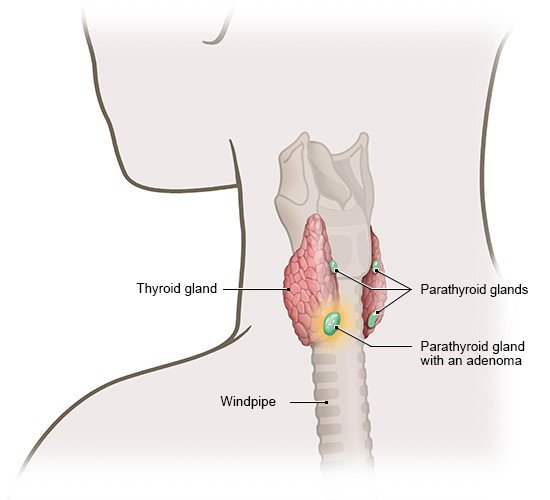
In hyperparathyroidism, the parathyroid glands make too much parathyroid hormone. In other words, they’re “overactive.” This can be caused by various things, such as a non-cancerous growth ( adenoma) in one of the glands. But it can also be a reaction to another medical condition.
The parathyroid glands are four small glands behind the thyroid gland. They produce parathyroid hormone, which ensures that there's always enough calcium in the blood. You can read more about what these glands do in the article “How do the parathyroid glands work?”
In hyperparathyroidism, too much parathyroid hormone is made. This may go unnoticed, but it can also affect your health in various ways.
What causes this overproduction of hormones? Hyperparathyroidism can either be caused by a problem with the parathyroid glands themselves or by a different medical condition.
- A problem with the parathyroid glands (primary hyperparathyroidism): If the parathyroid glands make more parathyroid hormone than the body needs “on their own," it is known as primary hyperparathyroidism. Then the calcium level in the blood rises even though there is already enough calcium there. In most cases, the extra parathyroid hormone is made by just one adenoma – a benign (not cancer) growth of gland tissue. Sometimes hyperparathyroidism is caused by specific medications; in very rare cases, it is caused by a malignant tumor (cancer).
- A reaction to another medical condition (secondary hyperparathyroidism): Here, the four parathyroid glands make more parathyroid hormone to compensate for a calcium deficiency caused by another medical issue, such as kidney disease. The medical term for this is secondary hyperparathyroidism.