Hyperparathyroidism

At a glance

  • Hyperparathyroidism often doesn't cause any symptoms for a long time. It is commonly only discovered by chance when people are found to have a high level of calcium in their blood.
  • If left untreated, it can damage the kidneys, bones and digestive tract.
  • It is often caused by a parathyroid adenoma – a benign (not cancer) growth that makes too much of a specific hormone.
  • Adenomas can be surgically removed.
  • Sometimes hyperparathyroidism is caused by another underlying condition. If that condition is treated, the parathyroid glands will also work normally again.

Introduction

Photo of a doctor taking a sample of blood from a patient

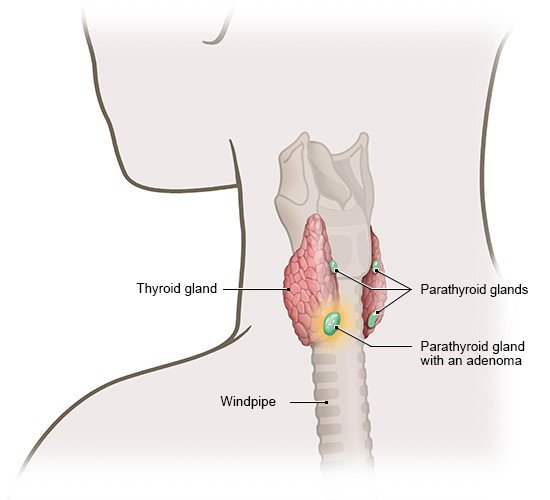
Hyperparathyroidism is often discovered by chance when people are found to have a high level of in their blood during a routine blood test. What does have to do with it? There are four parathyroid glands. Each about the size of a pea, they're found at the back of the thyroid gland. They make parathyroid hormone, which regulates levels in the blood. In hyperparathyroidism, the parathyroid glands make too much of this hormone (they are “overactive”), and that causes levels to rise.

Various tests, like blood and urine (pee) tests, can be done to see whether the hyperparathyroidism is the primary type or the secondary type. In the primary type, parathyroid glands make too much of the hormone “on their own.” Secondary hyperparathyroidism is caused by another medical issue, like kidney disease or a vitamin D deficiency. Then it's often only the parathyroid hormone levels that are high, and the levels may be normal. There are various treatment options for hyperparathyroidism, depending on what's causing it.

Symptoms

Hyperparathyroidism often goes unnoticed for a long time if it doesn't cause any symptoms, or only mild ones. Things like generally feeling tired or weak, having trouble concentrating or mood swings can also be caused by something else.

More typical symptoms may develop over time. These symptoms occur because the higher levels of parathyroid hormone lead to problems in the following three areas of the body:

  • Kidneys: Kidney stones may form in the kidneys. These can cause pain and cramping in your lower belly. The stones can damage the soft membranes lining the urinary tract, which may lead to blood in your urine (pee). You may also see small fragments of kidney stones in your urine when you go to the toilet.
  • Bone: To make up for the lack of in your blood, is released from bones in your body. This can lead to pain in your joints and back.
  • Digestive tract: Too much acid is made in the stomach. This can lead to symptoms such as loss of appetite, belly ache, nausea, constipation, bloating or weight loss.

Causes and risk factors

Hyperparathyroidism is often caused by a type of benign (not cancer) growth called an . Parathyroid adenomas are made out of parathyroid gland tissue. They make a lot of parathyroid hormone even when there is already enough in the blood. In most cases, there's just one in one of the four parathyroid glands. It is quite rare to have more than one in one or more parathyroid glands at the same time.

The illustration shows a thyroid gland with the four parathyroid glands behind it. One of them contains a single adenoma.

It is often not clear why adenomas develop. It is thought that certain medications play a role, especially those containing lithium. These can be prescribed for certain mental health problems, such as bipolar disorder.

In some people, hyperparathyroidism is passed down in their genes (hereditary). Then they may have growths in other glands, too. There is also a rare hereditary form of hyperparathyroidism that can already occur in newborn babies.

Sometimes, the parathyroid glands make a lot of parathyroid hormone because the body is losing or having trouble absorbing it due to another medical condition. A typical example here is chronic kidney disease.

Prevalence

1 to 4 out of every 1,000 people are likely to have hyperparathyroidism that is caused by the parathyroid glands themselves. Some estimates are higher. Experts believe that the disease has been diagnosed more frequently in recent years because blood levels are being tested more often. This means that it's also being discovered by chance in people who don't have any symptoms.

The disease typically first develops in middle age, between the ages of 50 and 60 – and it's more common in women than in men. But it can also develop in children and older adults.

Outlook

Many people don't notice anything at first. Then signs of the disease are only discovered when blood levels are measured – for example, during a routine check-up. Many people only have slightly higher levels and no symptoms. In others, increasing amounts of parathyroid hormone are produced over time, damaging the kidneys, bones and digestive tract, and eventually leading to symptoms.

If the hyperparathyroidism is caused by another medical condition, treating that condition is often the main focus. For example, some people may have had kidney disease for a long time and then already need dialysis.

Effects

Kidney stones can lead to complications. For example, if a stone becomes stuck in a ureter (tube between the kidneys and the bladder), it can cause severe cramping pain (colic) and possibly trouble peeing. This puts a strain on the kidneys and can lead to infections. Hyperparathyroidism can also lead to a build-up of deposits in the kidney tissue, causing the tissue to harden. This weakens the kidneys, and eventually they can no longer filter the blood properly (renal insufficiency).

Because your body takes from the bones, hyperparathyroidism can lead to a form of osteoporosis: The bones become unstable and may crack or break – even without falls or accidents. Increased stomach acid can lead to stomach ulcers or duodenal ulcers, which you might notice because of the pain they cause in the belly area. The ulcers may bleed as well. Sudden, heavy bleeding can even be life-threatening. Losing a small amount of blood over longer periods of time can result in anemia. Hyperparathyroidism can also lead to in the , causing severe belly pain, a fever and sometimes even serious circulation problems. Belly pain can also be caused by gallstones, although they rarely occur.

If the level in the blood increases a lot, further complications may arise. The medical term for this is hypercalcemia. It can occur in people who are bed-ridden. This is because if you don't move much, your bones break down faster than they rebuild. Calcium is released as a result. Hypercalcemia can also happen if you have high levels but still take or medications that increase your levels even more – such as certain kidney medications (diuretics) or vitamin D. People with hypercalcemia typically pee more and vomit. As a result, they become very dehydrated (don't have enough fluids in their body).

In rare cases, complications occur because high levels of in the blood affect the nerves. Then people become weak, drowsy and may lose consciousness. Some hallucinate or are confused. Life-threatening heart rhythm problems may occur, too. So hypercalcemia is a medical emergency that needs to be treated urgently in a hospital.

Diagnosis

Blood tests play an important role in the of hyperparathyroidism. In most cases, high blood levels are detected at first. Calcium levels are usually measured as part of routine blood tests. If there are also high levels of parathyroid hormone in your blood, that's usually a sign that you have one or more adenomas.

If you have high levels of parathyroid hormone but your levels are normal or even too low, it's likely that your parathyroid glands are making too much of the hormone to compensate for a deficiency caused by another medical issue.

More blood tests and urine tests can be done to find out how severe the hyperparathyroidism is or to rule out other illnesses. For example, some test results can help doctors to see how well your kidneys are working. Other test results can show whether the bones are already being affected.

If the doctor thinks you might have an , they will try to find it using an ultrasound scan, a (CT) scan, a scintigraphy, or a PET scan. Damage to the kidneys or bones can be seen using ultrasound scans and x-ray exams. If it's thought that you might have stomach ulcers, a gastroscopy may be done.

Treatment

The treatment options for hyperparathyroidism depend on what's causing it. If you have an but no symptoms and your blood level is only slightly high, you can wait and see at first. Your blood levels are then checked every 1 to 2 years.

Surgery to remove the may be considered if you have troublesome symptoms, damage to the kidneys, bones or digestive tract, or an increased risk of hypercalcemia. If possible, the procedure is then done using a minimally invasive technique that leaves healthy tissue intact.

Sometimes medications are used to stop adenomas making so much parathyroid hormone – for example, if you don't want to have surgery or are unable to have it.

If your parathyroid glands are overactive because of another medical problem that is causing a deficiency, surgery is not advisable. Then it's important to treat the underlying condition first instead. Some people with hyperparathyroidism need to take and vitamin D supplements over the long term to balance out the deficiency. Then the parathyroid glands no longer have to work so hard, and they make normal levels of parathyroid hormone again. If that doesn't help enough, you can try medication to make the parathyroid glands produce less of the hormone.

Further information

When people are ill or need medical advice, they usually go to see their family doctor first. Endocrinologists specialize in the and treatment of hormonal disorders. Information about health care in Germany can help you to navigate the German healthcare system and find a suitable doctor. You can use this list of questions to prepare for your appointment.

Chandran M, Bilezikian JP, Lau J et al. The efficacy and safety of cinacalcet in primary hyperparathyroidism: a systematic review and meta-analysis of randomized controlled trials and cohort studies. Rev Endocr Metab Disord 2022; 23(3): 485-501.

Deutsche Gesellschaft für Allgemein- und Viszeralchirurgie (DGAV). Operative Therapie des primären und renalen Hyperparathyreoidismus (S2k-Leitlinie). AWMF register no.: 088-009. 2020.

Deutsche Gesellschaft für Kinderendokrinologie und -diabetologie (DGKED). Primärer Hyperparathyeroidismus (S1-Leitlinie, in Überarbeitung). AWMF register no.: 174-006. 2016.

El-Hajj Fuleihan G, Chakhtoura M, Cipriani C et al. Classical and Nonclassical Manifestations of Primary Hyperparathyroidism. J Bone Miner Res 2022; 37(11): 2330-2350.

Gollisch K, Siggelkow H. Asymptomatischer primärer Hyperparathyreoidismus: Operieren oder beobachten? [Asymptomatic primary hyperparathyroidism: Operation or observation?]. Internist (Berl) 2021; 62(5): 496-504.

Jorde R, Bønaa KH, Sundsfjord J. Primary hyperparathyroidism detected in a health screening. The Trømsø study. J Clin Epidemiol 2000; 53(11): 1164-1169.

Loscalzo J, Kasper DL, Longo DL et al. Harrison's Principles of Internal Medicine (Vol. 1 & Vol. 2). New York: McGraw-Hill; 2022.

Miedlich S, Koch CA, Paschke R. Primärer Hyperparathyreoidismus: Heute ein meist asymptomatisches Krankheitsbild. Dtsch Arztebl Int 2002; 99(49).

Pappachan JM, Lahart IM, Viswanath AK et al. Parathyroidectomy for adults with primary hyperparathyroidism. Cochrane Database Syst Rev 2023; (3): CD013035.

Schlosser K, Wirowski D. Primärer Hyperparathyreoidismus – Teil 1: Epidemiologie, Anatomie und Symptomatik. Allgemein- und Viszeralchirurgie up2date 2013; 7(1): 23-36.

Wang X, Shi G, Li G et al. Systematic review of the risk of urolithiasis following parathyroidectomy in patients with primary hyperparathyroidism. Int Urol Nephrol 2023; 26(4): 1217-1225.

Weber T, Dotzenrath C, Dralle H et al. Management of primary and renal hyperparathyroidism: guidelines from the German Association of Endocrine Surgeons (CAEK). Langenbecks Arch Surg 2021; 406(3): 571-585.

Ye Z, Silverberg SJ, Sreekanta A et al. The Efficacy and Safety of Medical and Surgical Therapy in Patients With Primary Hyperparathyroidism: A Systematic Review and Meta-Analysis of Randomized Controlled Trials. J Bone Miner Res 2022; 37(11): 2351-2372.

IQWiG health information is written with the aim of helping people understand the advantages and disadvantages of the main treatment options and health care services.

Because IQWiG is a German institute, some of the information provided here is specific to the German health care system. The suitability of any of the described options in an individual case can be determined by talking to a doctor. informedhealth.org can provide support for talks with doctors and other medical professionals, but cannot replace them. We do not offer individual consultations.

Our information is based on the results of good-quality studies. It is written by a team of health care professionals, scientists and editors, and reviewed by external experts. You can find a detailed description of how our health information is produced and updated in our methods.


Comment on this page

What would you like to share with us?

We welcome any feedback and ideas - either via our form or by gi-kontakt@iqwig.de. We will review, but not publish, your ratings and comments. Your information will of course be treated confidentially. Fields marked with an asterisk (*) are required fields.

Please note that we do not provide individual advice on matters of health. You can read about where to find help and support in Germany in our information “How can I find self-help groups and information centers?

Über diese Seite

Created on July 23, 2026

Next planned update: 2029

Publisher:

Institute for Quality and Efficiency in Health Care (IQWiG, Germany)

Stay informed

Subscribe to our newsletter or newsfeed. You can find our growing collection of films on YouTube.