Hearing tests in newborns

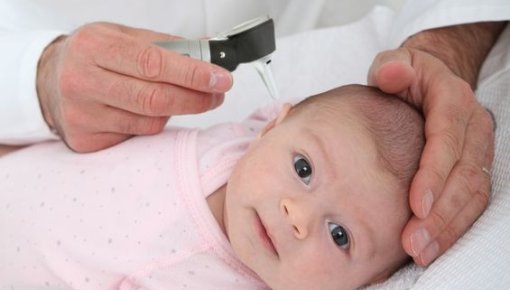
Photo of a baby being examined by a doctor

In Germany and other countries, newborn babies are routinely given hearing tests in order to detect and treat hearing impairments as early as possible. This can improve early language development in children who have hearing problems.

Nearly all babies can hear well: 997 out of 1,000 babies are born with normal hearing. Up to 3 out of 1,000 newborns have a moderate or severe hearing impairment. Most of these children hear a little worse than normal, but aren’t deaf. Without early hearing tests, hearing problems are often first detected when a child is between 2 and 4 years old. But hearing tests in newborns can’t detect all hearing impairments in children because some hearing impairments only develop later on in childhood.

What happens if a newborn has a hearing problem?

If a baby can’t hear properly, the brain cells responsible for hearing aren’t used much. As a result, these cells may not develop properly, and the child’s hearing might be permanently affected. This is difficult to “fix” later on in life. Children who don’t hear well might learn to talk later than other children. This, in turn, can affect their ability to learn in general, as well as their personal and social development.

What does newborn hearing screening involve?

Hearing tests are offered in all maternity units a few days after a baby is born. In the German program, this newborn hearing takes place as part of the “U2” check-up – which is the check-up done between the 3rd and 10th day of the newborn’s life.

It is difficult to judge whether babies can hear well. Whereas older children can actively participate in tests that check their reaction to tones and sounds, that’s not possible with babies. This is why newborn hearing uses methods where the child doesn't even need to be awake. Two tests are particularly suitable for newborns:

  • Otoacoustic emissions (OAE)
  • Auditory brainstem response (ABR)

These tests don’t hurt at all and can be done while the baby is sleeping.

What are “otoacoustic emissions” and how are they measured?

Otoacoustic emissions (OAE) are measured using an approach based on echoes. A small probe is placed inside the outer ear, where it repeatedly makes a soft “clicking” sound. These sounds travel to the inner ear, right through to the fine hair cells of the cochlea. These cells usually “respond” by vibrating – the vibrations are then carried from the inner ear back to the outer ear in the form of sound waves. There, a tiny microphone on the probe picks up the sound waves and measures how strong they are. If there is no response, or if it is very weak, the cochlea may not be receiving sounds properly. This problem is often caused by hair cells not working as they should.

But abnormal test results don’t always mean that the baby is hard of hearing, though. Sound waves might not be measured properly if the child doesn’t keep still, has fluid in their ear, or if background noises interfere. And the OAE test doesn’t measure how severe the hearing loss is. Although the test is relatively accurate, it sometimes fails to detect hearing impairments. This is known as a “false negative” test result.

"False positive" test results are also possible. If that happens, newborns with normal hearing are incorrectly diagnosed with hearing loss. Wrong diagnoses like this are usually quickly corrected when further tests are done.

The OAE test is simple and normally only takes a few minutes. It is done in a quiet environment and, if possible, when the baby is completely relaxed or asleep. This is because the results could be affected if, for instance, the baby makes a sound like sucking noises during the test.

How does the auditory brainstem response (ABR) test work?

This test measures whether sound waves are passed on to the brain properly. The ABR test involves taking an electroencephalogram (EEG) – a test that measures electrical activity in the brain. Before the test is done, small sensors (electrodes) are stuck on the baby’s scalp and behind their ears. The baby is then given special headphones, through which clicking noises are sent to the inner ear. The electrodes measure whether the brain receives the sound waves from the inner ear, in the form of electrical signals. If the signals don’t reach the brain properly, then the baby might have impaired hearing.

Like the other test, this test also needs to be done in a quiet environment. The more active and more awake the baby is, the more electrical signals their brain produces. This makes it difficult to distinguish between signals from the hearing nerves and other signals. So the test works best if the baby is asleep during it.

Together with the OAE test, the auditory brainstem response test helps determine whether the hearing loss is caused by damage to the inner ear or damage to the hearing nerve.

What are the advantages of doing these tests immediately after birth?

Hospitals offer the best possibilities for testing a large number of babies soon after they are born.

Treatment for hearing impairments would not be started at such a young age. But detecting a hearing problem very early on can help others better understand the child's behavior, and avoid interpreting it wrongly – for example, if they hardly react when spoken to.

Hearing impairments can also develop later on in childhood, though, due to things like infections in toddlers. So even if hearing tests show that there’s nothing wrong with a child’s hearing, it’s still important to keep monitoring whether they can hear well.

If a hearing problem is detected, treatment can be started as soon as possible. Research has shown that speech and language develop better in children whose hearing impairment was detected during newborn tests compared to children whose hearing problems were diagnosed later. They can speak better and are better at processing information. Studies haven't reached any conclusions about how an early affects the long-term psychological wellbeing and quality of life of these children. The treatment options include hearing aids, speech therapy, and patient education. Cochlear implants (electronic hearing aids) might be surgically implanted in certain cases.

Good to know:

You can find information on the various treatments here: What can help children with hearing loss or deafness?

Bayerisches Landesamt für Gesundheit und Lebensmittelsicherheit. Endbericht zur Evaluation des Neugeborenen-Hörscreenings 2011/2012 im Auftrag des Gemeinsamen Bundesausschusses. 2017.

Brockow I, Söhl K, Hanauer M et al. Neugeborenen-Hörscreening in Deutschland – Ergebnisse der Evaluationen 2011/2012 und 2017/2018 [Newborn hearing screening in Germany – results of the 2011/2012 and 2017/2018 evaluations]. Bundesgesundheitsbl 2023; 66(11): 1259-1267.

Institute for Quality and Efficiency in Healthcare (IQWiG, Germany). Neonatal screening for early detection of hearing impairment: Final report; Commission S05-01. 2007.

Lenarz T, Boenninghaus HG. Hals-Nasen-Ohren-Heilkunde. Berlin: Springer; 2012.

World Health Organization (WHO). Deafness and hearing loss. 2025.

Yoshinaga-Itano C, Manchaiah V, Hunnicutt C. Outcomes of Universal Newborn Screening Programs: Systematic Review. J Clin Med 2021; 10(13): 2784.

IQWiG health information is written with the aim of helping people understand the advantages and disadvantages of the main treatment options and health care services.

Because IQWiG is a German institute, some of the information provided here is specific to the German health care system. The suitability of any of the described options in an individual case can be determined by talking to a doctor. informedhealth.org can provide support for talks with doctors and other medical professionals, but cannot replace them. We do not offer individual consultations.

Our information is based on the results of good-quality studies. It is written by a team of health care professionals, scientists and editors, and reviewed by external experts. You can find a detailed description of how our health information is produced and updated in our methods.

Comment on this page

What would you like to share with us?

We welcome any feedback and ideas - either via our form or by gi-kontakt@iqwig.de. We will review, but not publish, your ratings and comments. Your information will of course be treated confidentially. Fields marked with an asterisk (*) are required fields.

Please note that we do not provide individual advice on matters of health. You can read about where to find help and support in Germany in our information “How can I find self-help groups and information centers?

Über diese Seite

Updated on November 17, 2025

Next planned update: 2028

Publisher:

Institute for Quality and Efficiency in Health Care (IQWiG, Germany)

Stay informed

Subscribe to our newsletter or newsfeed. You can find our growing collection of films on YouTube.