
How can labor be induced?

Photo of a pregnant woman and her partner, who is hugging her

Labor can be induced in various ways – some with medication, and some without. Sometimes women try to start the birth process themselves in other ways. But all of the approaches have the same aim: to start the birth before the contractions begin naturally.

Inducing labor is the process of making contractions start, and preparing the cervix for birth, before the birth starts on its own. One of the main reasons for doing it is that the baby's due date has passed. When that happens, the pregnant woman can decide whether and when labor should be induced. Sometimes, though, labor has to be induced for medical reasons.

If you decide that you want an induction, the doctor or midwife will tell you about the options. These will depend on things like whether you’re carrying more than one baby, whether you’ve had a C-section in the past, whether you’ve got any health issues and how your baby is doing. They will also tell you about the pros and cons of the different approaches, as well as their potential side effects.

The main ways to induce labor are:

  • Medication: Medications are used to ripen (soften) the cervix or to make the contractions start. They include dinoprostone, misoprostol and oxytocin.
  • Mechanical approaches: These cause the body to release that help to start labor. They include membrane sweeps, balloon catheters, dilators, and artificially breaking the water (opening the amniotic sac).
What can you do yourself to get labor started?

Toward the end of their pregnancy, many expectant mothers can hardly wait for things to finally “get going” – especially if their baby's due date has passed. Some then try out various things themselves, like going on long walks. Having sex or stimulating their own nipples is believed to induce labor, too. The idea is that the released when a woman is sexually aroused soften the cervix and help it to start opening (dilate). The in sperm are also thought to have this effect. But research has not clearly shown that sexual activity can make the birth start sooner.

Some pregnant women drink raspberry leaf tea to soften the cervix, while others try homeopathy, evening primrose oil, clove oil tampons, or hypnosis. There's no scientific proof that these approaches work, though.

Acupuncture

Some women try to start their contractions with the help of . But there's no scientific proof that this works, either. Research in this area found that the time it took to give birth was similar – no matter whether the women were given , sham or no at all. Sham is when the needles are inserted in random places or not deep enough into the skin, for example.

Castor oil

For a long time, castor oil was traditionally used to induce labor. Known for its laxative effect, it comes in the form of pure oil, a "cocktail" (mixed with juice), or capsules that can be swallowed. Castor oil can cause nausea. There's not enough research to say whether it's a safe and effective way to induce labor.

What are the medical reasons for inducing labor?

Please note that some of the following information describes the situation in Germany specifically. You may find that things are different in other countries.

When a baby is more than a week past its due date, induction can lower the health risks for the mother and baby. This is because problems are slightly more likely from the 42nd week onward. For example, it’s more common for these babies to need treatment in an intensive care unit when they’re born.

Overdue baby: Wait or induce labor?

If your due date has passed and been re-confirmed, it’s a good idea to find out all about the pros and cons of inducing labor and then make a decision together with your childbirth team (your gynecologist, midwife and/or hospital team). This decision aid can help you.

There are other reasons for inducing labor, too. One is if your water breaks too early and your contractions don’t start naturally in the next 24 hours. Another is if you have high blood pressure. This could be due to pre-eclampsia. Labor may also be induced if your baby is expected to be larger than average. Then an earlier birth could be easier for both you and your child. Your doctor or midwife might recommend inducing your labor for other health reasons – or at least give you the option.

Some women want to be induced before the 42nd week of their pregnancy even though they don’t have any special health problems. If this is something you’re considering, it’s important to carefully consider the pros and cons together with your doctor or midwife. In Germany, this kind of induction is possible from the 40th week onward.

Good to know:

Your doctor has to inform you of all the pros and cons before inducing labor. And you have to give your consent.

What does labor induction by a medical team involve?

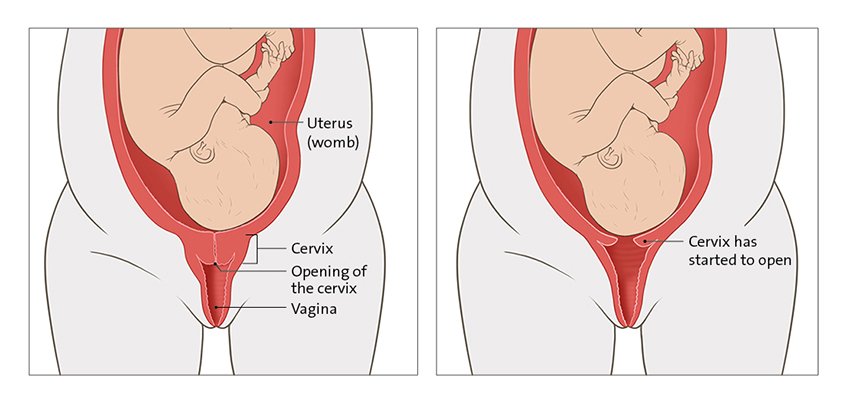
The aim of labor induction is to get the cervix to dilate (open). If the cervix has already dilated, the aim is to make the contractions start.

Closed cervix (left) and cervix that has started to open (right)

During pregnancy, the cervix is usually closed tight to keep the baby safely in the womb. When your body starts preparing for birth, it releases (prostaglandins) to make your cervix soften and dilate. A cervix that is ready for birth is called a “ripe” cervix. If this doesn’t happen by itself, mechanical approaches can be used to encourage the body to release the . There are also medications that can help the cervix to soften and the contractions to begin.

The approach used will depend on things like how dilated your cervix is and whether your water has broken. It will also depend on whether this is your first baby or whether you’ve had a C-section or other womb surgery in the past.

Where is labor induced?

Medically induced labor tends to be done in hospital, with the help of a childbirth team (a doctor and midwife). They keep an eye on you and your baby. That includes monitoring the baby’s heartbeat and your contractions. Sometimes, labor can be induced as an outpatient process. Then you can go home to wait for some time after you’ve been induced.

What medications can be used to induce labor?

Dinoprostone

Various medications can be used to soften the cervix. They contain the hormone dinoprostone, which is a prostaglandin.

You can get this medication in the form of a vaginal suppository (tablet) or a gel to put inside your vagina. Alternatively, it can be used in the form of a vaginal insert (also known as a pessary). This looks a bit like a small tampon and it stays in your vagina for up to one day. Before you’re given one of these products, the doctor will examine the opening of your cervix. Then they will insert the product.

Sometimes the effect of these products isn't strong enough to get the contractions going properly on their own. Then you can be given extra medication after a certain amount of time – through a drip, for example.

Misoprostol

Tablets containing misoprostol can also be used to induce labor. Misoprostol works in a similar way to prostaglandins. It helps to open the cervix and causes contractions. But you can only use it if you haven’t started having regular or painful contractions yet.

You take the tablet in hospital. The childbirth team keep an eye on you during the induction process. They check whether you and your baby are doing well and whether your contractions have started. If necessary, you can take another tablet a few hours later.

Good to know:

In Germany, the misoprostol medication approved for inducing labor is called Angusta. Up until 2021, there was another medication, called Cytotec, which contained a much higher dose of misoprostol than Angusta does. Cytotec wasn’t approved for labor induction, so it could only be used off-label here.

Oxytocin drip

Sometimes the cervix is soft and open, but the contractions don’t start or they’re too weak. Then an oxytocin drip can help. The medication is delivered into a vein in your arm. It makes the muscles in the womb tighten and squeeze, causing contractions. This effect usually kicks in within just a few minutes. Oxytocin drips can also be combined with a procedure to artificially break your water (open the amniotic sac).

What side effects can labor-inducing medication have?

Labor-inducing medication can cause digestive problems like nausea, vomiting and diarrhea. Other potential side effects include fever and shivering.

Too strong and frequent contractions

Your childbirth team will choose a dose that makes the contractions as normal as possible. But sometimes labor-inducing medication causes contractions that are too strong and too frequent. The medical name for this is uterine hyperstimulation. If this happens, you might need extra medication to reduce the contractions and the pain. Having contractions that are too strong and too frequent can be stressful for your baby too.

A tear in the wall of the womb

If the contractions are particularly strong, the wall of the womb might tear open (uterine rupture). This is a medical emergency because it can cause heavy bleeding and the baby might not get enough oxygen. If the womb tears, the medical team usually delivers the baby by C-section as quickly as possible, and then they sew up the tear after that. Research suggests that the womb may tear in up to 4 out of 1,000 medication-induced births.

The risk of a uterine rupture is slightly higher if you’ve had a C-section or other womb surgery in the past. Then your doctor will talk to you beforehand about whether labor can be induced in your case and, if so, which approach is suitable.

What is a membrane sweep?

One mechanical approach to inducing labor is called a membrane sweep. Here, the membranes of the amniotic sac surrounding the baby are separated from the wall of the womb. The doctor or midwife does this by inserting one or two fingers into your cervix and “sweeping” them around the lower part of your womb. It is also called membrane stripping or a cervical sweep.

Membrane sweeping causes the body to release that help the contractions to start (prostaglandins). It can be done several times if necessary. Research suggests that two sweeps in the space of one week are more likely to start labor than just one sweep. Women who have two sweeps are also less likely to need further labor-inducing measures.

Most women find the procedure uncomfortable. It can cause bleeding, but this is usually not harmful.

How are balloon catheters used?

A balloon is a thin tube with one or two small balloons at the end of it. The doctor inserts the tube through the vagina into your cervix. Then the balloons are filled with a liquid to make them bigger. As a result, the balloon presses against the inside of your cervix. This causes your body to release (prostaglandins) that make your cervix soften and help the contractions to start. The balloon stays in your cervix for around twelve hours. Some women find the process of inserting it unpleasant.

Like labor-inducing medication, balloon catheters can cause uterine hyperstimulation (contractions that are too strong and too frequent). The likelihood of this happening with balloon catheters is about the same as with misoprostol, but lower than with dinoprostone.

If the isn’t enough to induce labor, you can also take labor-inducing medication to help things along.

What do cervical dilators do?

Osmotic dilators (also called hygroscopic dilators) are thin rods that are inserted into the cervix. There, they absorb moisture and expand. This causes them to press against the inside of the cervix, like balloon catheters do.

How do doctors break your water?

If the cervix is already dilated, the doctor can artificially break your water (open the amniotic sac surrounding your baby). They do this using an instrument that looks a little like a crochet needle, which they insert through the vagina into the cervix. They then use the needle to burst the amniotic sac, and the fluid inside the sac comes out. This doesn't hurt. The aim is to make the contractions start.

Once the amniotic sac has been opened, your baby is no longer protected by the amniotic fluid. This means that can get into your womb. Because of this, you'll usually be given an oxytocin drip to speed up the birth as well.

After your water has broken, there's a risk of umbilical cord prolapse. This is when part of the umbilical cord slips past the baby into your vagina and gets squashed by the baby’s head or body. That can cut off the baby's blood and oxygen supply. If that happens, the medical team will deliver the baby quickly by C-section.

What does labor induction feel like and how long does it take?

Women generally have very different experiences of induced labor. While some say they would do it again, others would rather avoid it if they have another baby.

Inducing labor doesn't necessarily mean that everything will happen really quickly. Many women are surprised how long it still takes for their baby to arrive. When labor is induced, more vaginal examinations are needed than usual. These examinations can be uncomfortable. If you’re connected to a CTG machine to monitor the baby’s heartbeat and your contractions, the wires may stop you from moving around freely.

It can be helpful to ask your midwife or doctor about how labor can be induced in your hospital, and about the pros and cons of each approach. Induction of labor isn't an emergency – there's usually enough time to get used to the idea and have all your questions answered.

Baradwan S, Alshahrani MS, Khadawardi K et al. Twice-Weekly Versus Once-Weekly Membrane Sweeping in the Prevention of Post-Term Pregnancy: a Systematic Review and Meta-Analysis of Randomized Controlled Trials. Reprod Sci 2024; 31(1): 56-65.

Bundesinstitut für Arzneimittel und Medizinprodukte (BfArM). Angusta zur Geburtseinleitung: BfArM erinnert Ärztinnen und Ärzte an Dosierungs­empfehlungen und Kontraindikationen (Pressemitteilung). 2025.

De Vaan MD, Ten Eikelder ML, Jozwiak M et al. Mechanical methods for induction of labour. Cochrane Database Syst Rev 2023; (3): CD001233.

Heimstad R, Romundstad PR, Hyett J et al. Women's experiences and attitudes towards expectant management and induction of labor for post-term pregnancy. Acta Obstet Gynecol Scand 2007; 86(8): 950-956.

Institute for Quality and Efficiency in Health Care (IQWiG, Germany). Geburtseinleitung: Helfen nicht medikamentöse Verfahren wie Rizinusöl oder Akupunktur? Topic check report; No. T23-01. 2025.

Middleton P, Shepherd E, Morris J et al. Induction of labour at or beyond 37 weeks' gestation. Cochrane Database Syst Rev 2020; (7): CD004945.

Nishi D, Shirakawa MN, Ota E et al. Hypnosis for induction of labour. Cochrane Database Syst Rev 2014; (8): CD010852.

Rattanakanokchai S, Gallos ID, Kietpeerakool C et al. Methods of induction of labour: a network meta-analysis. Cochrane Database Syst Rev 2026; (1): CD015234.

Sanchez-Ramos L, Levine LD, Sciscione AC et al. Methods for the induction of labor: efficacy and safety. Am J Obstet Gynecol 2024; 230(3S): S669-S695.

Seitz S. Gynäkologie und Geburtshilfe. Berlin: Springer; 2023.

World Health Organization (WHO). WHO recommendations on induction of labour, at or beyond term. 2022.

World Health Organization (WHO). WHO recommendations on mechanical methods for induction of labour. 2022.

Zamora-Brito M, Fernández-Jané C, Pérez-Guervós R et al. The role of acupuncture in the present approach to labor induction: a systematic review and meta-analysis. Am J Obstet Gynecol MFM 2024; 6(2): 101272.

IQWiG health information is written with the aim of helping people understand the advantages and disadvantages of the main treatment options and health care services.

Because IQWiG is a German institute, some of the information provided here is specific to the German health care system. The suitability of any of the described options in an individual case can be determined by talking to a doctor. informedhealth.org can provide support for talks with doctors and other medical professionals, but cannot replace them. We do not offer individual consultations.

Our information is based on the results of good-quality studies. It is written by a team of health care professionals, scientists and editors, and reviewed by external experts. You can find a detailed description of how our health information is produced and updated in our methods.

Comment on this page

What would you like to share with us?

We welcome any feedback and ideas - either via our form or by gi-kontakt@iqwig.de. We will review, but not publish, your ratings and comments. Your information will of course be treated confidentially. Fields marked with an asterisk (*) are required fields.

Please note that we do not provide individual advice on matters of health. You can read about where to find help and support in Germany in our information “How can I find self-help groups and information centers?”

Über diese Seite

Created on October 6, 2026

Next planned update: 2029

Publisher:

Institute for Quality and Efficiency in Health Care (IQWiG, Germany)

Stay informed

Subscribe to our newsletter or newsfeed. You can find our growing collection of films on YouTube.