
How can you reduce the symptoms of post-thrombotic syndrome on your own?

Photo of a couple riding bikes

Movement and exercises for your calf muscles can help to move blood that has built up out of your legs. It is also a good idea to put your legs up to reduce the strain on them. Good skin care can relieve itching and protect your skin.

About 20 to 50 percent of all people who have deep vein thrombosis (DVT) develop post-thrombotic syndrome (PTS) in one leg afterwards. The veins in that leg are damaged and can no longer transport the blood to the heart as effectively. This can cause the affected leg to become swollen and painful. PTS can also cause itchy rashes, discoloration or ulcers.

But it is not always possible to tell the symptoms of PTS apart from the symptoms of DVT at first. That is why a clear of post-thrombotic syndrome is only possible after a few months.

PTS symptoms can stay more or less the same, but may also become more or less severe. Medical advice is important if you have severe symptoms or develop new symptoms which don't go away again after about a day.

A good mix of both stretching exercises and strengthening and taking the strain off the leg is a good idea. Good skin care helps with itching and protects against cracked skin.
How can I strengthen my calf muscles?

The calf muscles alternately push and pull on our veins every time we move our legs. This makes it easier for blood to flow back from our legs to the heart. Getting regular exercise and specifically training your calf muscles can support this natural “muscle pump.”

One study looked into whether people with PTS can relieve their symptoms by taking regular exercise. It suggested that a specific training program can relieve the symptoms and strengthen the muscles. The program included:

  • 60 to 120 minutes of moderate endurance sport per week
  • strengthening exercises for the lower leg and thigh muscles every other day
  • daily stretching exercises

Participants in the study were free to choose one type of endurance sport, for instance 30 minutes of Nordic walking or jogging three times a week.

People who have never done endurance sports before and can't manage 30 minutes right away can start off doing 15 minutes each time and gradually build on that, or alternate between walking and jogging. Cycling and step aerobics are also suitable.

Doctors can also prescribe physical therapy that includes exercises to treat PTS symptoms. The aim of that is to put together your own personal exercise program.

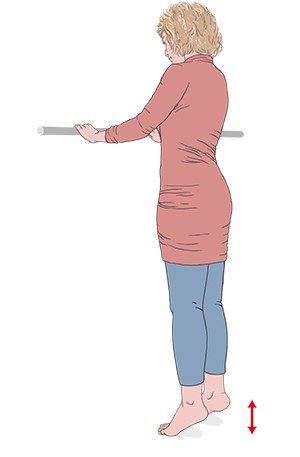
Strengthening exercises for the calf muscles: Calf lifts

Stand up straight with your feet in line with your hips. Your toes should be pointing straight ahead or slightly outwards. Then do the following:

  • Lift the heels of both feet off the floor and shift your weight to the balls of your feet.
  • Then slowly lower your heels again.
  • Repeat this exercise 10 times, and then take a 1-minute break.
  • Perform a total of 3 of these sets.

It is a good idea to hold on to a stable chair, table or railing when doing these exercises in case you lose your balance. But make sure that the lifting force always comes from the calf muscles.

To make the exercises more strenuous, you can raise one foot completely from the floor and shift your bodyweight upwards with just one leg. You can also increase the number of repetitions per set. The exercises should feel strenuous but not cause pain.

This illustration shows a rear view of a woman doing calf raises to strengthen her calf muscles

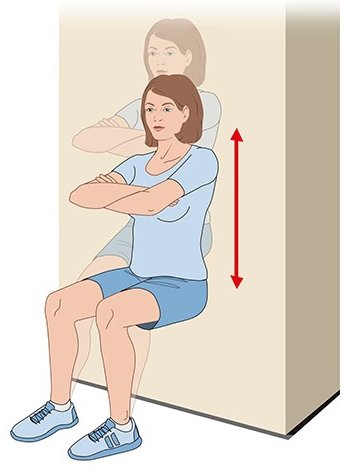
Strengthening exercises for the thigh muscles: Knee squats against the wall

This exercise involves both the calf muscles and the thigh muscles.

In this exercise, you lean with your back flat and straight against a flat wall or door. Keep your feet in line with your hips about half a meter from the wall. Your kneecaps and feet should be parallel and be pointing forwards. Then:

  • Cross your arms and slowly slide up and down the wall.
  • Lower your upper body so that your thighs and lower legs form a right angle. If you can't manage that yet, lower your upper body as far as you can in a controlled and safe way.
  • Repeat the exercise 10 times, and then take a 1-minute break.
  • Perform a total of 3 of these sets.

If you can't manage that many sets or repetitions at first, try doing fewer repetitions or do not go quite so far down when doing the squats. Later you can increase the number of repetitions per set.

It is important that your feet can grip well when doing the exercises.

This illustration shows a front diagonal view of a woman doing knee squats against a wall to strengthen her thigh muscles

How can I take the strain off my veins?

It is best to avoid standing or sitting for long periods of time as much as possible. This is because blood can build up in your legs. If you have to stand for a long time, you can walk around every now and then or rock back and forth on the balls of your feet. You can take the strain off the leg veins when sitting down by putting your feet up. Moving your feet every now and then—for example, by rotating them—activates your calf muscles. And it is not a good idea to cross your legs when sitting down.

People with severe symptoms or who have been stood up for a long time might find it pleasant to lie down with their back flat on the floor and their legs stretched out against the wall. Place your feet on the wall so that the angle between your legs and the floor is about 45 to 60 degrees.

Why is good skin care important?

Post-thrombotic syndrome causes dry and flaky skin in some people. Compression bandages or stockings can irritate and dry out the skin even more. Dry skin cracks easily and can be itchy. Scratching them can cause small wounds. Cracks and injuries offer easy entry to germs. That is why it's a good idea to take good care of your skin and use skin creams when needed.

Moisturizing or lipid-replenishing creams, gels, lotions and ointments are well suited for treating dry skin. Special (and often expensive) products are usually not necessary. People with allergies to certain substances should check the ingredients list before buying anything. Perfumes, surfactants (sodium lauryl sulfate) and antibacterial ingredients sometimes cause contact allergies.

You should try not to scratch yourself as much as possible to avoid damaging your skin. It can also help to keep your fingernails short: The risk of damaging the skin is then lower if you do accidentally scratch yourself.

Deutsche Gesellschaft für Angiologie – Gesellschaft für Gefäßmedizin (DGA). S2k-Leitlinie Diagnostik und Therapie der Venenthrombose und der Lungenembolie. AWMF register no.: 065-002. 2023.

Kahn SR, Shrier I, Shapiro S et al. Six-month exercise training program to treat post-thrombotic syndrome: a randomized controlled two-centre trial. CMAJ 2011; 183(1): 37-44.

Makedonov I, Kahn SR, Galanaud JP. Prevention and Management of the Post-Thrombotic Syndrome. J Clin Med 2020; 9(4): 923.

IQWiG health information is written with the aim of helping people understand the advantages and disadvantages of the main treatment options and health care services.

Because IQWiG is a German institute, some of the information provided here is specific to the German health care system. The suitability of any of the described options in an individual case can be determined by talking to a doctor. informedhealth.org can provide support for talks with doctors and other medical professionals, but cannot replace them. We do not offer individual consultations.

Our information is based on the results of good-quality studies. It is written by a team of health care professionals, scientists and editors, and reviewed by external experts. You can find a detailed description of how our health information is produced and updated in our methods.

Comment on this page

What would you like to share with us?

We welcome any feedback and ideas - either via our form or by gi-kontakt@iqwig.de. We will review, but not publish, your ratings and comments. Your information will of course be treated confidentially. Fields marked with an asterisk (*) are required fields.

Please note that we do not provide individual advice on matters of health. You can read about where to find help and support in Germany in our information “How can I find self-help groups and information centers?

Über diese Seite

Updated on July 22, 2026

Next planned update: 2029

Publisher:

Institute for Quality and Efficiency in Health Care (IQWiG, Germany)

Stay informed

Subscribe to our newsletter or newsfeed. You can find our growing collection of films on YouTube.