
Post-thrombotic syndrome: The right way to use medical compression stockings
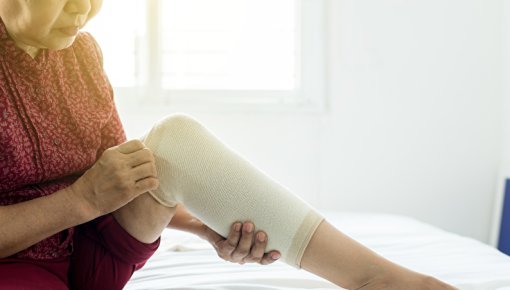
Photo of a woman with compression stockings sitting on a bed

Medical compression stockings are an important part of the treatment of post-thrombotic syndrome. It is important to handle the stockings properly to ensure they are effective and as comfortable as possible to wear.

In post-thrombotic syndrome (PTS), blood builds up in the veins of the legs. This can cause the affected leg to become swollen and painful. Complications such as ulcers and chronic wounds are also possible over the long term.

There are a few things you can try to relieve these symptoms: It is a good idea to exercise regularly and strengthen your calf muscles. That improves blood circulation. Putting your legs up every now and then takes the pressure off your veins.

Doctors also recommend compression stockings for PTS to reduce blood building up in the veins. The stockings may feel a little strange at first – putting them on correctly takes some practice. Using them properly and taking good care of them is important to avoid chafing the skin and tearing the stockings.
How do compression stockings work?

Compression stockings apply pressure to the veins from the outside. That helps transport blood from the legs back to the heart: The pressure pushes the veins together slightly. This causes the blood to flow faster, allowing the venous valves to close more effectively. The pressure also supports the calf muscles, which, by contracting alternately, push blood upward toward the heart (muscle pump).

This compression is meant to prevent blood from building up in the legs. This can relieve symptoms like pain or swollen legs and prevent complications such as chronic wounds.

Important:

Over-the-counter compression stockings and socks– such as those sold as sports gear– are not suitable for treating vein problems. This is because they usually don't meet the requirements for medical compression stockings.

Can compression stockings help with post-thrombotic syndrome?

There are hardly any studies on the effectiveness of compression stockings for treating post-thrombotic syndrome. But other studies have shown that compression stockings can help treat advanced venous insufficiency, and improve the healing of ulcers. That condition is similar to PTS, That is why experts assume that the stockings can also relieve the symptoms of PTS.

What types of compression stockings are there?

Compression stockings come in a variety of materials, colors, and designs. Some stockings have an open toe, others are closed. Some have a seam, others don't. The most suitable type of stocking will depend on the medical condition that needs to be treated. The most important factors are the correct size, length, and thickness.

You will be measured for the right size in the medical supply store, generally in the morning when your legs aren't yet swollen. The stockings have to be tight and fit perfectly. If they are too loose, they do not put enough pressure on the leg. If they are too tight, they can cut off the blood flow.

Compression stockings are available in four different lengths. In Germany, it is common to identify these lengths with a letter code system:

  • Below-knee stockings (A–D) reach up to the knee.
  • Mid-thigh stockings (A–F) reach halfway up the thigh.
  • Thigh-high stockings (A–G) reach up to the hips.
  • Compression tights (A–T) extend beyond the hips.

Post-thrombotic syndrome is commonly treated with compression stockings.

The pressure strength of compression stockings is measured in units of “millimeters of mercury,” written “mmHg” for short. The higher the number or compression class, the higher the pressure. There are 4 compression classes:

  • Compression class 1: 18 to 21 mmHg
  • Compression class 2: 23 to 32 mmHg
  • Compression class 3: 34 to 46 mmHg
  • Compression class 4: over 49 mmHg

Post-thrombotic syndrome is usually treated with compression class 2 stockings, or class 3 where needed.

Good to know:

If a doctor prescribes the stockings, the costs are covered by statutory health insurers, who generally pay for 2 to 4 pairs per year.

How do I put the stockings on properly?

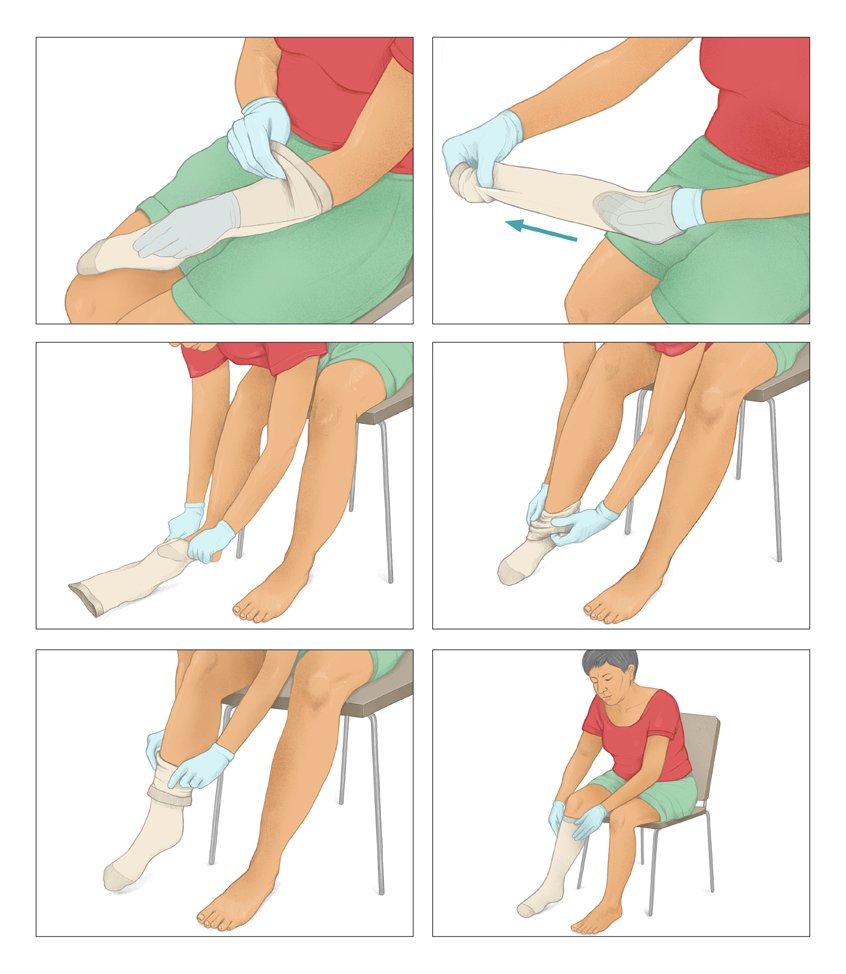
Post-thrombotic syndrome usually affects only one leg. So you will typically only need to wear one compression stocking on that leg. Put it on in the morning when your leg is least swollen, and sit down before you start. It takes a little practice to put the stocking on properly. It is best to do it as follows:

  • Reach into the stocking with one hand and hold the heel of the stocking from the inside.
  • While keeping hold of the heel part from the inside, use your other hand to grasp the opening of the stocking at the top and turn it inside out along your arm. Then the stocking will be inside out down to the heel.
  • Use both hands to pull the foot section apart slightly so that your foot can fit inside. Slip your toes into the foot section.
  • Pull the stocking over your foot and heel. Check that the stocking fits well so far and doesn't have any creases.
  • Now slide the rest of the stocking over your lower leg, gradually turning it right side out again. Then gradually work your way up the leg until the entire stocking is on.
  • Finally, smooth out the fabric with your hands from the bottom up so that it lies flat without any wrinkles. The seams should go straight up the leg.
This multi-panel photorealistic illustration shows, how to put on a compression stocking correctly in six steps.

Compression stockings are typically worn all day. If this is difficult or if wearing the stocking is very uncomfortable, you can remove it to have periods of rest after consulting with your doctor. Then it's important to put it back on before you put any weight on your leg. Sometimes it is also possible to use a lower compression class.

What helps you dress properly?

These tips can make it easier to put the stockings on and help not to damage them:

  • Make sure your skin is dry. That includes not putting on your stockings right after showering. Wait for any skin care products to bin before putting the stockings on.
  • Take off any rings or bracelets before putting the stockings on.
  • Wear rubber gloves: That makes it easier to get hold of the stocking material and prevents tears. It is easy to tear the material if you get a fingernail caught on one of the stitches.

You can ask for advice in the medical supply store about how best to take care of the compression stockings. Aids are available for people who cannot lean forward very well or who don't have enough strength in their hands. Doctors can prescribe these kinds of aids if they are needed for medical reasons. Nursing services can also be arranged to help with putting the compression stockings on and taking them off again.

How should the stockings be washed and cared for?

It is important to take good care of compression stockings for hygiene. That will also help them last longer. It is recommended to wash the stockings each time you wear them if possible.

You can wash the stockings in the evening by hand with a little detergent or shampoo and hang them up to dry overnight. The manufacturer's washing and care instructions will tell you whether your stockings can be machine-washed. But fabric softeners, dryer sheets, optical brighteners, and stain removers are usually not allowed because they damage the fabric.

Some materials are not supposed to come into direct contact with skin care products like creams because they can harm the fabric of the stocking and make it wear out faster. The silicone-coated anti-slip strips on the stockings are particularly sensitive to many personal care products. You can find more details about this in the washing and care instructions as well.

Important:

If properly cared for, compression stockings can be used for about six months. They should then be replaced because the material gets slacker over time and the compression effect gets weaker.

What are the possible disadvantages of compression stockings?

Compression stockings can be uncomfortable to wear – especially at the start, when you haven't gotten used to them yet. When it's warmer out, you'll quickly start sweating underneath. The stockings can also dry out your skin, which can sometimes cause itching. Moisturizing skincare products can help relieve the itching. But make sure any creams or lotions are fully absorbed before you put on your stockings. You can try out different types of stocking materials to see whether they are easier to manage or cause less sweating.

Occasionally, the socks might chafe your skin and cause blisters, rashes or other kinds of skin injuries. Then you can contact the medical supply store where you bought the stockings. The specialists there can check whether you need stockings with a different fitting or another sort of stitching.knitting style. Chafing can also often be prevented by using the stockings as intended and making use of proper skin care. It is a good idea to see a doctor if you have a wound that doesn't heal, though.

Putting them on compression stockings takes a little practice. But serious side effects are very rare.

When are compression stockings not suitable?

Compression stockings can make symptoms worse with some associated medical conditions, and can even lead to serious complications like lasting skin damage. That is why it’s important to tell your doctor about any other medical conditions you might have.

Compression stockings might be unsuitable in the following cases:

Weeping skin inflammations and rashes or arthritis might also be reasons not to use compression stockings.

Azirar S, Appelen D, Prins MH et al. Compression therapy for treating post-thrombotic syndrome. Cochrane Database Syst Rev 2019; (9): CD004177.

Deutsche Gesellschaft für Angiologie – Gesellschaft für Gefäßmedizin (DGA). S2k-Leitlinie Diagnostik und Therapie der Venenthrombose und der Lungenembolie. AWMF register no.: 065-002. 2023.

Makedonov I, Kahn SR, Galanaud JP. Prevention and Management of the Post-Thrombotic Syndrome. J Clin Med 2020; 9(4): 923.

O'Meara S, Cullum N, Nelson EA et al. Compression for venous leg ulcers. Cochrane Database Syst Rev 2012; (11): CD000265.

IQWiG health information is written with the aim of helping people understand the advantages and disadvantages of the main treatment options and health care services.

Because IQWiG is a German institute, some of the information provided here is specific to the German health care system. The suitability of any of the described options in an individual case can be determined by talking to a doctor. informedhealth.org can provide support for talks with doctors and other medical professionals, but cannot replace them. We do not offer individual consultations.

Our information is based on the results of good-quality studies. It is written by a team of health care professionals, scientists and editors, and reviewed by external experts. You can find a detailed description of how our health information is produced and updated in our methods.

Comment on this page

What would you like to share with us?

We welcome any feedback and ideas - either via our form or by gi-kontakt@iqwig.de. We will review, but not publish, your ratings and comments. Your information will of course be treated confidentially. Fields marked with an asterisk (*) are required fields.

Please note that we do not provide individual advice on matters of health. You can read about where to find help and support in Germany in our information “How can I find self-help groups and information centers?

Über diese Seite

Updated on July 22, 2026

Next planned update: 2029

Publisher:

Institute for Quality and Efficiency in Health Care (IQWiG, Germany)

Stay informed

Subscribe to our newsletter or newsfeed. You can find our growing collection of films on YouTube.