How our teeth and jaws work together

Our teeth allow us to take a bite out of hard foods such as raw vegetables, crispbread or apples, break them down in our mouths, and chew solid food until it is soft. For this to be possible, the chewing muscles and the bones of the jaw have to work well together, too.

The structure of our set of teeth

Our teeth are made of a hard, bone-like substance. They are held in small hollow spaces in our upper and lower jawbones, called tooth sockets or dental . These are a part of the periodontium. Strong fibers anchor the teeth in place there.

Your teeth are arranged in two arches. When you close your mouth and bite, these two arches typically fit together with a slight overlap.

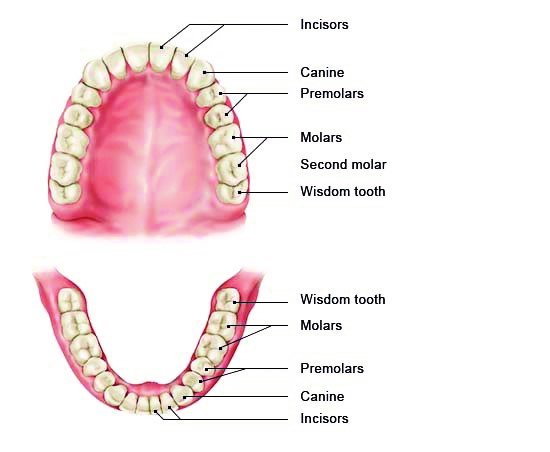
A full set of adult teeth includes 16 upper teeth and 16 lower teeth at the most. Each row has:

  • 4 incisors in the middle
  • 2 canine teeth next to the incisors; 1 to the left and 1 to the right
  • 5 back teeth on each side, including the premolars, molars and wisdom teeth

So, the upper and lower jaws contain a total of 32 teeth.

The photorealistic illustration shows the upper and lower rows of teeth from above, including wisdom teeth.

What are the different kinds of teeth?

Teeth have different shapes because they have different jobs to do. The incisors have narrow edges, and the canine teeth are sharp at the tip. When we close our mouth to bite, the lower incisors are pushed up just behind the upper incisors. This helps the front teeth to tear off bite-sized pieces of food – for instance, from a carrot or a sandwich.

The molars look different: They have wide chewing surfaces with raised mounds (cusps) and small grooves. When we bite down, the cusps of the upper molars fit into the grooves of the lower teeth. That way, they can grind food when we chew. The back teeth just behind the canine teeth are called premolars.

Baby teeth and permanent teeth: What happens when we get new teeth?

When children are born, their jawbones already contain a "bud" for every tooth. The teeth later develop from these buds. When a tooth pushes through a baby's gums and can be seen, we say that it has come in, or that it has “erupted.”

Known as teething, this process starts around the age of six months. It can be painful and may sometimes cause a fever. The child’s first set of 20 baby teeth is usually complete by the age of two years.

At that point, toddler’s skulls have not yet reached their full size. Because the baby teeth don’t get any bigger, they are gradually replaced by 32 larger teeth, starting when the child is about six years old. The baby teeth fall out first to make room for these permanent teeth. That way, adults have teeth that are the right size for their mouths.

Most people have all of their permanent teeth by the time they reach their early teens. One exception is the molars right at the back of the mouth, known as wisdom teeth: They often start appearing around the age of 18 or later. But not everyone has wisdom teeth in their jaw. And if they do, only some of these teeth may erupt or none at all.

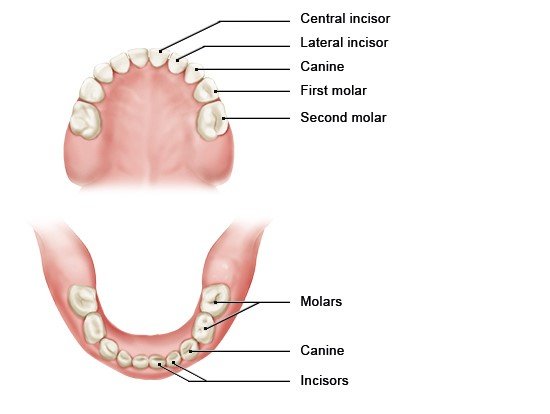
The photorealistic illustration shows a set of 20 baby teeth from above.

What role do bones and muscles play?

Bones and muscles play an important role when it comes to chewing, as well as opening and closing your mouth.

The skull is made up of several plate-like bones. These include the upper jawbone (maxilla) and the lower jawbone (mandible). Our teeth are embedded in these bones.

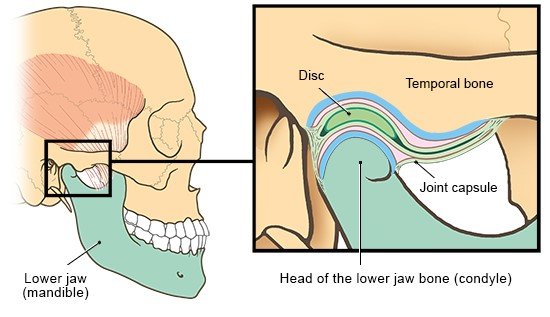
The upper jawbone is rigidly fixed to other bones of the skull, but the lower jawbone is not: A bit like a swing, it is attached to the temporal bones at the two joints of the jaw, allowing it to move.

The simplified anatomical illustration shows the jaw joint on one side of the skull, including a more detailed view on the right.

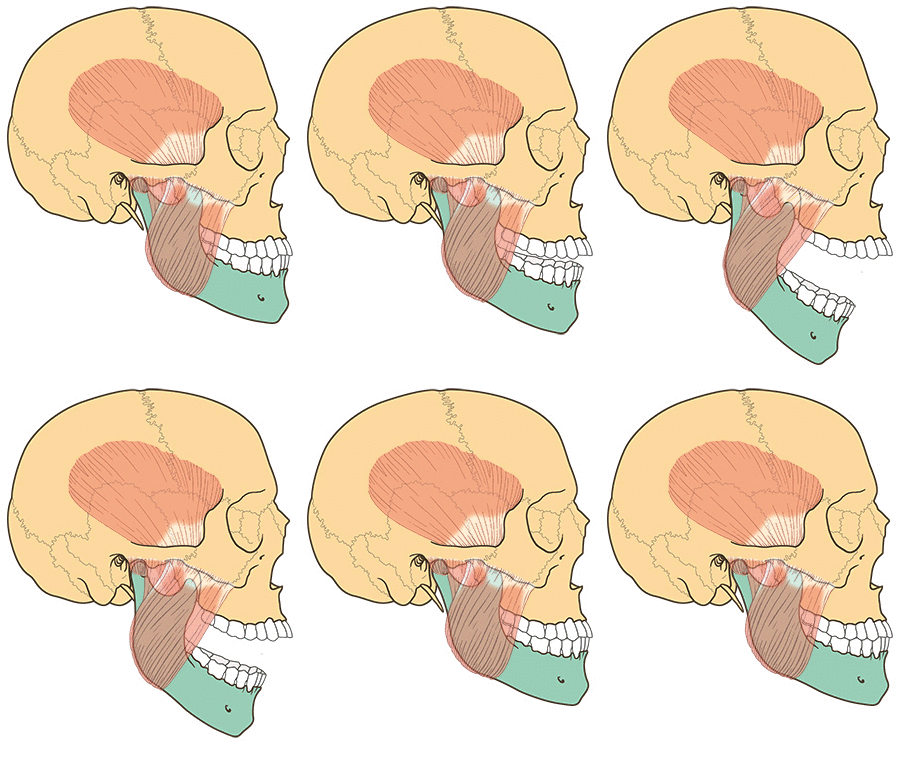
Several muscles run between the lower jawbone and the skull. When these muscles are tensed (tightened), the lower jaw can be pulled up tightly against the upper jaw. This helps us to take a powerful bite. When the muscles are relaxed, our mouth opens. Some of the muscle fibers can actively help to open the mouth as well. Through the interactions of the various muscle groups, the lower jaw can also be moved slightly sideways and forward or backward. That makes it easier to grind food between our back teeth.

The animated illustration shows how the jaw joints connect the lower jaw to the skull, and how muscles allow the mouth to open and close.

Lippert H. Lehrbuch Anatomie. Munich: Urban und Fischer; 2017.

Menche N. Biologie Anatomie Physiologie. Munich: Urban und Fischer; 2023.

Pschyrembel online. 2026.

IQWiG health information is written with the aim of helping people understand the advantages and disadvantages of the main treatment options and health care services.

Because IQWiG is a German institute, some of the information provided here is specific to the German health care system. The suitability of any of the described options in an individual case can be determined by talking to a doctor. informedhealth.org can provide support for talks with doctors and other medical professionals, but cannot replace them. We do not offer individual consultations.

Our information is based on the results of good-quality studies. It is written by a team of health care professionals, scientists and editors, and reviewed by external experts. You can find a detailed description of how our health information is produced and updated in our methods.

Comment on this page

What would you like to share with us?

We welcome any feedback and ideas - either via our form or by gi-kontakt@iqwig.de. We will review, but not publish, your ratings and comments. Your information will of course be treated confidentially. Fields marked with an asterisk (*) are required fields.

Please note that we do not provide individual advice on matters of health. You can read about where to find help and support in Germany in our information “How can I find self-help groups and information centers?

Über diese Seite

Updated on July 20, 2026

Next planned update: 2029

Publisher:

Institute for Quality and Efficiency in Health Care (IQWiG, Germany)

Stay informed

Subscribe to our newsletter or newsfeed. You can find our growing collection of films on YouTube.