Living with celiac disease

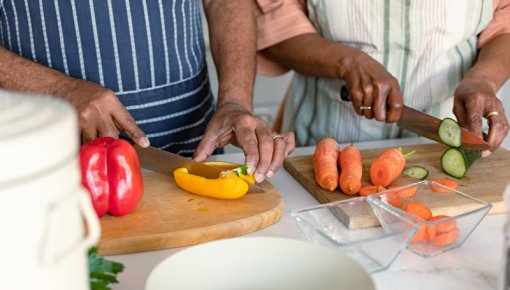
Photo of a couple preparing vegetables

Living with celiac disease means you have to completely avoid foods and drinks containing gluten for the rest of your life. That is a big change at first, affecting your diet and some lifestyle habits too. Practical tips and tricks can help, as well as talking to others affected by the disease.

People often have celiac disease symptoms for a long time before it is diagnosed. For those who have been living with the symptoms every day, getting the can be a big relief at first. It often takes a while to understand how much you will have to change your diet and other things in your life. You will also have to learn a lot about celiac disease – and explain it to others. Many people don’t know what living a gluten-free life really means. There are also a lot of misconceptions about gluten in food.

Cooking and eating together is often a very important part of life. You can still do that if your family and friends stick to certain rules and follow some practical tips.

How can you switch to a gluten-free diet at home?

Being diagnosed with celiac disease often changes people’s relationship with food. Some may not have paid much attention to what they ate before their . Others might have already taken more care to eat well. For some people, changing to a gluten-free diet takes the joy out of eating at first because the choice of "allowed" foods seems so limited. But others are keen to experiment and discover new foods and dishes.

Following a gluten-free diet means having to make sure that any foods you buy really don't contain any gluten at all. You can find more information about which foods do and don't contain gluten here.

Good to know:

Labels like the crossed-out ear of wheat make shopping easier. Professional dietary advice can also help you to transition to a gluten-free diet.

Gluten-free foods can become contaminated by foods containing gluten (cross-contact). Even breadcrumbs or flour dust can be enough if these foods are stored or prepared together. To avoid contamination, it can be helpful to use separate cupboards, drawers, bread bins and chopping boards. Kitchen appliances such as toasters and hand mixers increase the risk of contamination and are difficult to clean properly. There are re-usable “toaster bags” that make sure the bread doesn't touch the toaster. Another option is to buy a second appliance that you only use for gluten-free food. It is also important to check corners and crevices for crumbs when cleaning. Using separate spoons can help to prevent contamination of things like gluten-free spreads with flour or crumbs.

Is financial support available?

Switching to gluten-free foods can take a financial toll because they are often much more expensive. But a tax compensation rule for that was introduced in Germany in 2021. You can claim it on your tax return as a disability allowance. In Germany, people with celiac disease are generally considered to have a degree of disability of 20. In the year 2022, that meant they were able to claim a standard amount of 384 euros for the year.

Eating out: What should you know?

There are still only very few cafés and restaurants with a completely gluten-free menu. But some do offer gluten-free dishes. You may sometimes have to check with staff that the dishes listed as gluten-free on the menu really are gluten-free: A lot of people don’t know that even the smallest amounts of gluten can lead to in people with celiac disease.

It can be daunting and overwhelming to have to think of all these things. Some people with celiac disease avoid eating out as a result. In Germany, people who are diagnosed with celiac disease are given a “celiac disease passport” (Zöliakie-Pass) by their doctor or support group. You can show it to the restaurant staff when you eat out, so they know you have the disease.

Occasions like birthdays and weddings can be especially challenging for people who are following a gluten-free diet. But there's no need to miss out on the celebrations if you plan ahead and make arrangements. And big events like weddings are planned far in advance anyway. That gives you the opportunity to let the hosts know and tell them what you need. If you would like to hire caterers yourself, it can be a good idea to check how much they know about celiac disease and if they can provide gluten-free alternatives. At barbecues, you can put gluten-free meat and vegetables (without a marinade or with your own) on a clean barbecue first, or use barbecue trays. You could take your own gluten-free cakes or salads along, too. Cooking together in smaller groups of friends can motivate them to find out more about gluten-free food and cooking.

What about traveling with celiac disease?

People with celiac disease are sometimes anxious about traveling. But it's entirely possible to travel if you plan well. For example, you should make sure the hotel offers gluten-free food before booking. Self-catering holiday apartments are a good alternative.

When traveling abroad, it's a good idea to find out how to check food labels for gluten in the local language and how easy it is to get gluten-free products there. The product range in some other countries may be similar or even bigger than in your country. It might be a good idea to take a few gluten-free foods with you just in case.

Children with celiac disease: What to do at childcare, school and playdates?

Children with celiac disease can go to birthday parties or sleepovers, too. If your child eats at childcare or school, for example, it's important to talk to the kitchen staff about your child's dietary needs. Your child could also bring their own gluten-free ready meals or homemade meals along for the kitchen staff to heat up.

It is easier for your child to take part in group events if you speak openly with other parents, carers and teachers. Planning the food together and later addressing any problems that might have occurred can help you to improve your strategy for the future.

Last but not least, it’s important to explain what a gluten-free diet is in a simple way, so that other children understand what it means. After all, children often like to share food, candy and snacks with each other. Good information can also help pre-school children to know which foods have gluten in them, and which don't. For instance, the German society for celiac disease (Deutsche Zöliakie Gesellschaft) offers leaflets for children and teenagers in German.

Bacigalupe G, Plocha A. Celiac is a social disease: family challenges and strategies. Fam Syst Health 2015; 33(1): 46-54.

Crocker H, Jenkinson C, Peters M. Quality of life in coeliac disease: qualitative interviews to develop candidate items for the Coeliac Disease Assessment Questionnaire. Patient Relat Outcome Meas 2018; 9: 211-220.

Garnweidner-Holme L, Sende K, Hellmann M et al. Experiences of managing a gluten-free diet on multiple levels of society: a qualitative study. BMC Nutrition 2020; 6(1): 65.

Houbre B, Costantini ML, Pouchot J et al. The subjective experience of subjects diagnosed with celiac disease in adulthood. Eur Rev Appl Psychol 2018; 68(1): 35-43.

Madden AM, Riordan AM, Knowles L. Outcomes in coeliac disease: a qualitative exploration of patients'views on what they want to achieve when seeing a dietitian. J Hum Nutr Diet 2016; 29(5): 607-616.

Ring Jacobsson L, Johansson Stark A, Eckerblad J. Illness beliefs among people living with treated coeliac disease. Scand J Caring Sci 2020; 34(2): 401-408.

Taylor E, Dickson-Swift V, Anderson K. Coeliac disease: the path to diagnosis and the reality of living with the disease. J Hum Nutr Diet 2013; 26(4): 340-348.

IQWiG health information is written with the aim of helping people understand the advantages and disadvantages of the main treatment options and health care services.

Because IQWiG is a German institute, some of the information provided here is specific to the German health care system. The suitability of any of the described options in an individual case can be determined by talking to a doctor. informedhealth.org can provide support for talks with doctors and other medical professionals, but cannot replace them. We do not offer individual consultations.

Our information is based on the results of good-quality studies. It is written by a team of health care professionals, scientists and editors, and reviewed by external experts. You can find a detailed description of how our health information is produced and updated in our methods.

Comment on this page

What would you like to share with us?

We welcome any feedback and ideas - either via our form or by gi-kontakt@iqwig.de. We will review, but not publish, your ratings and comments. Your information will of course be treated confidentially. Fields marked with an asterisk (*) are required fields.

Please note that we do not provide individual advice on matters of health. You can read about where to find help and support in Germany in our information “How can I find self-help groups and information centers?

Über diese Seite

Created on March 24, 2026

Next planned update: 2029

Publisher:

Institute for Quality and Efficiency in Health Care (IQWiG, Germany)

Stay informed

Subscribe to our newsletter or newsfeed. You can find our growing collection of films on YouTube.