

Celiac disease

At a glance

  • People with celiac disease have an abnormal reaction to gluten (a protein in certain cereal grains).
  • Gluten is found in many foods.
  • Celiac disease is an autoimmune disease that causes chronic inflammation in the small intestine.
  • Typical symptoms include digestive problems and exhaustion, but there are often no symptoms.
  • If left untreated, celiac disease can lead to malnutrition and organ damage.
  • Switching to a gluten-free diet usually improves the symptoms.

Introduction

Photo of a man holding his belly in pain

Digestive problems like nausea, belly ache or diarrhea can be caused by various things. One of them is celiac disease, sometimes called gluten-sensitive enteropathy or celiac sprue in the past. People with this condition have an abnormal reaction to gluten, which is a protein found in many cereals. Celiac disease (also spelt "coeliac") can develop at any age and does not go away. It can be treated effectively by following a strict gluten-free diet.

In celiac disease, the body’s overreacts to parts of gluten that are usually harmless. Even the smallest amounts of gluten can then cause an in the soft lining (mucous membrane) of the small intestine. The starts to attack the mucous membrane too, making the worse. This is referred to as an autoimmune reaction because the attacks its own body. This reaction is the difference between celiac disease and a wheat or wheat sensitivity.

If people with celiac disease continue to eat foods with gluten in them, they will end up with chronic in their small intestine. The mucous membrane lining the intestine changes and various symptoms may occur – not only in the digestive system.

Removing gluten from your diet makes the go down and the mucous membrane usually recovers. The symptoms then get better or disappear completely. Because a lot of foods contain cereals, it is especially important that people with celiac disease check food labels for traces of gluten.
Symptoms

Celiac disease can affect different organs and different parts of the body. But some people have celiac disease without any noticeable symptoms. The most common symptoms are:

  • Tiredness and mood changes such as irritability, feeling down, or even
  • Digestive problems such as abdominal pain, persistent diarrhea or constipation, a bloated belly
  • Loss of appetite, weight loss (in adults) or lack of weight gain, delayed growth or development (in children and teenagers)

Younger children with celiac disease may have other symptoms such as vomiting or problems with tooth enamel.

A very rare form called Duhring’s disease (or dermatitis herpetiformis) affects the skin, leading to symptoms such as redness, burning and itching, clusters of blisters, a rash and bumps.

Causes and risk factors

Celiac disease can develop in people who have certain genes (HLA gene types DQ2 or DQ8). Just over 30 out of 100 people in Germany have these genes. But only about 2 to 3 out of 100 people with these genes develop celiac disease. It is still not clear why they have an autoimmune reaction to gluten and others don’t.

The risk of celiac disease is also higher in people who already have another autoimmune disease such as type 1 diabetes, Hashimoto’s disease or rheumatoid arthritis. For example, up to 10 out of 100 people with type 1 diabetes have celiac disease.

Celiac disease runs in families, too. About 10 to 15 out of 100 first-degree relatives of people with celiac disease also have it. Because of this, it is recommended that the children and parents of people who are diagnosed with celiac disease are tested for it, too. It can also be a good idea to be tested if your siblings or grandparents have celiac disease.

Some experts believe that gastrointestinal infections (tummy bugs) during childhood can increase the risk of celiac disease, but it's not yet clear whether that's the case.

Prevalence

About 1 to 2% of people in Europe have been diagnosed with celiac disease.

Outlook

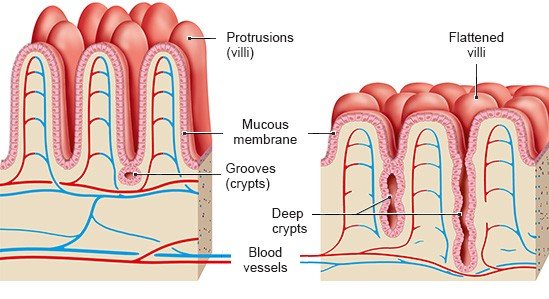
If left untreated, celiac disease leads to permanent in the small intestine. The tissue changes: The finger-like protrusions (villi) in the mucous membrane become flatter and can no longer absorb as many nutrients. The grooves (crypts) between the villi in the small intestine get deeper, too.

Illustration: Left – Healthy lining of the small intestine; Right – Damaged lining of the small intestine

Over time, that often leads to nutrient deficiencies that can cause anemia and constant . Even though the first occurs in the small intestine, it can spread to other areas of the body and cause a variety of symptoms – like a skin rash or movement and walking problems (e.g. trembling and balance problems).

In the vast majority of people who follow a strict gluten-free diet, the intestine recovers and the symptoms go away. If the symptoms don't go away after changing your diet, it is called “refractory celiac disease.” Fewer than 1% of people with celiac disease currently have this form. Refractory celiac disease is practically unheard of in children.

Effects

Chronic in the intestine isn't the only effect of untreated celiac disease. If you don't change your diet, it can cause bone problems and osteoporosis in the long term. Untreated celiac disease can already cause growth problems and damage bones in children and teenagers. That can also happen in children and teenagers who don't have many typical celiac disease symptoms, or don't have any symptoms at all.

If celiac disease is not discovered or treated, it can damage the liver and cause problems with nerves (neuropathies). It can also make it harder to have children and lead to complications during pregnancy.

Continuing to eat gluten over many years can increase your risk of cancer – for example, in your digestive tract, head, neck, and chest area. The risk of tumors in the lymphatic system (T-cell lymphoma) is especially high.

All of these effects and risks can be avoided or reduced by sticking to a strictly gluten-free diet.

Diagnosis

Celiac disease often goes unnoticed for a long time. Because of this, it's important to tell your doctor about all of the symptoms you have, even those that are not typical of celiac disease.

If you're more likely to develop celiac disease – for example, because close relatives have it or because you have another autoimmune disease such as type 1 diabetes – it can be a good idea to see a doctor and be tested for it even if you don’t have any symptoms.

The involves taking a sample of blood and testing it in a laboratory

  • to look for immunoglobulin A (IgA) antibodies against an enzyme called tissue transglutaminase (tTG or TG2), and
  • to measure the concentration of IgA, which is important for interpreting the above reading.

Increased levels of tTG-IgA antibodies are a sign of celiac disease. The results come back after about one week.

The test is only reliable if you eat enough gluten beforehand. Because of this, it's important not to avoid gluten if you think you might have celiac disease. People who have already reduced the gluten in their diet have to increase it again for about three months before they are tested for celiac disease.

As well as the blood test, the usually involves taking tissue samples from the upper part of your small intestine during a gastroscopy (where a thin tube with a tiny camera is inserted through your mouth and stomach). If the tissue is found to be damaged in the typical way, that confirms that you have celiac disease. Children with very high tTG antibody levels may not need to have tissue samples taken.

If the tissue samples and blood test don't lead to clear results, identifying what type of HLA gene you have can help to rule out celiac disease. This is also done by taking a sample of blood and testing it in a laboratory, where they look for specific gene sections that are always present in those who have the disease.

In Germany, people who are diagnosed with celiac disease are given a “celiac disease passport” (Zöliakie-Pass) that contains all of the diagnostic test results. This document confirms that you have an official , which can be important if you change doctors. Later test results can also be noted down there.

Treatment

If you are diagnosed with celiac disease, following a strict gluten-free diet is usually enough for the lining of the intestine to heal and the symptoms to get better. You have to stick to the diet permanently because eating gluten will always lead to in the lining of the intestine. It is important to avoid even the smallest amounts of gluten because they also cause problems.

Digestive problems normally go away if you stick to a strict gluten-free diet. But that can take a number of weeks, or often even several months. Other symptoms such as exhaustion and tiredness often get better if you avoid gluten.

Permanently changing your diet means having to change some lifestyle habits, too. Practical tips and tricks can help here, as well as talking to others affected by the disease.

Further information

When people are ill or need medical advice, they usually go to see their family doctor or pediatrician first. People who think they may have celiac disease can also make an appointment to see a gastroenterologist.

In our topic "Health care in Germany" you can read about how to find the right doctor – and our list of questions can help you to prepare for your appointment.

The website of the German society for celiac disease (Deutsche Zöliakie Gesellschaft) offers a lot of practical information about living with celiac disease, including where to find support groups in Germany.

Braun J, Müller-Wieland D. Basislehrbuch Innere Medizin. Munich: Urban und Fischer; 2018.

Chou R, Blazina I, Bougatsos C et al. Screening for Celiac Disease: A Systematic Review for the U.S. Preventive Services Task Force. (AHRQ Evidence Syntheses; No. 144). 2017.

Eigner W, Bashir K, Primas C et al. Dynamics of occurrence of refractory coeliac disease and associated complications over 25 years. Aliment Pharmacol Ther 2017; 45(2): 364-372.

Felber J, Bläker H, Fischbach W et al. Aktualisierte S2k-Leitlinie Zöliakie der Deutschen Gesellschaft für Gastroenterologie, Verdauungs- und Stoffwechselkrankheiten (DGVS). AWMF register no.: 021-021. 2021.

Husby S, Koletzko S, Korponay-Szabo I et al. European Society Paediatric Gastroenterology, Hepatology and Nutrition Guidelines for Diagnosing Coeliac Disease 2020. J Pediatr Gastroenterol Nutr 2020; 70(1): 141-156.

Pinto-Sanchez MI, Causada-Calo N, Bercik P et al. Safety of Adding Oats to a Gluten-Free Diet for Patients With Celiac Disease: Systematic Review and Meta-analysis of Clinical and Observational Studies. Gastroenterology 2017; 153(2): 395-409.e393.

Pschyrembel Online. Zöliakie. 2022.

Schuppan D, Zimmer KP. The diagnosis and treatment of celiac disease. Dtsch Arztebl Int 2013; 110(49): 835-846.

Seiler CL, Kiflen M, Stefanolo JP et al. Probiotics for Celiac Disease: A Systematic Review and Meta-Analysis of Randomized Controlled Trials. Am J Gastroenterol 2020; 115(10): 1584-1595.

Trovato CM, Raucci U, Valitutti F et al. Neuropsychiatric manifestations in celiac disease. Epilepsy Behav 2019; 99: 106393.

IQWiG health information is written with the aim of helping people understand the advantages and disadvantages of the main treatment options and health care services.

Because IQWiG is a German institute, some of the information provided here is specific to the German health care system. The suitability of any of the described options in an individual case can be determined by talking to a doctor. informedhealth.org can provide support for talks with doctors and other medical professionals, but cannot replace them. We do not offer individual consultations.

Our information is based on the results of good-quality studies. It is written by a team of health care professionals, scientists and editors, and reviewed by external experts. You can find a detailed description of how our health information is produced and updated in our methods.

Comment on this page

What would you like to share with us?

We welcome any feedback and ideas - either via our form or by gi-kontakt@iqwig.de. We will review, but not publish, your ratings and comments. Your information will of course be treated confidentially. Fields marked with an asterisk (*) are required fields.

Please note that we do not provide individual advice on matters of health. You can read about where to find help and support in Germany in our information “How can I find self-help groups and information centers?

Print page

Über diese Seite

Created on March 24, 2026

Next planned update: 2029

Publisher:

Institute for Quality and Efficiency in Health Care (IQWiG, Germany)

Stay informed

Subscribe to our newsletter or newsfeed. You can find our growing collection of films on YouTube.