
Symptoms of celiac disease

Photo of a very tired woman

Celiac disease can cause a wide variety of symptoms. These include digestive problems, loss of appetite, tiredness, mood changes and even skin problems. But sometimes it doesn’t cause any symptoms at all.

In celiac disease, the body's overreacts to gluten – a protein found in many types of cereal grains. That causes in the mucous membrane lining the small intestine, which can lead to various digestive problems. But some people have celiac disease without any noticeable symptoms.

Many of the symptoms are very general and can be caused by other things or go away again just as quickly as they appeared. Because of this, celiac disease often goes unnoticed at first. So it's important to look at the whole picture and assess the symptoms together with what you eat.
What symptoms can celiac disease cause?

Typical symptoms include:

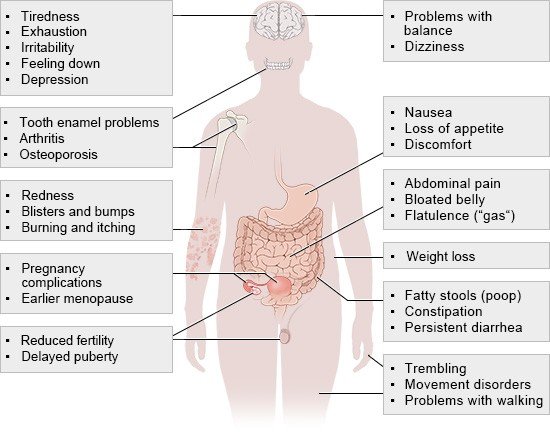
  • Tiredness and exhaustion
  • Abdominal pain, flatulence (gas), discomfort or nausea
  • Persistent diarrhea, constipation, or larger amounts of fatty, greasy stool (poop)
  • Visibly bloated belly
  • Loss of appetite and weight loss in adults
  • Lack of weight gain and growth (failure to thrive) in children and teenagers
  • Irritability, feeling down and depression
Illustration: Celiac disease – Effects of malnutrition caused by chronic inflammation in the intestine

Celiac disease can also affect the nervous system or the thyroid gland. And it may be the cause of dizziness and certain movement disorders (ataxia).

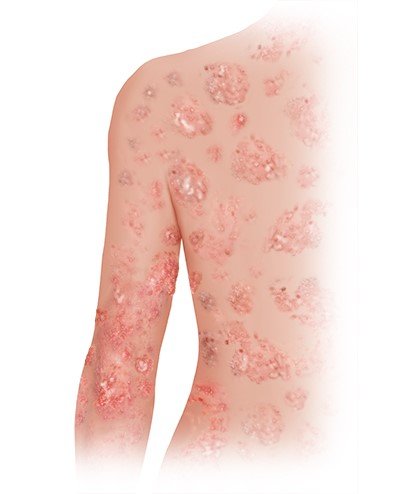
In adults, celiac disease sometimes leads to skin problems, too. The rare form known as dermatitis herpetiformis (“Duhring’s disease”) causes clusters of blisters, redness, , or bumps on the skin that usually burn and itch. The skin symptoms often occur on the elbows, knees, scalp, forehead and torso.

Illustration: Skin rash caused by celiac disease

If a woman is unable to get pregnant or has a premature birth or miscarriage, that could be because she has celiac disease without knowing it. Celiac disease can reduce in women and men.

What are the other possible effects of the inflammation in the intestine?

Regardless of whether it causes noticeable symptoms, celiac disease (including the special form "Duhring’s disease") leads to in the small intestine. The chronically inflamed lining of the intestine can no longer absorb as many nutrients, resulting in malnutrition.

A lack of iron, calcium, zinc, magnesium, and vitamins D or B can cause a wide variety of symptoms. For example, an iron deficiency can lead to anemia, where the blood can no longer transport enough oxygen. This can result in a number of symptoms, ranging from tiredness and dizziness to hair loss.

What are the symptoms of celiac disease in children?

Like adults, younger children with celiac disease can have symptoms like abdominal pain and diarrhea. But they may develop other symptoms as well:

  • Problems with tooth enamel
  • Skin problems such as rashes
  • Neurological or psychological problems like anxiety, hyperactivity and attention deficit disorders

In babies and very young children who have already started eating solid foods, the following might be a sign of celiac disease:

  • Vomiting
  • Loss of appetite
  • Fussiness, becoming withdrawn
  • Weak muscles
  • Loss of already learned motor skills
  • Tooth development problems
  • Pale skin

Casella S, Zanini B, Lanzarotto F et al. Celiac disease in elderly adults: clinical, serological, and histological characteristics and the effect of a gluten-free diet. J Am Geriatr Soc 2012; 60(6): 1064-1069.

Felber J, Bläker H, Fischbach W et al. Aktualisierte S2k-Leitlinie Zöliakie der Deutschen Gesellschaft für Gastroenterologie, Verdauungs- und Stoffwechselkrankheiten (DGVS). AWMF register no.: 021-021. 2021.

Pschyrembel Online. Zöliakie. 2022.

IQWiG health information is written with the aim of helping people understand the advantages and disadvantages of the main treatment options and health care services.

Because IQWiG is a German institute, some of the information provided here is specific to the German health care system. The suitability of any of the described options in an individual case can be determined by talking to a doctor. informedhealth.org can provide support for talks with doctors and other medical professionals, but cannot replace them. We do not offer individual consultations.

Our information is based on the results of good-quality studies. It is written by a team of health care professionals, scientists and editors, and reviewed by external experts. You can find a detailed description of how our health information is produced and updated in our methods.

Comment on this page

What would you like to share with us?

We welcome any feedback and ideas - either via our form or by gi-kontakt@iqwig.de. We will review, but not publish, your ratings and comments. Your information will of course be treated confidentially. Fields marked with an asterisk (*) are required fields.

Please note that we do not provide individual advice on matters of health. You can read about where to find help and support in Germany in our information “How can I find self-help groups and information centers?

Über diese Seite

Created on March 24, 2026

Next planned update: 2029

Publisher:

Institute for Quality and Efficiency in Health Care (IQWiG, Germany)

Stay informed

Subscribe to our newsletter or newsfeed. You can find our growing collection of films on YouTube.