Pelvic floor exercises

Although you cannot really see or feel your pelvic floor, you can still learn to move the muscles of the pelvic floor voluntarily, and to strengthen them through training – just as you can with your arm or leg muscles. Pelvic floor exercises involve both tensing and relaxing these muscles. If you feel unsure about starting out, your can also help you learn how to do the exercises.

What is the pelvic floor?

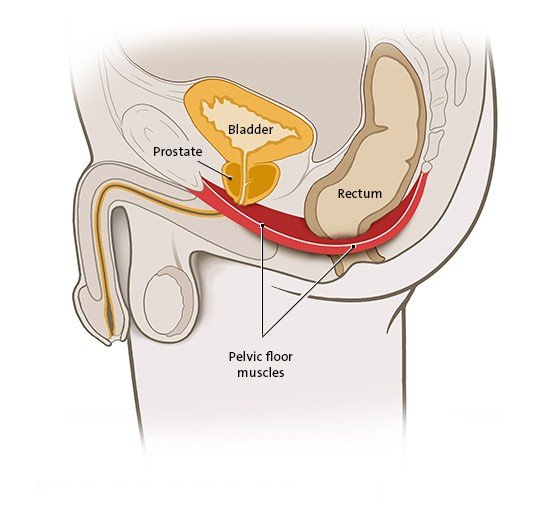
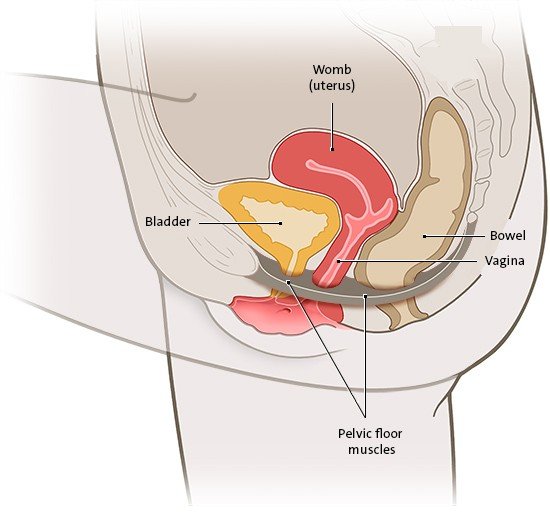
The pelvic floor is made up of muscles, ligaments and connective tissue. The pelvic floor closes the pelvic cavity and the pelvic organs from below and is curved upward at the edges. The muscles stretch from the pubic bone at the front back to the sacrum and tailbone at the bottom of the spine, and on the sides the muscles attach to both sitting bones.

This simplified anatomical illustration shows the pelvic floor in women and the nearby organs.
This simplified anatomical illustration shows the position of the pelvic floor in men and the nearby organs.

Openings for the rectum, the urethra and the vagina lead through the pelvic floor’s layer of muscles. The pelvic floor muscles relax during bowel movements and urination, and in women also during sexual intercourse and childbirth.

The perineum is part of the pelvic floor too. It is located between the scrotum and the anus in men, and between the vagina and the anus in women.

What does the pelvic floor do?

A strong and healthy pelvic floor is important for your health because it

  • provides support for abdominal and pelvic organs such as the bladder, bowel and uterus.
  • withstands the high pressure that results from, for example, coughing and laughing, straining during a bowel movement, and physical exertion – for instance when lifting heavy objects.
  • is important for bladder and bowel control – even during physical exertion.

When does it make sense to do pelvic floor exercises?

Pelvic floor exercises can be recommended to prevent problems. For example, obesity and any surgery in the pelvic area can put strain on the pelvic floor. Doing exercises regularly can also be useful during pregnancy and after childbirth.

Pelvic floor exercises may also be suitable if you already have certain problems. Strengthening your pelvic floor can then help to relieve the symptoms. Doctors can recommend exercises for you if you have a weak bladder (urinary ) or uterine prolapse, for example.

Breathing

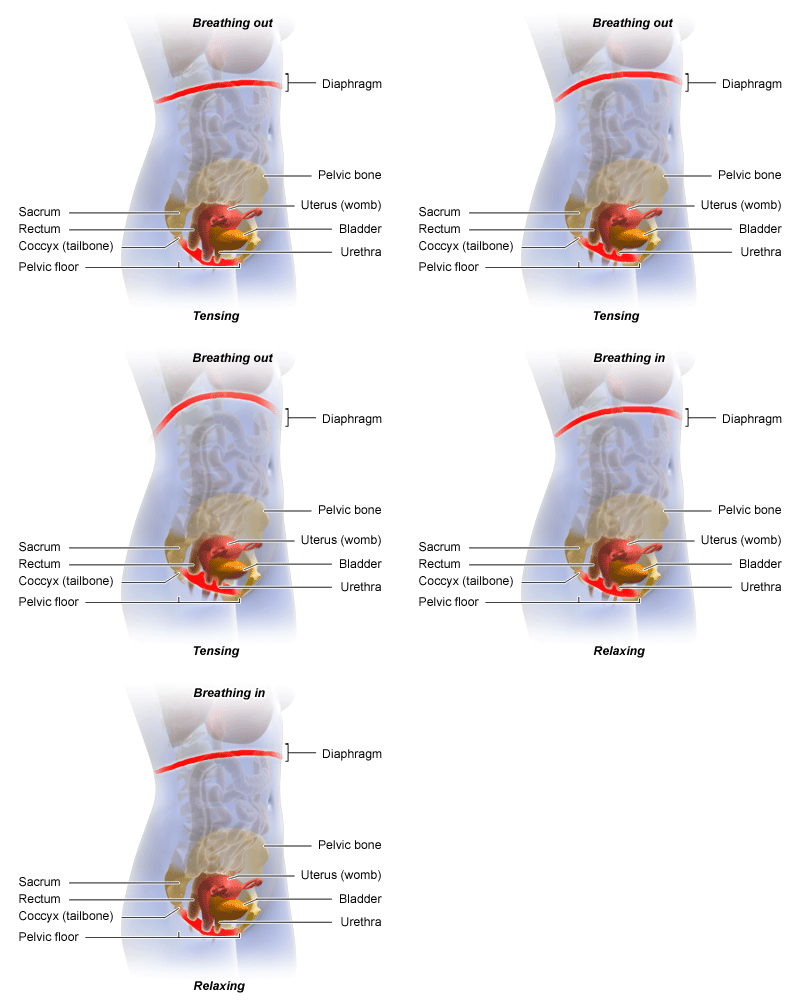
Breathing technique is a major part of pelvic floor exercises because your diaphragm and pelvic floor work together through the pressure in the belly:

  • When you breathe in (inhale), the diaphragm falls and the abdominal organs are pushed down. This causes the pelvic floor to stretch out and sink downward.
  • When you breathe out (exhale), the diaphragm rises again, the pelvic floor muscles contract, and the pelvic floor rises again.

Coordinated breathing and movement of the diaphragm allow the pelvic floor muscles to contract powerfully, and then relax.

These exercises can help you become more aware of your own breathing:

Lie down on your back so that you are comfortable. Place your feet slightly apart with your knees bent, and rest one hand lightly on your stomach. Breathe in and out steadily. When you breathe in your stomach rises slightly, and when you breathe out your stomach falls again.

Becoming aware of your pelvic floor

Many people have difficulties with pelvic floor exercises at first because they involve muscles inside of our body that you don’t see moving. That is why it is important to be able to feel the muscles first in order to be able to train the pelvic floor. The following exercises can help:

  • When you clench the muscle at the end of your urethra, as if you were trying to interrupt the flow of urine, you automatically tense the other pelvic floor muscles as well. You should not do this exercise regularly, though; it is just a way to get a feel for your pelvic floor muscles.
  • You can also feel tensed pelvic floor muscles on your perineum. To do this, lie comfortably on your back and tense your pelvic floor as described above.

When doing the exercises, it is important to tense pelvic floor muscles on their own, without the help of the stomach or buttock muscles. This way you can avoid exercising the “wrong” muscles.

Pelvic floor exercises are designed to help you individually

Pelvic floor exercises involve tensing the pelvic floor, holding the tensed muscles for a certain amount of time and then relaxing them again. The exercises are usually repeated several times. It is important not to hold your breath while doing the exercises, but to combine the exercises with your breathing.

There are a lot of different types of exercises for the pelvic floor. It can be strengthened just as well while standing as while sitting or lying. You can consult your doctor or physical therapist to find out which exercises are best suited for you. Adult education centers, midwife practices and many other places also offer courses in pelvic floor training.

Pelvic floor tips in everyday life

There are also simple things that you can do in everyday life to avoid straining your pelvic floor muscles too much. The main goal is to avoid putting pressure on your pelvic floor.

Standing up

If you are lying down and get up while keeping your upper body straight, your stomach muscles tense and push your pelvic floor down. You can reduce the pressure by rolling onto your side first, propping yourself up with your arms, and then getting up.

Posture

If your back is not straight, there is less tension in your pelvic floor and the organs in your abdomen are squashed together, so they push down on the pelvic floor. You can stop this from happening by keeping your back straight while sitting and walking.

Lifting objects

To reduce the strain on your pelvic floor when lifting things, bend your knees and keep your back straight when coming back up instead of keeping your legs straight and bending forward. It can also help to hold the object close to your body and tense your pelvic floor muscles.

Holding your breath when lifting heavy things stops the muscles in your back, stomach and pelvic floor from working together as well as they could. The muscles work better together if you carry on breathing.

Coughing and sneezing

Coughing or sneezing leads to a sudden increase in pressure in your abdomen. This can put strain on your pelvic floor if your upper body is bent forward. You can reduce the strain by looking up or over your shoulder while coughing or sneezing.

Abdominal exercises

Abdominal exercises like sit-ups put a lot of pressure on your abdomen. This can be a problem if you have a weak bladder, if you are pregnant, or if you have had a baby in the last few months. If any of those apply to you, you can talk to your doctor about perhaps avoiding abdominal exercises for a while, or doing lighter exercises instead.

Andreae S, Avelini P, Berg M et al. Lexikon der Krankheiten und Untersuchungen. Stuttgart: Thieme; 2008.

Deutsche Gesellschaft für Gynäkologie und Geburtshilfe (DGGG). S2k-Leitlinie Harninkontinenz der Frau. AWMF register no.: 015-091. 2022.

Hay-Smith EJ, Starzec-Proserpio M, Moller B et al. Comparisons of approaches to pelvic floor muscle training for urinary incontinence in women. Cochrane Database Syst Rev 2024; (12): CD009508.

Loscalzo J, Kasper DL, Longo DL et al. Harrison's Principles of Internal Medicine (Vol. 1 & Vol. 2). New York: McGraw-Hill; 2022.

Ontario Health (Quality). Pelvic Floor Muscle Training for Stress Urinary Incontinence, Fecal Incontinence, and Pelvic Organ Prolapse: A Health Technology Assessment. Ont Health Technol Assess Ser 2024; 24(6): 1-172.

Pschyrembel online. Beckenboden. 2025.

Seitz S. Gynäkologie und Geburtshilfe. Berlin: Springer; 2023.

Woodley SJ, Lawrenson P, Boyle R et al. Pelvic floor muscle training for preventing and treating urinary and faecal incontinence in antenatal and postnatal women. Cochrane Database Syst Rev 2020; (5): CD007471.

IQWiG health information is written with the aim of helping people understand the advantages and disadvantages of the main treatment options and health care services.

Because IQWiG is a German institute, some of the information provided here is specific to the German health care system. The suitability of any of the described options in an individual case can be determined by talking to a doctor. informedhealth.org can provide support for talks with doctors and other medical professionals, but cannot replace them. We do not offer individual consultations.

Our information is based on the results of good-quality studies. It is written by a team of health care professionals, scientists and editors, and reviewed by external experts. You can find a detailed description of how our health information is produced and updated in our methods.

Comment on this page

What would you like to share with us?

We welcome any feedback and ideas - either via our form or by gi-kontakt@iqwig.de. We will review, but not publish, your ratings and comments. Your information will of course be treated confidentially. Fields marked with an asterisk (*) are required fields.

Please note that we do not provide individual advice on matters of health. You can read about where to find help and support in Germany in our information “How can I find self-help groups and information centers?

Über diese Seite

Updated on January 15, 2026

Next planned update: 2029

Publisher:

Institute for Quality and Efficiency in Health Care (IQWiG, Germany)

Stay informed

Subscribe to our newsletter or newsfeed. You can find our growing collection of films on YouTube.