Spinal stenosis: When is surgery an option?

Photo of a nurse and patient in hospital

People with spinal stenosis might have surgery if their symptoms have lasted several months or years, are causing them a lot of distress, and aren’t responding to other treatments. But there is no proof that surgery makes the symptoms better.

Spinal stenosis is a narrowing of the spinal canal. The aim of having surgery is to free up space to relieve the pressure on the nerves and blood vessels that run through the spinal canal. The idea is that this will relieve symptoms like lower back pain and make day-to-day life easier.

Surgery is an option to consider if

  • the symptoms are so bad that they’re making day-to-day life difficult,
  • they last several months or more,
  • conservative treatment hasn’t been successful, and
  • diagnostic imaging methods (typically an MRI scan) suggest that spinal stenosis is the cause.

Before deciding to go ahead with the procedure, it’s important to carefully weigh the pros and cons. One thing to bear in mind is your own personal situation - things like other health problems you have, your age, and your work and home environment. But it’s also important to think about what you want and what benefit you expect to get from the procedure. If you’re unsure, you can ask a doctor for a second opinion.

In rare cases, spinal stenosis can cause a medical emergency because the nerves in the spinal canal are so compressed that the person can’t move their limbs and/or their bladder or bowel stops working properly (cauda equina syndrome). Then surgery is the only option.

What surgical techniques are used?

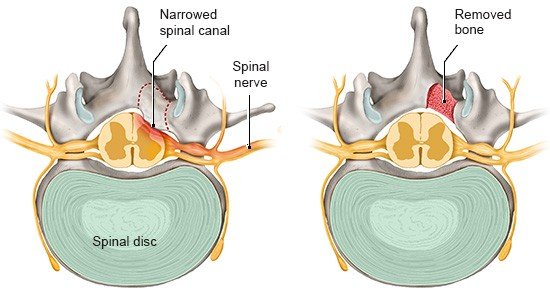
The most common technique used for spinal stenosis is laminectomy. This involves removing the bones and ligaments that are making the spinal canal too narrow and pressing down on the nerves and vessels. Bones and ligaments are key to the stability and flexibility of the spine, so the surgeon will remove as little as possible.

Die linke Grafik zeigt die Bandscheibe mit verengtem Spinalkanal, die rechte den bei der Dekompression entfernten Knochen.

If the person also has spondylolisthesis, the surgery might be a combination of laminectomy and a procedure called spinal fusion. Spondylolisthesis is when vertebrae slide and are no longer aligned correctly. Another word for spinal fusion is spondylodesis.

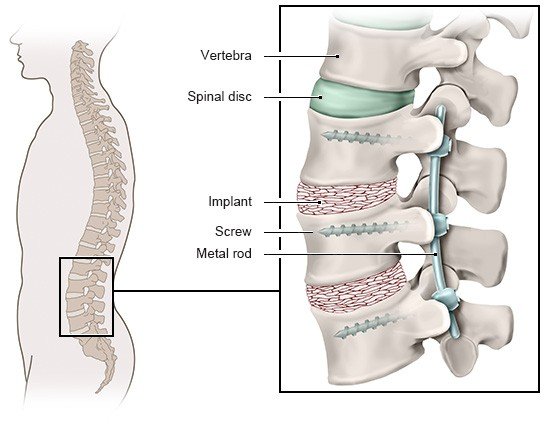
In spinal fusion surgery, the vertebrae are joined together to keep them in place. One way of doing this is to use screws. If the spinal disc is damaged, the surgeon will remove it and fill the resulting gap between the vertebrae with bone or a titanium implant.

Die Grafik zeigt das Vorgehen bei einer Wirbelkörperversteifung mit Detailansicht von Wirbelkörper, Bandscheibe, Ersatzmaterial sowie Schrauben und Metallstab.

Other procedures, like dynamic stabilization or insertion of interspinous spacers, are hardly ever used for spinal stenosis. Medical societies currently don't recommend them for this condition.

Is open or endoscopic surgery used?

Laminectomy (with or without spinal fusion) can be carried out as an open, microsurgical or endoscopic procedure.

  • Open surgery: The surgeon looks through a cut in the skin to see the part of the body they need to operate on. Sometimes they use a microscope (microsurgical decompression). If they don’t, the cut needs to be a little bit bigger. People who have this microsurgical procedure are given a general anesthetic and have to stay in hospital for a few days. The risks associated with this procedure include bleeding, nerve damage and infections. General anesthesia may lead to complications like difficulty breathing or circulation problems.
  • Endoscopic surgery: Also known as keyhole surgery, this only requires a small cut, no more than one centimeter long. The is pushed through to where the surgery is needed and then the surgeon guides micro-sized instruments through it with the help of x-ray images. This type of surgery requires only local anesthesia. The idea is that the person will recover more quickly from the procedure and there won’t be any potentially problematic scars. There are risks however, including bleeding, nerve damage and .

Can surgery ease the symptoms and what are the risks?

There hasn’t been much research on whether surgery eases symptoms more than conservative treatment. The findings have been contradictory but generally show that surgery doesn’t have any advantages.

There has been a lot of good-quality research on whether an additional spinal fusion procedure makes sense if the person has spondylolisthesis too. The conclusion was that a combination of laminectomy and spinal fusion didn’t offer any advantage over laminectomy on its own.

But the additional procedure to fuse vertebrae does increase the risk of complications. They include heart attacks or severe loss of blood during surgery but also problems later on due to the wound not healing properly. One large-scale study showed that complications requiring hospital treatment occurred in

  • 6 to 7 out of 100 people (of whom 1 to 2 had fatal symptoms) following laminectomy and
  • 9 to 10 out of 100 people (of whom 3 to 4 had fatal symptoms) following spinal fusion.

In addition, people who have spinal fusion surgery need to spend one to two more days in the hospital.

Surgery can also damage the nerves so badly that the person becomes paralyzed, but this is extremely rare.

Good to know:

Doctors who recommend surgery have to tell you about your right to get a second medical opinion free of charge. Our decision aids can also help you weigh up the pros and cons of surgery for spinal stenosis and other spinal diseases.

Abdel-Fattah AR, Bell F, Boden L et al. To fuse or not to fuse: The elderly patient with lumbar stenosis and low-grade spondylolisthesis. Systematic review and meta-analysis of randomised controlled trials. Surgeon 2023; 21(1): e23-e31.

Bove AM, Lynch AD, Ammendolia C et al. Patients' experience with nonsurgical treatment for lumbar spinal stenosis: a qualitative study. Spine J 2018; 18(4): 639-647.

Chen Z, Wu W, Xiong H et al. Systematic review and meta-analysis of the therapeutic effects of minimally invasive transforaminal interbody fusion on spondylolisthesis. Ann Palliat Med 2021; 10(9): 9848-9858.

Chen Z, Xie P, Feng F et al. Decompression Alone Versus Decompression and Fusion for Lumbar Degenerative Spondylolisthesis: A Meta-Analysis. World Neurosurg 2018; 111: e165-e177.

Davis RE, Vincent C, Henley A et al. Exploring the care experience of patients undergoing spinal surgery: a qualitative study. J Eval Clin Pract 2013; 19(1): 132-138.

Deutsche Gesellschaft für Neurologie (DGN). Leitlinien für Diagnostik und Therapie in der Neurologie: Lumbale Radikulopathie (S2k-Leitlinie). AWMF register no.: 030-058. 2018.

Deutsche Gesellschaft für Orthopädie und Orthopädische Chirurgie (DGOOC). Spezifischer Kreuzschmerz (S2k-Leitlinie, in Überarbeitung). AWMF register no.: 187-059. 2017.

Kalff R, Ewald C, Waschke A et al. Degenerative lumbar spinal stenosis in older people: current treatment options [Degenerative lumbale Spinalkanalstenose im höheren Lebensalter: Aktuelle Behandlungsoptionen]. Dtsch Arztebl 2013; 110(37): 613-624.

Machado GC, Ferreira PH, Yoo RI et al. Surgical options for lumbar spinal stenosis. Cochrane Database Syst Rev 2016; (11): CD012421.

North American Spine Society. Diagnosis and treatment of degenerative lumbar spinal stenosis. 2011.

Peterson S, Mesa A, Halpert B et al. How people with lumbar spinal stenosis make decisions about treatment: A qualitative study using the Health Belief Model. Musculoskelet Sci Pract 2021; 54: 102383.

Pranata R, Lim MA, Vania R et al. Decompression Alone Compared to Decompression With Fusion in Patients With Lumbar Spondylolisthesis: Systematic Review, Meta-Analysis, and Meta-Regression. Int J Spine Surg 2022; 16(1): 71-80.

Thomé C, Börm W, Meyer F. Degenerative lumbar spinal stenosis: current strategies in diagnosis and treatment. Dtsch Arztebl Int 2008; 105(20): 373-379.

Zaina F, Tomkins-Lane C, Carragee E et al. Surgical versus non-surgical treatment for lumbar spinal stenosis. Cochrane Database Syst Rev 2016; (1): CD010264.

IQWiG health information is written with the aim of helping people understand the advantages and disadvantages of the main treatment options and health care services.

Because IQWiG is a German institute, some of the information provided here is specific to the German health care system. The suitability of any of the described options in an individual case can be determined by talking to a doctor. informedhealth.org can provide support for talks with doctors and other medical professionals, but cannot replace them. We do not offer individual consultations.

Our information is based on the results of good-quality studies. It is written by a team of health care professionals, scientists and editors, and reviewed by external experts. You can find a detailed description of how our health information is produced and updated in our methods.


Comment on this page

What would you like to share with us?

We welcome any feedback and ideas - either via our form or by gi-kontakt@iqwig.de. We will review, but not publish, your ratings and comments. Your information will of course be treated confidentially. Fields marked with an asterisk (*) are required fields.

Please note that we do not provide individual advice on matters of health. You can read about where to find help and support in Germany in our information “How can I find self-help groups and information centers?

Über diese Seite

Created on February 3, 2026

Next planned update: 2029

Publisher:

Institute for Quality and Efficiency in Health Care (IQWiG, Germany)

Stay informed

Subscribe to our newsletter or newsfeed. You can find our growing collection of films on YouTube.