Spinal stenosis in the lower back (lumbar spinal stenosis)

At a glance

  • Spinal stenosis can put pressure on the nerves in the spinal canal. This can be very painful.
  • The pain can spread to your one or both legs or you might feel tingling or numbness there.
  • The symptoms tend to be worse when you’re standing or walking than when you’re sitting.
  • It is important to stay as active as possible despite the symptoms.
  • Often, painkillers and exercise are all the treatment that’s needed.

Introduction

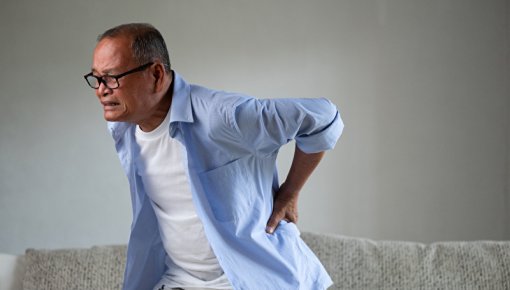
Photo of a man with back pain

Pain in the lower back is a very common problem. It’s usually not easy to say what the exact cause is. Symptoms that also affect your legs can be a sign of spinal stenosis.

Spinal stenosis is the narrowing of the spinal canal. This canal contains the spinal cord and the nerves running through it, as well as the blood vessels that supply blood to the legs. If it narrows, it might not leave enough space for the nerves and vessels. This can cause symptoms in the back and legs – but it doesn’t always.

Some people are born with spinal stenosis, but it’s much more usual for it to develop as part of the normal aging process (degenerative spinal stenosis). In most cases, the lower part of the spine is affected (lumbar spinal stenosis).

Symptoms

Spinal stenosis can cause pain in the lower back that also spreads to your bottom and thighs, and sometimes even down your lower leg as well. You might only have pain in your leg instead, or it might feel heavy and tired. Pain that spreads down to your leg is called sciatica.

People usually feel the symptoms of spinal stenosis when their spine is under strain, especially when walking slowly or standing. Bending forward slightly can reduce the strain on the nerves. That’s why people with spinal stenosis often lean forward a little when they’re walking or sit down every now and again to lean their upper body forward. Walking lengthy distances is difficult for them.

You might get a tingling or numb sensation in your legs too, or not be able to move them properly. This can make you feel a bit shaky on your feet.

Numbness and impaired mobility can be a sign of a serious problem such as nerve damage but this is rare. There is a condition called “cauda equina syndrome,” which causes the limbs to stop working properly or a sudden loss of bladder or bowel function. If this happens, you should seek medical advice right away.

Causes

Spinal stenosis is usually due to the normal aging process. As we grow older, the discs, bones and ligaments in our spine suffer from wear and tear.

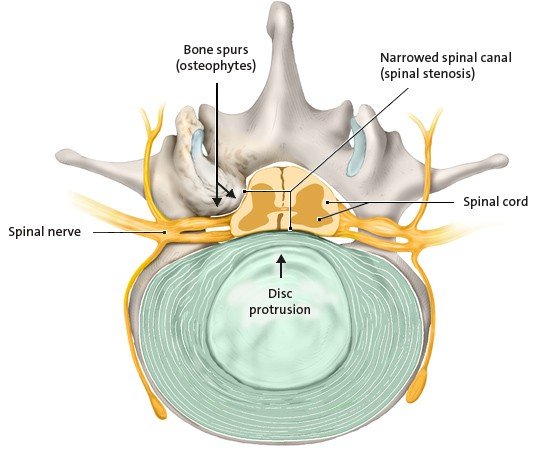
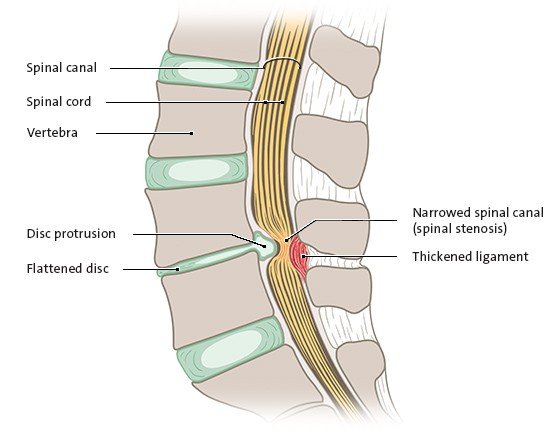
Fluid leaks out of the discs and they become brittle and cracked, which can weaken the spine. Sometimes our body tries to compensate for this by growing new bone tissue known as bone spurs (osteophytes) on the vertebrae. The ligaments between the vertebral arches can also thicken with age.

Symptoms can occur if the discs, bone spurs or ligaments push against the spinal canal or the nerves that branch off the spine.

Illustration: Narrowed spinal canal, cross section, view from above
Illustration: Narrowed spinal canal, longitudinal section, view from side

The natural curve in the lower spine can become more pronounced as a result of changes in the spine. This can cause your back to overarch or flatten when you’re standing. That can be painful too.

Prevalence

Spinal stenosis is pretty rare in people under the age of 50. It becomes more common with age. In around 20 to 30 out of 100 people over the age of 60, (MRI) shows spinal stenosis. But only one fifth of those people actually have symptoms.

Outlook

The pain tends to increase gradually over time. Many people can’t remember exactly when it began. Often, symptoms like numb or tingling legs don’t appear until quite a bit later, if at all.

Sometimes the symptoms improve on their own. A study followed around 150 people with moderate spinal stenosis symptoms for a period of three years. During that time:

  • The symptoms decreased slightly in around 30% of the participants.
  • They stayed more or less the same in around 50%.
  • They got worse in around 20%.

It is not possible to predict how a person’s spinal stenosis will develop.

Effects

The age-related changes in the spine can cause the vertebrae to move around more. This is called spondylolisthesis. When this happens, the vertebrae can also press against nerves and blood vessels. People who have spinal stenosis often get spondylolisthesis as well. Then there’s usually no way of telling whether which illness has caused the symptoms in the lower back. However, leg pain only happens if the person has stenosis.

Diagnosis

To work out what’s causing your symptoms, your doctor will ask you to describe them. They’ll also give you a physical examination. Often, your description and the examination are enough for a because the symptoms of spinal stenosis are very specific.

You’ll need a scan (MRI, for example) if the pain doesn’t get better with treatment, if you’re in extreme pain or if you lose the feeling in your legs or can’t move them properly. Then it’s important to find out whether the cause is something other than spinal stenosis. An x-ray can be useful if the doctor suspects you may have spondylolisthesis. This condition can usually be clearly seen on an x-ray.

Imaging techniques are always used before surgery or before you’re given an injection for the pain in your back. The aim then is to determine more precisely where the surgery or injection is needed.

Treatment

No treatment is necessary if the spinal stenosis is discovered by chance and isn’t causing any symptoms.

If you do have symptoms, there are various treatments you can try:

  • Adjusting your posture to relieve the strain. This could mean bending your upper body forward or tilting your pelvis, for instance.
  • Manual therapy to mobilize the affected section of the spine and the nerve roots where the spine becomes the sacrum. This also includes stretching and mobilizing the hip, pelvic and spinal joints as well as doing upper body exercises.
  • Physical therapy to learn exercises and postures to reduce the strain on your spine so you can do them on your own at home.
  • Painkillers to relieve the back pain and ensure mobility despite the symptoms. The doctor will usually prescribe anti-inflammatory painkillers like Ibuprofen. It is best if you only take the smallest effective dose and only when you really need them. Most other painkillers tend not to be recommended because they are ineffective, not proven to be effective, or cause side effects.

The general recommendation for people with spinal stenosis is to stay as active as possible.

“Multimodal pain management” can be useful, especially if the symptoms don't go away and become chronic. This kind of pain management is provided by specialists from various areas of expertise, such as doctors, physiotherapists and psychologists. They can help you to stay mobile and cope with the symptoms.

Treatment for spinal stenosis focuses on non-surgical (conservative) methods. If the symptoms last several months or years and don’t get better with conservative treatment, surgery may be an option. You have the right to a second opinion from a specialist before having this surgery. Our decision aid for spinal stenosis surgery can also help you weigh the pros and cons of surgery.

Immediate surgery is required if the nerves are so badly damaged that you can’t move your legs properly or your bladder or bowel stops working properly. Bladder or bowel dysfunction is a sign of a condition called “cauda equina syndrome.” This is a rare condition but it requires priority emergency treatment.

Rehabilitation

Patients who have surgery are sometimes prescribed rehabilitative therapy afterward. The aim is to support the recovery process and help ensure lasting maximum mobility. Rehabilitation can include strengthening, stretching and balance exercises. Usually, there’s a physical therapist to show you how to do the exercises.

Doctors don’t give a blanket recommendation for or against rehabilitation after spinal stenosis surgery. They tend to decide based on your individual work and home situation.

Everyday life

The symptoms caused by spinal stenosis can vary in intensity from day to day. On bad days, they can stop you doing your job properly. Everyday chores like cleaning or shopping can be difficult too, and lots of things take more time. Then it’s sometimes a good idea to ask family or friends to help.

On days when you’re in a lot of pain, you might not feel up to doing things like socializing or going to see a movie. So it can make things easier if you contact people on the fly or decide to do something when the pain isn’t so bad instead of planning ahead. Having said that, worrying about the pain getting worse can be distressing.

There is no miracle cure for spinal stenosis symptoms. They are often persistent over long periods of time. The challenge then is to accept the situation and work out good strategies for your day-to-day life. Chronic pain can be such a physical and psychological strain that it sometimes causes problems like , though. One option then is to consider behavioral therapy, where you learn to cope better with the illness and its effects.

Further information

When people are ill or need medical advice, they usually go to see their family doctor first. In our topic "Health care in Germany" you can read about how to find the right doctor – and our list of questions can help you to prepare for your appointment.

In Germany there are numerous sources of support for people who have back problems, including support groups and information centers. You can use our list to help find local services.

Ammendolia C, Hofkirchner C, Plener J et al. Non-operative treatment for lumbar spinal stenosis with neurogenic claudication: an updated systematic review. BMJ Open 2022; 12(1): e057724.

Atlas SJ, Delitto A. Spinal stenosis: surgical versus nonsurgical treatment. Clin Orthop Relat Res 2006; 443: 198-207.

Davis RE, Vincent C, Henley A et al. Exploring the care experience of patients undergoing spinal surgery: a qualitative study. J Eval Clin Pract 2013; 19(1): 132-138.

Deutsche Gesellschaft für Neurologie (DGN). Leitlinien für Diagnostik und Therapie in der Neurologie: Lumbale Radikulopathie (S2k-Leitlinie). AWMF register no.: 030-058. 2018.

Deutsche Gesellschaft für Orthopädie und Orthopädische Chirurgie (DGOOC). Leitlinie zur konservativen, operativen und rehabilitativen Versorgung bei Bandscheibenvorfällen mit radikulärer Symptomatik (S2k Leitlinie). AWMF register no.: 187-057. 2020.

Deutsche Gesellschaft für Orthopädie und Orthopädische Chirurgie (DGOOC). Spezifischer Kreuzschmerz (S2k-Leitlinie, in Überarbeitung). AWMF register no.: 187-059. 2017.

Jensen RK, Jensen TS, Koes B et al. Prevalence of lumbar spinal stenosis in general and clinical populations: a systematic review and meta-analysis. Eur Spine J 2020; 29(9): 2143-2163.

Kalff R, Ewald C, Waschke A et al. Degenerative lumbar spinal stenosis in older people: current treatment options [Degenerative lumbale Spinalkanalstenose im höheren Lebensalter: Aktuelle Behandlungsoptionen]. Dtsch Arztebl 2013; 110(37): 613-624.

Kalichman L, Kim DH, Li L et al. Spondylolysis and spondylolisthesis: prevalence and association with low back pain in the adult community-based population. Spine 2009; 34(2): 199-205.

Kasch R, Truthmann J, Hancock MJ et al. Association of Lumbar MRI Findings with Current and Future Back Pain in a Population-based Cohort Study. Spine (Phila Pa 1976) 2022; 47(3): 201-211.

Katz JN, Zimmerman ZE, Mass H et al. Diagnosis and Management of Lumbar Spinal Stenosis: A Review. JAMA 2022; 327(17): 1688-1699.

Lyle S, Williamson E, Darton F et al. A qualitative study of older people's experience of living with neurogenic claudication to inform the development of a physiotherapy intervention. Disabil Rehabil 2017; 39(10): 1009-1017.

Mayer HM, Heider FC. Der lumbale Bandscheibenvorfall. Orthopädie und Unfallchirurgie up2date 2016; 11(06): 427-447. 427.

McGregor AH, Probyn K, Cro S et al. Rehabilitation following surgery for lumbar spinal stenosis. Cochrane Database Syst Rev 2013; (12): CD009644.

North American Spine Society. Diagnosis and treatment of degenerative lumbar spinal stenosis. 2011.

Thomé C, Börm W, Meyer F. Degenerative lumbar spinal stenosis: current strategies in diagnosis and treatment. Dtsch Arztebl Int 2008; 105(20): 373-379.

Traeger AC, Underwood M, Ivers R et al. Low back pain in people aged 60 years and over. BMJ 2022; 376: e066928.

IQWiG health information is written with the aim of helping people understand the advantages and disadvantages of the main treatment options and health care services.

Because IQWiG is a German institute, some of the information provided here is specific to the German health care system. The suitability of any of the described options in an individual case can be determined by talking to a doctor. informedhealth.org can provide support for talks with doctors and other medical professionals, but cannot replace them. We do not offer individual consultations.

Our information is based on the results of good-quality studies. It is written by a team of health care professionals, scientists and editors, and reviewed by external experts. You can find a detailed description of how our health information is produced and updated in our methods.

Comment on this page

What would you like to share with us?

We welcome any feedback and ideas - either via our form or by gi-kontakt@iqwig.de. We will review, but not publish, your ratings and comments. Your information will of course be treated confidentially. Fields marked with an asterisk (*) are required fields.

Please note that we do not provide individual advice on matters of health. You can read about where to find help and support in Germany in our information “How can I find self-help groups and information centers?

Über diese Seite

Created on February 3, 2026

Next planned update: 2029

Publisher:

Institute for Quality and Efficiency in Health Care (IQWiG, Germany)

Stay informed

Subscribe to our newsletter or newsfeed. You can find our growing collection of films on YouTube.