Non-surgical treatment for spinal stenosis

Group of people doing water aerobics

If spinal stenosis in the lower back (lumbar spinal stenosis) is causing symptoms, it’s mainly treated with exercises, manual therapy, and, if needed, medication. The important thing is to find out what makes you feel better and helps you cope with the symptoms in your day-to-day life.

The spinal canal is where the spine's nerves and blood vessels are located. As we get older, the lower part of this canal increasingly tends to get narrower. This is called spinal stenosis, and it can cause symptoms like back pain, which sometimes spread to the legs as well. Numbness or a tingling sensation in your legs or feet is also common. These symptoms can make you feel a little unsteady, and walking long distances is often difficult.

Most people with spinal stenosis are given conservative (non-surgical) treatment for these symptoms.

Does exercise and relieving the strain on your spine help?

It is important to stay as physically active as possible despite the pain. Lying or sitting for a long time weakens your muscles and bones, which can cause additional problems. So it makes sense to carry on with your normal routine if your symptoms allow it, or if you can manage it with the help of painkillers. Exercise often has a positive effect on your mood too.

People with spinal stenosis mainly get symptoms when they’re walking slowly or standing. These activities make the natural arch in the lower part of the spine more pronounced, which increases the pressure on the narrowed section of the spinal canal. But that doesn’t mean that walking or standing is bad for you.

Bending your upper body forward eases the symptoms because there’s more space between the lower vertebrae. Often, just bending forward very slightly can help. To do this, you can try sitting down for a bit or resting your forearms on a rail or shopping cart. If you want to bend further forward, you can stand with your hands on your knees and bend them a little. If you can get into a squatting position, you can try that too.

It is often still very much possible to take a brisk walk outdoors or on a treadmill, or to walk uphill, because your upper body bends forward automatically. Walking downhill, on the other hand, can make you overarch your back, which might make the symptoms worse. If you want to go hiking, for instance, but you tend to overarch your back, you can try going uphill by foot and downhill by public transport.

Cycling – outside or on an exercise bike – is really good for people with spinal stenosis because you naturally bend forward when you sit on a bike. It can also help you keep fit. Swimming on your back and water aerobics are also worth a try.


What do physical therapy and occupational therapy involve?

Physical therapy involves doing posture exercises, guided by the therapist, to stop you from overarching your spine. One thing you learn is to align your pelvis properly when standing, like we do automatically when sitting. The therapist also does various exercises with you to relax and stretch your lower back muscles because shortened muscles and tension can make the overarching worse. Strengthening exercises can help keep you mobile so you can continue to do things for yourself. The aim is to be able to do the exercises so well that you can make them part of your everyday routine.

Physical therapy can also include manual therapy and treatments based on physical stimuli. Manual treatment may include special techniques for relaxing tense muscles or locked joints. Treatments based on physical stimuli use warming and cooling methods to relieve pain.

Common treatments include:

  • Massages: Various massage techniques are used to relax muscles and ease tension.
  • Heating and cooling: This includes the use of hot packs and heating patches, hot baths, going to the sauna or using an infrared lamp. Heat can also help relax tense muscles. Cold packs, like cold wraps or gel packs, are also used to help soothe irritated nerves.
  • Ultrasound therapy: Here the lower back is treated with sound waves. The small vibrations that are produced generate heat and relax the body tissue.
  • Acupuncture: This involves inserting thin needles into specific points on the skin with the aim of influencing the flow of energy through the body’s energy pathways (meridians). But there is no scientific proof that these energy pathways exist.

With occupational therapy, the idea is to learn how to cope with the physical symptoms in your day-to-day life. It involves things like practicing new ways of doing particular movements or developing strategies for reducing and getting rid of pain.

There hasn’t been enough research yet on how effective these treatments are. The things that can make you feel better and at least help for a little while vary from person to person. Some people find heat treatments and massages soothing while others enjoy the increased sense of confidence they get from exercises to increase strength and mobility.

Which medications help to reduce the symptoms?

Back pain or pain that spreads to the legs (sciatica) can be treated with medication. The recommended medication is usually anti-inflammatory painkillers like diclofenac, ibuprofen or naproxen. These are also known as NSAIDs (non-steroidal ). Ideally, any medication should be combined with other kinds of treatment.

You can get low-dose anti-inflammatory painkillers from a pharmacy without a prescription. The most common side effects are stomach problems like stomach ache. NSAIDs can also cause stomach ulcers and bleeding in the stomach if you take them regularly or over a long period.

Important to remember:

Before you take any painkillers (including over-the-counter products), find out how to use them safely, what side effects they might have, and what could happen if you take them in combination with other medications.

Paracetamol is available over the counter too, but it doesn’t help to relieve back pain.

There are also medications that your doctor has to prescribe for you. Opioids like fentanyl, morphine, oxycodone or tramadol should only be used very rarely, for a short time and under close medical supervision. Taking these drugs for a longer time can lead to habitual use and physical dependence. Opioids aren’t more effective at relieving back pain than anti-inflammatory painkillers like ibuprofen anyway. Possible side effects range from nausea, vomiting and constipation to dizziness, breathing problems and blood pressure fluctuation.

Medications to relax the muscles (muscle relaxants) are not recommended either because they have side effects like drowsiness, gastrointestinal problems, dizziness, and an increased risk of falls. They can also affect your ability to drive. It’s not advisable to take them for longer than two weeks.

Anti-epileptic drugs, like pregabalin, are typically prescribed for epilepsy but are thought to ease nerve pain (neuralgia) too. However, there hasn’t been enough research on whether they’re an effective treatment for sciatica. In addition, they tend to cause side effects like drowsiness and . Anti-epileptic drugs can also affect your ability to drive.

Antidepressants are usually used for treating depression. Some of these medications have also been approved for the treatment of chronic pain. But there is no good-quality research into how effective they are for treating back pain or spinal stenosis.

Can injections help?

Another possibility is to inject anti-inflammatory medications like steroids and/or anesthetics near to the narrowed section of the spinal canal to ease any irritated nerves. There are different ways of doing this:

  • In lumbar spinal nerve analgesia, the medication is injected directly at the point where the nerve root leaves the spinal canal. This has a numbing effect on the irritated nerve root.
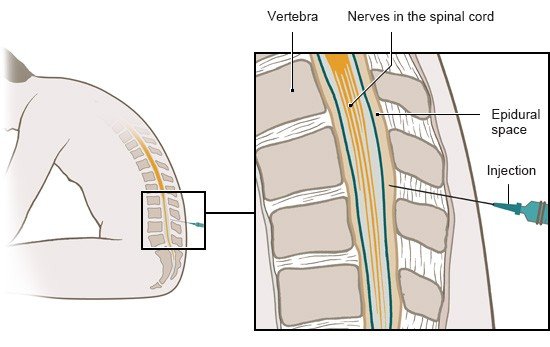
  • In lumbar epidural analgesia, the medication is injected into what is known as the epidural space (“epidural injection”). The epidural space surrounds the spinal cord and the spinal fluid in the spinal canal. This is also where the nerve roots are located. The doctor uses (CT) or x-ray imaging to see where the medication needs to be injected.
Die Grafik zeigt, wie eine wirbelsäulennahe Kortisonspritze in den Epiduralraum gesetzt wird.

It isn’t clear whether epidural injections help. They may have side effects such as bleeding, and nerve damage.

What medical aids (“Hilfsmittel”) are available?

In Germany, doctors can prescribe medical aids ("Hilfsmittel") to make it easier for someone with a specific condition to cope with day-to-day life. Examples of these medical aids include gadgets to help you put on your socks, tights, or trousers. There are also walking aids like frames that give you something to rest your weight on or sit down on if you’ve been walking a while and need a rest. Public health insurers cover the costs of these aids apart from a fixed co-payment which you pay yourself. But insurers will only cover those costs if the aid was prescribed by a doctor and if it’s an approved device.

Sometimes the doctor will prescribe a brace with the aim of aligning the spine and pelvis properly to stop you from overarching your spine. Different doctors may disagree about the use of braces. Whatever the case, you definitely shouldn’t wear one for a long period or all the time. They can cause the muscles that stabilize your upper body to weaken, making the symptoms worse. Braces need to be prescribed by a doctor. Then the public health insurer will usually review your case to see whether they can cover the costs.

When can cognitive behavioral therapy (CBT) help?

If you’ve tried various treatments but the symptoms continue for a long time and are causing you a lot of distress, it might be a good idea to take a look at how you deal with the pain. How we perceive pain and how well we cope with it is influenced by many factors, including our mind. So it can be useful to recognize unfavorable ways of thinking or behaving and try to change them. Behavioral therapy can be worth a try if the pain is permanent or lasts a long time. You can combine it with other treatments too. It can also help you understand chronic pain better so you know how to cope with it in your day-to-day life.

What is multimodal pain management?

Multimodal pain management is provided by specialists from various areas of expertise, such as doctors, physical therapists and psychologists. They help you keep active and cope with your symptoms. A multimodal approach can be a particularly good idea if you’ve had symptoms for a long time.

Which treatment is best for me?

Which treatment is best for you personally depends on various factors, including how bad your symptoms are, any other health problems you have, what you want and what benefit you expect to get.

Generally speaking, there is no good-quality research on any of the above treatment options. In particular, there’s a lack of comparative research. So it makes sense to talk to a doctor about which treatment is right for you. You might also discuss which treatments you could combine. The approach you take will depend on your symptoms and your general health.

For people who’ve had spinal stenosis symptoms for a long time and haven’t gotten any relief from non-surgical treatment, surgery may be an option. This involves expanding the spinal canal to reduce the pressure on the nerves. But research hasn’t proven whether surgery provides more relief than conservative treatment. So, if your doctor recommends surgery, it’s a good idea to get a second medical opinion before making a decision.

If you can’t move your legs properly or your bladder/bowel stops working properly, you should see a doctor immediately. Bladder/bowel dysfunctions are a sign of a condition called “cauda equina syndrome,” which occurs when nerve roots in the lower spine (lumbar region) are squashed for a long time. This is a rare condition but it requires priority emergency treatment.

Ammendolia C, Hofkirchner C, Plener J et al. Non-operative treatment for lumbar spinal stenosis with neurogenic claudication: an updated systematic review. BMJ Open 2022; 12(1): e057724.

Atlas SJ, Delitto A. Spinal stenosis: surgical versus nonsurgical treatment. Clin Orthop Relat Res 2006; 443: 198-207.

Deutsche Gesellschaft für Neurologie (DGN). Leitlinien für Diagnostik und Therapie in der Neurologie: Lumbale Radikulopathie (S2k-Leitlinie). AWMF register no.: 030-058. 2018.

Deutsche Gesellschaft für Orthopädie und Orthopädische Chirurgie (DGOOC). Spezifischer Kreuzschmerz (S2k-Leitlinie, in Überarbeitung). AWMF register no.: 187-059. 2017.

Kalff R, Ewald C, Waschke A et al. Degenerative lumbar spinal stenosis in older people: current treatment options [Degenerative lumbale Spinalkanalstenose im höheren Lebensalter: Aktuelle Behandlungsoptionen]. Dtsch Arztebl 2013; 110(37): 613-624.

Katz JN, Zimmerman ZE, Mass H et al. Diagnosis and Management of Lumbar Spinal Stenosis: A Review. JAMA 2022; 327(17): 1688-1699.

Klein C. Orthopädie für Patienten: Medizin verstehen. Remagen: Michels-Klein; 2014.

Lurie J, Tomkins-Lane C. Management of lumbar spinal stenosis. BMJ 2016; 352: h6234.

North American Spine Society. Diagnosis and treatment of degenerative lumbar spinal stenosis. 2011.

Onakpoya IJ, Thomas ET, Lee JJ et al. Benefits and harms of pregabalin in the management of neuropathic pain: a rapid review and meta-analysis of randomised clinical trials. BMJ Open 2019; 9(1): e023600.

Thomé C, Börm W, Meyer F. Degenerative lumbar spinal stenosis: current strategies in diagnosis and treatment. Dtsch Arztebl Int 2008; 105(20): 373-379.

Van der Gaag WH, Roelofs PD, Enthoven WT et al. Non-steroidal anti-inflammatory drugs for acute low back pain. Cochrane Database Syst Rev 2020; (4): CD013581.

Wagner CJ, Lindena G, Ayyad G et al. Weniger Operationen und Kosten wegen Rückenschmerzen in einem Versorgungsprogramm mit interdisziplinärem Zweitmeinungsverfahren. Schmerz 2022 [Epub ahead of print].

IQWiG health information is written with the aim of helping people understand the advantages and disadvantages of the main treatment options and health care services.

Because IQWiG is a German institute, some of the information provided here is specific to the German health care system. The suitability of any of the described options in an individual case can be determined by talking to a doctor. informedhealth.org can provide support for talks with doctors and other medical professionals, but cannot replace them. We do not offer individual consultations.

Our information is based on the results of good-quality studies. It is written by a team of health care professionals, scientists and editors, and reviewed by external experts. You can find a detailed description of how our health information is produced and updated in our methods.

Comment on this page

What would you like to share with us?

We welcome any feedback and ideas - either via our form or by gi-kontakt@iqwig.de. We will review, but not publish, your ratings and comments. Your information will of course be treated confidentially. Fields marked with an asterisk (*) are required fields.

Please note that we do not provide individual advice on matters of health. You can read about where to find help and support in Germany in our information “How can I find self-help groups and information centers?

Über diese Seite

Created on February 3, 2026

Next planned update: 2029

Publisher:

Institute for Quality and Efficiency in Health Care (IQWiG, Germany)

Stay informed

Subscribe to our newsletter or newsfeed. You can find our growing collection of films on YouTube.