
Low back pain: When should you see a doctor?
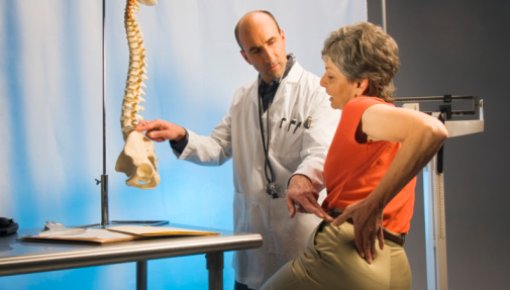
Photo of doctor and a patient holding her lower back in pain

Low back pain can be quite distressing, but is generally harmless. Only rarely is it caused by a serious problem such as pinched nerves or an . Certain symptoms could be signs of a more serious cause.

If you notice any of these signs together with back pain, it's important to see a doctor.

One serious complication of a slipped disc, for example, is known as cauda equina syndrome. Here, a group of nerves in the lower back are compressed (squeezed together) so much that it could lead to permanent nerve damage. To stop that from happening, emergency surgery is needed. You should also seek medical advice if there are any signs of an or tumor.

What symptoms could be signs of a serious problem?

If you have one or more of the following symptoms, you should have them checked out by a doctor:

  • Pain that spreads down to below your knee or into a foot and is accompanied by numbness, tingling or muscle weakness: These are typical symptoms of sciatica (a problem with the sciatic nerve), usually caused by a slipped disc. But they can also be a sign of cauda equina syndrome. If the symptoms are severe – and particularly if there are signs of leg paralysis – you should see a doctor immediately.
  • Problems urinating (peeing) or passing stool (pooping): Other possible signs of cauda equina syndrome include trouble noticing that your bladder is full, no longer clearly feeling the urge to pee when your bladder is full, a reduced ability to feel your bladder emptying when you pee, or not being able to voluntarily stop peeing mid-flow. Problems with the sphincter muscle, leading to trouble passing stools (pooping) or holding them in, can also be a sign of nerve damage.
  • Numbness in the buttocks or genital area, or around the anus: These could be signs of cauda equina syndrome, too. You may notice numbness around the anus when wiping yourself after going to the toilet, for example.
  • Fever, chills or night sweats: These could be signs of an in the spine.
  • Unexplained weight loss and physical weakness (particularly with a history of cancer): These are possible signs of a tumor. Tumors in the spine are usually metastatic tumors that have developed from a previous cancer tumor (in the breast or prostate gland, for instance). Physical weakness can also be a sign of .
  • Low back pain after an accident. If your back hurts after a road accident or sports accident, or after falling from a great height, you may have a bone fracture. The bones of older people with low bone density (osteoporosis) are more fragile. They might fracture a back bone simply by stumbling and falling while walking, lifting a heavy object the wrong way or twisting their spine awkwardly.

These are only possible signs of a serious problem and don't necessarily mean that you have one. It is important to see a doctor for a proper assessment.

What happens next?

The doctor will assess your symptoms, taking into account various aspects such as

  • Your age
  • Your biological sex
  • Previous illnesses
  • Whether you're taking medication (for example, long-term treatment with steroids)
  • Previous treatments (like injections or operations)

The doctor will also examine your back and, for example, feel your spine, stretch your sciatic nerve and check the reflexes in your knees and feet.

A serious illness can usually be ruled out through the questions you answer, your description of the symptoms, and the physical examination. Depending on your individual situation, the doctor may arrange for further examinations. For example, if they think you might need urgent treatment or have a serious medical condition, you might have an x-ray, (MRI) scan or blood tests.

How often is back pain a sign of something serious?

Research has shown that back pain is rarely dangerous: It is only caused by a serious medical problem in less than 1% of people who go to their family doctor because of the pain. In most of these more serious cases, the problem is a fractured spine due to osteoporosis. Even in the emergency room, less than 5% of people with back pain have a condition that needs urgent treatment.

Cauda equina syndrome is very rare: It occurs in less than 3 out of 100,000 adults each year.

Barraclough K. Cauda equina syndrome. BMJ 2021; 372: n32.

Bundesärztekammer (BÄK), Kassenärztliche Bundesvereinigung (KBV), Arbeitsgemeinschaft der Wissenschaftlichen Medizinischen Fachgesellschaften (AWMF). Nationale Versorgungsleitlinie Nicht-spezifischer Kreuzschmerz (in Überarbeitung). AWMF register no.: nvl-007. 2017.

Casser HR, Seddigh S, Rauschmann M. Acute Lumbar Back Pain. Dtsch Arztebl Int 2016; 113(13): 223-234.

Galliker G, Scherer DE, Trippolini MA et al. Low Back Pain in the Emergency Department: Prevalence of Serious Spinal Pathologies and Diagnostic Accuracy of Red Flags. Am J Med 2020; 133(1): 60-72.e14.

Henschke N, Maher CG, Refshauge KM et al. Prevalence of and screening for serious spinal pathology in patients presenting to primary care settings with acute low back pain. Arthritis Rheum 2009; 60(10): 3072-3080.

IQWiG health information is written with the aim of helping people understand the advantages and disadvantages of the main treatment options and health care services.

Because IQWiG is a German institute, some of the information provided here is specific to the German health care system. The suitability of any of the described options in an individual case can be determined by talking to a doctor. informedhealth.org can provide support for talks with doctors and other medical professionals, but cannot replace them. We do not offer individual consultations.

Our information is based on the results of good-quality studies. It is written by a team of health care professionals, scientists and editors, and reviewed by external experts. You can find a detailed description of how our health information is produced and updated in our methods.

Comment on this page

What would you like to share with us?

We welcome any feedback and ideas - either via our form or by gi-kontakt@iqwig.de. We will review, but not publish, your ratings and comments. Your information will of course be treated confidentially. Fields marked with an asterisk (*) are required fields.

Please note that we do not provide individual advice on matters of health. You can read about where to find help and support in Germany in our information “How can I find self-help groups and information centers?

Über diese Seite

Updated on December 16, 2025

Next planned update: 2028

Publisher:

Institute for Quality and Efficiency in Health Care (IQWiG, Germany)

Stay informed

Subscribe to our newsletter or newsfeed. You can find our growing collection of films on YouTube.