Epidurals and other medications to relieve labor pain

Photo of a woman in labor sitting in a hospital room

Many pregnant women wonder how they will cope with labor pain. Some would like to avoid medication if possible. Others feel reassured knowing that they could use it if necessary. The medication-based pain-relief options include epidurals and opioids.

When dealing with labor pain, being reassured and supported by a partner or other trusted person can already help a lot. Other things that can help include moving around and changing positions, as well as strategies like controlling your breathing, applying heat or doing relaxation exercises.

Please note that some of the following information describes the situation in Germany specifically. You may find that things are different in other countries.

Women who have their baby in a hospital can be given medication that relieves the pain while still allowing them to stay awake and experience the birth. Epidurals are the most commonly used form of medication-based pain relief in childbirth. Other medications are available too, though, including opioids. But they aren't used as much.

Pain relief during childbirth: What can help?

When deciding whether or not to try a specific pain management approach or medication, it's a good idea to find out more about the different options first. This decision aid can help here.

What is an epidural?

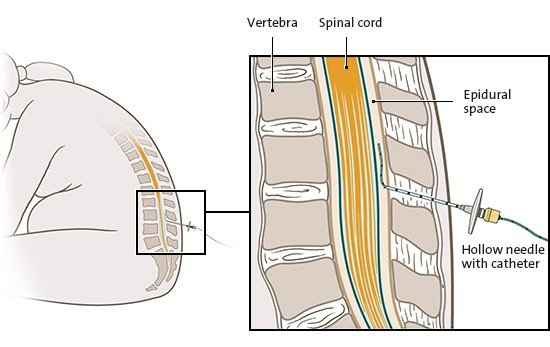
An epidural involves delivering medications through a thin tube () into an area in the lower spine called the epidural space. The medications are usually a combination of a local anesthetic and a painkiller (opioid).

The epidural space surrounds the spinal cord. The medication numbs the spinal nerves to stop them sending pain signals from the lower belly area to the brain.

The pain-relieving effect is typically felt about 10 to 20 minutes later. Once the epidural has started working, you feel no pain – or hardly any pain – in your lower belly area. But you’re still awake and fully aware of what’s happening during the birth.

The simplified anatomical illustration shows how an epidural is done and where it goes (detailed view on the right)

How is the epidural given?

You can have an epidural in one of two different positions: Either you bend forward with your back as round as possible, in a seated position, or you can lie on your side. First, your lower back is disinfected and numbed with a local anesthetic. Then the doctor inserts a hollow needle between two bones in the lower spine, into the epidural space.

A (thin tube) is then pushed through the needle into the epidural space. Then the needle is removed and the is taped to your back so it doesn’t slip and you can move about as freely as possible. The stays in place throughout the birth and the medical team carefully remove it afterwards.

There is a small pump attached to the . It supplies small amounts of the medication to the spinal cord area. The dose of the medication is usually increased gradually to avoid injecting too much at once. Sometimes there's a patient-controlled pump. This means that you can give yourself more medication if the pain gets worse.

As a precaution, your blood pressure and pulse are monitored too. A CTG device measures your baby’s heartbeat and your contractions. Women in labor are often given fluids through a drip to stabilize their blood pressure. These fluids enter the vein through a small tube (cannula) that is inserted into the back of their hand or lower arm. If your blood pressure does drop, the medical team can use the cannula to quickly give you medication to help.

Epidurals can be given at almost any time during the birth – even when the cervix has already fully opened. There are a few situations where it's difficult or not possible to give an epidural. One example is if the contractions are so frequent (just before the baby is born) that you have trouble sitting still for long enough. Then the medical team might recommend also using medication to reduce the contractions, or not having an epidural.

Good to know:

It is often possible to go to the hospital for a pre-admission consultation before the birth, where you can discuss the pros and cons of having an epidural. Doing that doesn’t mean you have to have an epidural when the time comes. But it can save time if you decide to have one during the birth.

How effective are epidurals?

Epidurals are very effective and relieve labor pain better than other medications do. Most women who have an epidural feel little or no pain. Research has found that about 75 out of 100 women who had an epidural were very satisfied with the pain relief. Only 1 out of 100 women who had an epidural needed additional painkillers during labor.

What are the side effects of epidurals?

An anesthetist will explain things in detail before you’re given the epidural. Common (but usually temporary) side effects of epidurals are:

  • Drowsiness: About 55 out of 100 women feel drowsy and tired.
  • Trouble peeing: About 18 out of 100 women have trouble peeing because of the numbness in their lower body. A is then sometimes used to let the pee flow out of the bladder.
  • Nausea and vomiting: Around 16 out of 100 women feel sick or have to vomit.
  • Low blood pressure: In about 16 out of 100 women, the epidural causes their blood pressure to drop. Low blood pressure can make you feel dizzy or sick. The doctor can give the woman a drip and medication to help with this.
  • Fever: Around 13 out of 100 women develop a fever due to the epidural. When this happens, the medical team keeps a particularly close eye on the baby for the first few days after the birth. This involves doing things like blood tests and checking the baby's body temperature.
  • Itching: About 3 out of 100 women experience this side effect.
  • Trouble breathing: About 2 out of 100 women are given oxygen through a mask because their breathing slows down.

In rare cases, the epidural needle is inserted too deep and damages the outer protective layer of the spinal cord. Then cerebrospinal fluid may leak out (a liquid that surrounds and protects the spinal cord). The leak can lead to a severe headache that usually goes away after a few days.

Some women are worried that epidurals might cause long-lasting back pain. But research shows that back pain isn't more common in women who had an epidural than it is in women who used other medication for labor pain. Permanent damage from injuries to the spine or infections from the procedure are extremely rare.

Some women can’t have an epidural – for instance, because they're allergic to the medication or have a blood-clotting problem. Then other types of pain management may be more suitable.

How does the epidural affect the baby?

Any medication that a woman is given during labor enters the child’s body as well, through the umbilical cord. This includes the local anesthetic and pain-relief drugs (opioids) used for epidurals. But epidurals haven't been shown to have any special risks or long-term negative effects for the child.

If there are opioids in the epidural, they might affect the baby’s breathing. But this risk is much lower with an epidural than if the woman has opioids injected into a muscle or vein. If there are any breathing problems, they can be treated with medication.

How does the epidural affect how the birth goes and how long it takes?

An epidural can influence:

  • The length of the birth: Women who’ve had an epidural take slightly longer to give birth on average.
  • The urge to push: Many women don't feel when or how they should push because of the epidural. When that happens, the midwife or doctor has to tell them what to do.

Epidurals do not increase the chances of needing a Cesarean section. C-sections are just as common in women who’ve had an epidural as they are in women who’ve been given an opioid injection into a muscle or vein. If you end up needing a C-section, though, the epidural can simply be used with a higher dose of medication. That way, you don’t usually need any extra anesthesia.

Can you walk around if you have an epidural?

If the epidural is set up well, you can stand up and walk around. When you’re preparing for the birth, you can ask your hospital if they do “walking epidurals.” But your legs might feel numb and weak, depending on the dose used. So you could feel a little unsteady on your feet or not be able to get up at all for a while. If that happens, you may not be able to get into certain positions or you might need help to do so. In addition to the epidural, you’ll be given a drip and CTG monitoring. These can affect your ability to move around too.

If a Cesarean section is needed, the epidural dose is increased. Then the entire lower half of your body is completely numb and you can’t move your legs for some time.

How are opioids used for labor pain?

Opioids are strong painkillers. They can be injected into a muscle (typically in the buttocks) or delivered into a vein through a thin tube. There are various types of opioids with different effects. Some start working faster than others, some last longer, and some are stronger. You can talk to your doctor about what options are available.

Some women are given a PCA (patient-controlled analgesia) pump that allows them to give themselves a dose if needed. If you have one of these pumps, you'll also have CTG monitoring to measure your baby’s heartbeat and your contractions. The medical team will attach a small sensor to one of your fingers as well, to check whether there’s enough oxygen in your blood.

Most women can have opioids that are injected into a muscle or vein, but sometimes that’s not possible for health reasons. Opioids can be a good alternative if a woman can’t have an epidural or doesn’t want one.

How well do opioids relieve labor pain?

Opioids do relieve the pain, but not as effectively as epidurals do. Research shows that 50 out of 100 women are very satisfied with the pain relief from opioids.

What are the side effects of opioids?

Opioids can have the following, temporary side effects:

  • Drowsiness: About 55 out of 100 women feel drowsy and tired after using opioids.
  • Nausea and vomiting: Around 25 out of 100 women feel sick or have to vomit.
  • Trouble breathing: About 7 out of 100 women are given oxygen through a mask or medication because their breathing slows down.
  • Fever: About 5 out of 100 women develop a fever.
  • Itching: This occurs in about 3 out of 100 women.
  • Low blood pressure: In about 1 out of 100 women, there's a drop in blood pressure.

How do opioids affect the baby?

If a woman receives opioids during labor, it can affect her newborn baby’s breathing – especially when higher doses are used. Then the baby may be given a drug called an opioid antagonist to improve their breathing.

How else can labor pain be managed?

Spinal anesthesia

Spinal anesthesia (also known as a spinal block) works in a similar way to epidurals, but the medication is injected even closer to the spinal cord – into an area called the subarachnoid space. This causes the entire lower half of the body to feel numb. Unlike an epidural, no is used, so medication can't be added later.

Spinal anesthesia has a faster effect than an epidural. For this reason, it's used if a Cesarean section needs to be done after the birth process has begun but it's too late to start an epidural.

It is also possible to combine spinal anesthesia and an epidural. Then the pain relief is a little faster than if the epidural is used on its own. This combination is more likely to cause itching and nausea, though.

Pudendal nerve block

A pudendal nerve block can be done during the last phase of labor. This involves injecting a numbing medication into tissue in the vagina and the perineum (between the vagina and the anus). But this is usually only done if the birth isn't progressing properly, and the child needs to be delivered with the help of a suction cup or forceps.

"Gas and air"

Here you breathe in gas and air (nitrous oxide and oxygen) through a mask. The main effect is that it makes you feel less scared. The actual pain relief isn’t as reliable as with the other medications. One advantage, though, is that you can regulate how much of it you breathe in. Gas and air starts working quickly, but it also wears off quickly.

It may cause nausea, vomiting, drowsiness and dizziness. If the dose isn’t too high, it doesn’t seem to have any negative effects on the birth process and the baby.

Anim-Somuah M, Smyth RM, Cyna AM et al. Epidural versus non-epidural or no analgesia for pain management in labour. Cochrane Database Syst Rev 2018; (5): CD000331.

Deutsche Gesellschaft für Anästhesiologie und Intensivmedizin (DGAI), Deutsche Gesellschaft für Gynäkologie und Geburtshilfe (DGGG). S1-Leitlinie Die geburtshilfliche Analgesie und Anasthäsie. AWMF register no.: 001-038 (under revision). 2020.

Deutsche Gesellschaft für Gynäkologie und Geburtshilfe (DGGG), Deutsche Gesellschaft für Hebammenwissenschaft (DGHW). Die vaginale Geburt am Termin (S3-Leitlinie) (in Überarbeitung). AWMF register no.: 015-083. 2020.

Grangier L, Martinez de Tejada B, Savoldelli GL et al. Adverse side effects and route of administration of opioids in combined spinal-epidural analgesia for labour: a meta-analysis of randomised trials. Int J Obstet Anesth 2020; 41: 83-103.

Pschyrembel online. Periduralanästhesie. 2025.

Smith LA, Burns E, Cuthbert A. Parenteral opioids for maternal pain management in labour. Cochrane Database Syst Rev 2018; (6): CD007396.

Tan HS, Zeng Y, Qi Y et al. Automated mandatory bolus versus basal infusion for maintenance of epidural analgesia in labour. Cochrane Database Syst Rev 2023; (6): CD011344.

Zhang P, Yu Z, Zhai M et al. Effect and Safety of Remifentanil Patient-Controlled Analgesia Compared with Epidural Analgesia in Labor: An Updated Meta-Analysis of Randomized Controlled Trials. Gynecol Obstet Invest 2021; 86(3): 231-238.

IQWiG health information is written with the aim of helping people understand the advantages and disadvantages of the main treatment options and health care services.

Because IQWiG is a German institute, some of the information provided here is specific to the German health care system. The suitability of any of the described options in an individual case can be determined by talking to a doctor. informedhealth.org can provide support for talks with doctors and other medical professionals, but cannot replace them. We do not offer individual consultations.

Our information is based on the results of good-quality studies. It is written by a team of health care professionals, scientists and editors, and reviewed by external experts. You can find a detailed description of how our health information is produced and updated in our methods.


Comment on this page

What would you like to share with us?

We welcome any feedback and ideas - either via our form or by gi-kontakt@iqwig.de. We will review, but not publish, your ratings and comments. Your information will of course be treated confidentially. Fields marked with an asterisk (*) are required fields.

Please note that we do not provide individual advice on matters of health. You can read about where to find help and support in Germany in our information “How can I find self-help groups and information centers?”

Über diese Seite

Updated on September 14, 2026

Next planned update: 2029

Publisher:

Institute for Quality and Efficiency in Health Care (IQWiG, Germany)

Stay informed

Subscribe to our newsletter or newsfeed. You can find our growing collection of films on YouTube.