How do the parathyroid glands work?

The parathyroid glands make a hormone called parathyroid hormone, which ensures that you always have the right amount of in your blood. Calcium isn't only important for your bones. It also affects how your blood clots and how your nerves work. So it's important that there's not too little or too much in the blood. That's why the parathyroid glands are considered to be vital organs.

Humans have four parathyroid glands. The medical term for these glands is "glandulae parathyroideae."

Where are the parathyroid glands?

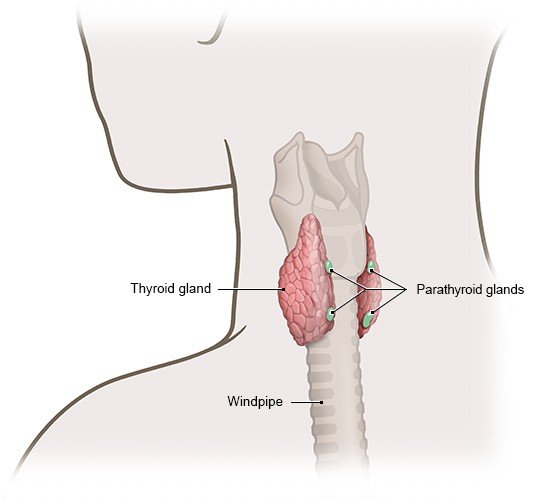
Each of the four parathyroid glands is about the size of a pea. They are found at the back of the thyroid gland: two in the upper part and two in the lower part. The voice box and windpipe are near to the parathyroid glands, and so are blood vessels and important nerves – including the nerve that supplies the voice box.

The anatomical illustration shows the four parathyroid glands, each of which is about the size of a pea. They are found behind the thyroid gland.

Why do the parathyroid glands make parathyroid hormone?

Parathyroid hormone makes sure that there is always enough in the blood. It does this in two main ways:

  • Calcium is stored in bones as a building block. If there's too little in the blood, parathyroid hormone causes the bones to release .
  • If levels are too low, parathyroid hormone stops from leaving your body in your urine (pee). Instead, the is “re-absorbed” from the urine and then it goes back into your bloodstream.

Parathyroid hormone also affects the level of phosphate in your blood. Like , phosphate is a type of mineral that is important for your bone metabolism. Its jobs include regulating energy levels and activating enzymes. If there's too much phosphate in your blood, parathyroid hormone 'tells' your kidneys to get rid of phosphate by dumping it into your urine.

Parathyroid hormone also causes the bowel to absorb more and phosphate – but only indirectly: Your body needs vitamin D to absorb these minerals, and parathyroid hormone tells your kidneys to make more vitamin D.

How is the production of parathyroid hormone regulated in the parathyroid glands?

The amount of parathyroid hormone made by the parathyroid glands depends on the amount of in the blood. The parathyroid glands have a good blood supply, and their cells constantly monitor the level of in the blood. If it starts to drop, the parathyroid glands make more parathyroid hormone. As a result, the bones release more , and the kidneys get rid of less . This causes the level of in the blood to rise again. As soon as levels return to normal, the parathyroid glands make normal amounts of parathyroid hormone again. If the levels continue to rise, the parathyroid glands make less parathyroid hormone.

To make sure that you always have exactly the right amounts of and phosphate in your blood, the levels of parathyroid hormone, vitamin D and calcitonin (another hormone) react to each other in a finely tuned way. Made in the thyroid gland, calcitonin does the opposite of what parathyroid hormone does: If there's a lot of in the blood, it reduces the breakdown of bone tissue so that less is released from the bones into the bloodstream. Calcitonin also causes the kidneys to get rid of more by dumping it into your urine.

Brandes R, Lang F, Schmidt R. Physiologie des Menschen: mit Pathophysiologie. Berlin: Springer; 2019.

Lippert H. Lehrbuch Anatomie. Munich: Urban und Fischer; 2017.

Loscalzo J, Kasper DL, Longo DL et al. Harrison's Principles of Internal Medicine (Vol. 1 & Vol. 2). New York: McGraw-Hill; 2022.

Menche N. Biologie Anatomie Physiologie. Munich: Urban und Fischer; 2023.

Pschyrembel Online. 2025.

IQWiG health information is written with the aim of helping people understand the advantages and disadvantages of the main treatment options and health care services.

Because IQWiG is a German institute, some of the information provided here is specific to the German health care system. The suitability of any of the described options in an individual case can be determined by talking to a doctor. informedhealth.org can provide support for talks with doctors and other medical professionals, but cannot replace them. We do not offer individual consultations.

Our information is based on the results of good-quality studies. It is written by a team of health care professionals, scientists and editors, and reviewed by external experts. You can find a detailed description of how our health information is produced and updated in our methods.

Comment on this page

What would you like to share with us?

We welcome any feedback and ideas - either via our form or by gi-kontakt@iqwig.de. We will review, but not publish, your ratings and comments. Your information will of course be treated confidentially. Fields marked with an asterisk (*) are required fields.

Please note that we do not provide individual advice on matters of health. You can read about where to find help and support in Germany in our information “How can I find self-help groups and information centers?

Über diese Seite

Created on July 23, 2026

Next planned update: 2029

Publisher:

Institute for Quality and Efficiency in Health Care (IQWiG, Germany)

Stay informed

Subscribe to our newsletter or newsfeed. You can find our growing collection of films on YouTube.