
Surgery for diverticulitis and diverticular disease

Photo of a woman at a doctor's appointment

Bowel surgery can sometimes relieve long-term symptoms caused by diverticula – but there are risks involved. Surgery is needed in some cases, though, to avoid serious diverticulitis-related complications such as an intestinal perforation (a hole in the wall of the bowel).

Diverticula are small pouches in the wall of the bowel, in which stool (poop) can get stuck. They are often harmless and do not cause any problems. If they do cause symptoms, they can usually be treated without surgery.

In non-emergency situations, it’s important to carefully consider the pros and cons of bowel surgery for diverticula-related problems before making a decision. This surgery is associated with risks, and there’s no guarantee that it will make the symptoms go away. Whether or not surgery is considered will depend on various factors, including the severity of the symptoms, how long you have had them, the risk of complications, and how effective other measures have been.
Good to know:

If diverticula lead to recurring or ongoing problems, various things can help – such as a change in diet or medication. You can read more about that in the article "Diverticular disease: How are chronic symptoms treated?"

Sometimes different doctors give different advice. Finding out as much as you can about the pros and cons of the treatment options, and getting a second opinion if you are unsure, can help you to make a decision.

When is surgery considered for acute diverticulitis?

Surgery usually isn’t necessary in people who currently have inflamed or infected diverticula (acute diverticulitis). But there are some exceptions. If abscesses (collections of pus) have formed, and treatment with isn’t successful, surgery is unavoidable. The aim is then to prevent serious complications such as a perforation (hole) in the wall of the bowel, which can lead to an inflammation of the membrane that surrounds the organs in your belly (peritonitis) and sepsis (blood poisoning).

Even if diverticulitis has been successfully treated with antibiotics, surgery may help to prevent further episodes. This is because about half of all people who have had a larger abscess develop diverticulitis again within a few years – sometimes with serious complications. Surgery is possible about six weeks after the end of the treatment.

Whether or not surgery is a good idea will also depend on whether you have other medical conditions. For example, people who have a weakened immune system or chronic kidney disease are at higher risk of serious diverticulitis-related complications.

When is surgery considered for chronic diverticular disease?

Sometimes recurrent can lead to the formation of fistulas (tunnel-like passageways between two organs) or narrowing of the bowel (intestinal stenosis). Fistulas increase the risk of complications, so surgery to remove them is generally recommended if they arise. Surgery may be recommended for stenosis too, depending on how narrow the bowel has become.

In every other situation, the main aim of treatment is to relieve symptoms in everyday life, such as abdominal pain and digestive problems.

In people who have recurrent diverticulitis that causes ongoing problems, surgery can relieve the symptoms and reduce the risk of further episodes. This is what research in this area suggests. But the surgery hardly affects the risk of diverticulitis-related complications. The reason for this: Research has shown that the risk of complications is highest the first time you have diverticulitis. It is a lot lower when you have further episodes. After the fifth episode, it is less than 1%.

It is not clear what pros and cons surgery has in people who have symptomatic uncomplicated diverticular disease (SUDD). Because of this, surgery is not recommended here. SUDD is characterized by ongoing or recurrent symptoms such as pain, bloating and irregular bowel movements (poop).

What happens during the surgery?

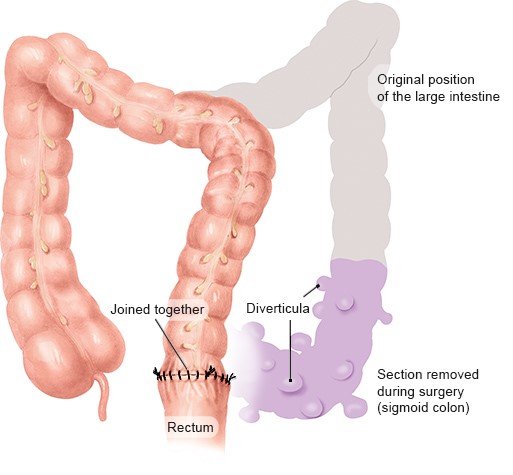
The most common type of surgery for diverticular disease is called sigmoid resection (sigmoidectomy). The sigmoid colon is the section of the large intestine that comes just before the , at the end of the bowel. This is the section where the strain of going to the toilet puts the most pressure on the wall of the bowel, so the most diverticula occur there. The surgery involves removing the sigmoid colon and a small area of the . After that, the ends of the bowel are sewn back together again. Because diverticula can also occur in other parts of the bowel, it’s usually not possible to remove all of them.

The surgery is generally done through small cuts in the wall of the belly (laparoscopy). But it is sometimes done through a larger cut in the belly (open surgery).

The bowel has to be completely empty before the procedure. To empty it, you have to drink about 1 liter of a laxative solution and 2 to 3 liters of water the day before surgery. People can have an enema too, which is where liquid is put into the to help cleanse and empty the bowel. This is important so that no stool gets into the abdominal cavity during surgery.

The simplified anatomical illustration shows a sigmoid resection, the most common type of surgery for chronic diverticular disease

What are the possible risks of surgery?

There’s a risk of injury to the bowel or nearby organs during surgery. The surgery may also lead to scarring in the abdominal cavity, which can cause pain or digestive problems.

Another possible risk is known as an anastomotic leak. This is where stitches that were used to sew the two ends of the bowel together come undone again soon after surgery. Bowel contents may then leak into the abdominal cavity, leading to dangerous infections there. Anastomotic leaks occur in about 3 out of 100 people who have this surgery.

Out of every 100 operations, about

  • 2 abscesses,
  • 4 wound infections and
  • 3 episodes of major bleeding

occur too.

And there are the general risks associated with surgery, such as anesthetic-related problems, pneumonia or thrombosis.

What does surgery for peritonitis involve?

Complicated diverticulitis might lead to peritonitis. This is an of the inner lining of the abdominal cavity (space inside the belly). Pus might then spread inside the cavity, which can result in sepsis (blood poisoning). This is a medical emergency requiring urgent surgery.

To treat peritonitis, the surgeon first rinses out the abdominal cavity and creates a temporary bowel opening (stoma) in the abdominal wall. It usually takes several months for the peritonitis to go away completely. Only then can surgeons do a sigmoid resection. The temporary bowel opening can then be closed again.

Balk EM, Adam GP, Cao W et al. Management of Colonic Diverticulitis. (AHRQ Comparative Effectiveness Reviews; No. 233). 2020.

Fowler H, Gachabayov M, Vimalachandran D et al. Failure of nonoperative management in patients with acute diverticulitis complicated by abscess: a systematic review. Int J Colorectal Dis 2021; 36(7): 1367-1383.

Haas JM, Singh M, Vakil N. Mortality and complications following surgery for diverticulitis: Systematic review and meta-analysis. United European Gastroenterol J 2016; 4(5): 706-713.

Kertzman BA, Amelung FJ, Bolkenstein HE et al. Does surgery improve quality of life in patients with ongoing- or recurrent diverticulitis; a systematic review and meta-analysis. Scand J Gastroenterol 2024; 59(7): 770-780.

Leifeld L, Germer CT, Bohm S et al. S3-Leitlinie Divertikelkrankheit / Divertikulitis. Gemeinsame Leitlinie der Deutschen Gesellschaft für Gastroenterologie, Verdauungs- und Stoffwechselkrankheiten (DGVS) und der Deutschen Gesellschaft für Allgemein- und Viszeralchirurgie (DGAV). AWMF register no.: 021-020. 2021.

Morris AM, Regenbogen SE, Hardiman KM et al. Sigmoid diverticulitis: a systematic review. JAMA 2014; 311(3): 287-297.

IQWiG health information is written with the aim of helping people understand the advantages and disadvantages of the main treatment options and health care services.

Because IQWiG is a German institute, some of the information provided here is specific to the German health care system. The suitability of any of the described options in an individual case can be determined by talking to a doctor. informedhealth.org can provide support for talks with doctors and other medical professionals, but cannot replace them. We do not offer individual consultations.

Our information is based on the results of good-quality studies. It is written by a team of health care professionals, scientists and editors, and reviewed by external experts. You can find a detailed description of how our health information is produced and updated in our methods.

Comment on this page

What would you like to share with us?

We welcome any feedback and ideas - either via our form or by gi-kontakt@iqwig.de. We will review, but not publish, your ratings and comments. Your information will of course be treated confidentially. Fields marked with an asterisk (*) are required fields.

Please note that we do not provide individual advice on matters of health. You can read about where to find help and support in Germany in our information “How can I find self-help groups and information centers?

Über diese Seite

Updated on February 9, 2026

Next planned update: 2029

Publisher:

Institute for Quality and Efficiency in Health Care (IQWiG, Germany)

Stay informed

Subscribe to our newsletter or newsfeed. You can find our growing collection of films on YouTube.