
Diverticular disease and diverticulitis

At a glance

  • Diverticula are small pouches in the wall of the bowel where stool (poop) can get stuck.
  • Diverticular disease can cause symptoms such as pain in the lower abdomen (belly) and problems with digestion.
  • In diverticulitis, the diverticula are inflamed or infected.
  • The symptoms can usually be treated effectively.
  • If the inflammation or infection spreads, complications may arise.

Introduction

Photo of a man lying on a sofa holding his belly in pain

Symptoms like pain in the lower abdomen, flatulence, constipation and diarrhea may be caused by diverticula. Diverticula are pouches in the lining of the bowel (intestine). They arise when the wall of the bowel bulges out through weak areas of bowel muscle. The pouches are usually small and balloon-like, and the contents of the bowel (stool, or “poop”) might get into them. Diverticula are often harmless, but can lead to pain and other symptoms in the bowel or become infected.

Simply put, there are three different forms:

  • Diverticulosis: You have diverticula, but no symptoms.
  • Diverticular disease: This general term is used when the diverticula cause symptoms or complications. If the symptoms never really go away or keep coming back, it is considered to be chronic diverticular disease.
  • Diverticulitis: The diverticula are inflamed or infected. This can lead to acute symptoms or chronic diverticular disease. If diverticulitis results in a collection of pus (an abscess), it's considered to be complicated diverticulitis. If not, it's known as uncomplicated diverticulitis.

Diverticulitis can usually be treated effectively, but may have serious consequences if an spreads.

Symptoms

Most diverticula don’t cause any symptoms. Diverticular disease is typically associated with pain in the lower left part of the abdomen (belly) or – less commonly – the lower right part. It can also lead to bloating, constipation or diarrhea. The symptoms often come and go, but they may also be ongoing. They commonly get worse after meals, and then better again after going to the toilet and having a bowel movement (pooping). Sometimes diverticula bleed.

If diverticula become inflamed or infected (diverticulitis), they cause sudden dull pain in the lower belly, accompanied by a mild fever. Other symptoms include constipation, diarrhea, bloating, nausea and sometimes cramping too. Only in rare cases does diverticulitis lead to vomiting. If a doctor pushes down on your belly, your belly muscles automatically tense up (a reflex known as muscular defense). When they suddenly let go, the pain gets worse.

Causes and risk factors

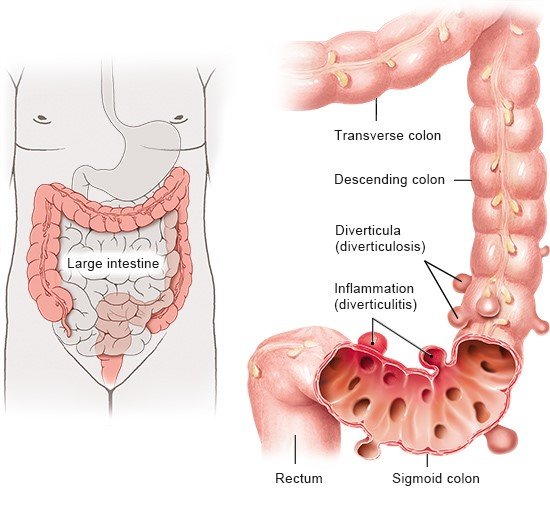
Diverticula develop in areas of the bowel wall where the muscles are weaker. They usually arise in the sigmoid colon. This s-shaped section of the large intestine (colon) is roughly 40 to 45 centimeters long and found just before the . The contents of the bowel put the most pressure on the muscular wall here.

The simplified anatomical illustration shows the position of the large intestine in the body (left) and the sigmoid colon with diverticula and diverticulitis.

Some people are more likely to develop diverticula because of their genes. Further risk factors include weak connective tissue and problems with the wave-like movements of the bowel wall. Older and very overweight people are at greater risk, too.

The influence of lifestyle factors hasn’t yet been properly determined. A diet that is low in fiber can lead to constipation and hard stools, so it seems logical that too little fiber will increase the risk of diverticular disease. Eating a lot of red meat, smoking and not getting enough movement are also believed to be risk factors.

It is still not clear how diverticula become inflamed or infected and what increases the risk of this happening. But it is believed to be more likely in areas of reduced blood supply and if hard lumps of stool form in the diverticula.

Complications are more common in people who have a weakened (for instance, after an organ transplant) or severe kidney disease. The long-term use of particular medications probably increases the risk of more serious complications. These medications include non-steroidal anti-inflammatory drugs (NSAIDs), steroids and opioids.

Prevalence

Many people have diverticula without knowing it. These sac-like pouches are more common in older age: About 13% of people under the age of 50 have diverticula, and about 50% of people over the age of 70 have them. They are similarly common in men and women.

About 1% of all people who have diverticula develop diverticulitis within ten years. It can occur at any age.

Effects

Diverticula often remain unnoticed if they don’t cause any symptoms. But they sometimes lead to chronic digestive problems and pain, or may become inflamed or infected.

Diverticulitis can usually be treated effectively and then goes away after a few weeks. But about 20% of those who have diverticulitis get it again at least once within a few years.

If the or spreads from the diverticula to the bowel wall, the surrounding area or nearby organs, complications can occur: Abscesses (collections of pus) or fistulas may develop. A fistula is an abnormal tunnel-like passageway between two organs, such as the bowel and the bladder. These complications must be treated quickly, often with surgery.

One rare but serious complication may arise if the wall of the bowel tears (intestinal perforation). If the contents of the bowel then leak out into the abdominal cavity, the inner lining of the belly (peritoneum) may become inflamed, leading to a life-threatening condition known as peritonitis. This typically causes severe belly pain, a hard belly, fever, nausea, a rapid heartbeat and general weakness. If symptoms like this occur, it's important to see a doctor right away.

In some people, diverticula keep becoming inflamed or infected despite having been treated successfully in the past. This can lead to scarring that causes the bowel to become narrow (intestinal stenosis), making it difficult for stool to pass through it. In the worst case, the bowel may become blocked (ileus).

The risk of complications is greatest when someone has diverticulitis for the first time. After that, further episodes are a lot less likely to lead to complications. The main consequences of recurring diverticulitis are chronic symptoms such as irregular bowel movements, bloating and abdominal (belly) pain.

Some people have ongoing symptoms although their bowel isn’t inflamed.

Good to know:

Diverticula do not develop into bowel cancer. This kind of cancer develops from in the bowel.

Diagnosis

Diverticula that do not cause any symptoms are often only found by chance – for example, during a colonoscopy. If you go to the doctor because of symptoms you are experiencing, she or he will first ask about any other illnesses you have and medication you are taking. This is followed by a physical examination where they listen to your belly, and also feel your belly and inside your bottom. Depending on the symptoms, you may have blood and urine tests, and your temperature might be measured. You will usually have an ultrasound scan as well. If there is still no clear , you may need to have a CT () scan and perhaps a colonoscopy too (inspection of the inside of the bowel using a camera).

This can help to rule out other illnesses – the symptoms of diverticular disease are similar to the symptoms of conditions like appendicitis or irritable bowel syndrome (IBS).

Colonoscopies are too risky during acute diverticulitis because any could spread if the bowel is injured. But people are often advised to have a colonoscopy about 4 to 6 weeks after the symptoms have cleared up. This is to make sure that they weren’t caused by , bowel cancer or another illness.

Prevention

Eating enough fiber helps to make sure that your stool doesn’t get too hard. This could prevent discomfort or in people with diverticula. There’s a lot of fiber in whole-grain foods, vegetables, legumes (e.g. beans or lentils) and fruits. Physical exercise stimulates digestion too, but it's not clear whether it can prevent diverticula-related symptoms.

Sometimes people with diverticula are advised to avoid certain foods – particularly nuts, seeds, sweetcorn and popcorn. For a long time, it was thought that small bits of these foods could get stuck in diverticula and cause them to become inflamed or infected. But studies have shown that not to be true. So there's no need to avoid eating things like nuts.

Treatment

Diverticula that don’t cause any symptoms don’t have to be treated. The treatment options for acute diverticulitis depend on how severe it is. The aim is of treatment is to

  • avoid complications from the or ,
  • relieve acute symptoms,
  • stop diverticulitis from occurring again, and
  • avoid chronic symptoms.

Infections in diverticulitis are caused by , so they can be treated with antibiotics. Antibiotics are usually not needed in uncomplicated diverticulitis. But it's important to use them if complications arise or if there’s an increased risk of that happening. Complications may have to be treated in the hospital.

If acute diverticulitis doesn’t improve or someone has ongoing symptoms, the affected part of the bowel can be surgically removed. Because of the associated risks, it’s important to carefully consider the pros and cons of this surgery first. But serious complications like peritonitis require immediate surgery.

For people who have chronic diverticular disease, it can be worth trying to eat more fiber. There’s not yet enough good research to be able to say whether probiotic food products can help. The drug mesalazine or surgery may be considered, too.

Further information

When people are ill or need medical advice, they usually go to see their family doctor first. Information about health care in Germany can help you to navigate the German healthcare system and find a suitable doctor. You can use this list of questions to prepare for your appointment.

Andeweg CS, Berg R, Staal JB et al. Patient-reported Outcomes After Conservative or Surgical Management of Recurrent and Chronic Complaints of Diverticulitis: Systematic Review and Meta-analysis. Clin Gastroenterol Hepatol 2016; 14(2): 183-190.

Balk EM, Adam GP, Cao W et al. Management of Colonic Diverticulitis. (AHRQ Comparative Effectiveness Reviews; No. 233). 2020.

Brown RF, Lopez K, Smith CB et al. Diverticulitis: A Review. JAMA 2025 [Epub ahead of print].

Carabotti M, Annibale B, Severi C et al. Role of Fiber in Symptomatic Uncomplicated Diverticular Disease: A Systematic Review. Nutrients 2017; 9(2): 161.

Dichman ML, Rosenstock SJ, Shabanzadeh DM. Antibiotics for uncomplicated diverticulitis. Cochrane Database Syst Rev 2022; (6): CD009092.

Lahner E, Bellisario C, Hassan C et al. Probiotics in the Treatment of Diverticular Disease. A Systematic Review. J Gastrointestin Liver Dis 2016; 25(1): 79-86.

Leifeld L, Germer CT, Bohm S et al. S3-Leitlinie Divertikelkrankheit / Divertikulitis. Gemeinsame Leitlinie der Deutschen Gesellschaft für Gastroenterologie, Verdauungs- und Stoffwechselkrankheiten (DGVS) und der Deutschen Gesellschaft für Allgemein- und Viszeralchirurgie (DGAV). AWMF register no.: 021-020. 2021.

Morris AM, Regenbogen SE, Hardiman KM et al. Sigmoid diverticulitis: a systematic review. JAMA 2014; 311(3): 287-297.

IQWiG health information is written with the aim of helping people understand the advantages and disadvantages of the main treatment options and health care services.

Because IQWiG is a German institute, some of the information provided here is specific to the German health care system. The suitability of any of the described options in an individual case can be determined by talking to a doctor. informedhealth.org can provide support for talks with doctors and other medical professionals, but cannot replace them. We do not offer individual consultations.

Our information is based on the results of good-quality studies. It is written by a team of health care professionals, scientists and editors, and reviewed by external experts. You can find a detailed description of how our health information is produced and updated in our methods.

Comment on this page

What would you like to share with us?

We welcome any feedback and ideas - either via our form or by gi-kontakt@iqwig.de. We will review, but not publish, your ratings and comments. Your information will of course be treated confidentially. Fields marked with an asterisk (*) are required fields.

Please note that we do not provide individual advice on matters of health. You can read about where to find help and support in Germany in our information “How can I find self-help groups and information centers?

Über diese Seite

Updated on February 9, 2026

Next planned update: 2029

Publisher:

Institute for Quality and Efficiency in Health Care (IQWiG, Germany)

Stay informed

Subscribe to our newsletter or newsfeed. You can find our growing collection of films on YouTube.