What does genetic testing involve?

Genetic tests examine a person's genes (DNA), so they are also referred to as DNA analysis. This can be done to help estimate their risk of a particular disease or detect any hereditary diseases, for instance. The tests are usually done using a blood sample or a small amount of saliva. Genetic testing is currently only useful for a few conditions. Because the results may also have repercussions for children and siblings, genetic tests may only be performed in certain situations. This is typically regulated by law – in Germany the Genetic Diagnosis Act (Gendiagnostikgesetz) covers this sort of testing.
What kinds of genetic tests are there?

Genetic tests can be divided into three general categories depending on their purpose:

  • Diagnostic tests: These tests are mainly used to find the cause of an existing disease.
  • Prognostic tests: These help to predict your risk of getting a disease in the future. Depending on the particular medical condition, these tests can also help assess how the disease might develop or what the risk is of it coming back.
  • Predictive tests: These tests are used to predict whether a disease will respond to a specific treatment. That may also include determining whether a person has certain metabolic characteristics that, for instance, influence the effectiveness of a drug, or that may lead to the development of a disease in conjunction with certain environmental factors. Predictive tests can help to plan treatment.

Genetic tests can also indicate the likelihood of a genetic trait or a condition being inherited by your children. They are used both in medicine as well as in forensics and paternity testing.

The structure of our genetic information

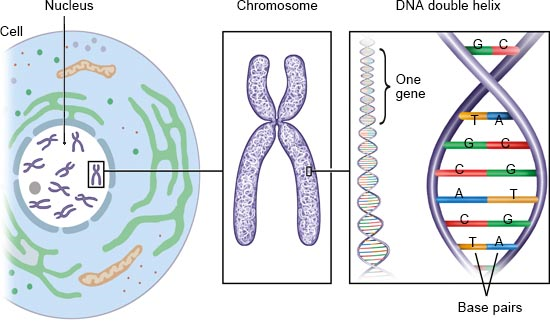
Our genetic material is located in our cell nuclei in the form of chromosomes. These chromosomes consist of proteins structured in helix-like DNA strands, where the information is stored.

The strands of DNA look like a twisted ladder, known as a double helix. Each step of this ladder is made up of two bases.

The order (sequence) of the different steps produces a code of letters. The cell uses this as a blueprint, primarily to produce proteins. The section of a DNA strand that contains one specific piece of information – such as the blueprint for a particular protein – is called a gene.

The illustration shows genetic material in the cell nucleus on the left and, on the right, a detailed view of a chromosome and the DNA, which resembles a rope ladder.

What does the examination involve?

Blood cells are commonly used for genetic testing. A standard blood sample is all that is needed. Sometimes, hairs on your body or cells from the mucous lining of the mouth are tested too. The latter can be taken from inside your cheek using a cotton swab.

The genetic material (DNA) is then isolated from the cells and analyzed using highly precise methods. This can be done in various ways, depending on what needs to be found. For example, the sequence of the building blocks in the DNA can be analyzed. The different genes and changes within genes can be detected by comparing the sequences of the building blocks.

The DNA analysis is done at a certified laboratory. It may take several weeks for the results to come back.

What are the effects of genetic mutations?

Each one usually contains the blueprints for a specific protein. Every protein has a special purpose, such as regulating part of the body's metabolism or assisting in cell division. Any changes to a gene can also result in changes to the blueprint. Proteins produced according to the altered blueprint may no longer function properly – for example, they could block metabolic processes at a certain point. Other genetic mutations cause cells to produce too much of a certain protein. Because proteins do so many different things, the effect that a change has on your general health depends on the exact nature of the change.

Other kinds of genetic mutations have no impact on your health, or only a minor one. The effects will then often depend on other genes, as well as lifestyle and environmental factors. This is one reason why genetic testing can only rarely be used to make predictions about future health issues with a high level of certainty. Genetic testing is often no more conclusive than other tests.

What are genetic tests used for?

Genetic testing can help answer questions such as:

What is the cause of a disease and how can it be treated?

For example, gene tests are used for some types of cancer to find out which genetic mutations are responsible for the tumor. If this is known, the cancer can sometimes be treated in a more targeted way. So far these specialized treatments can be used for certain forms of breast, lung, colon and skin cancer, for instance.

DNA analysis can also show how the body’s metabolism processes a particular drug. Side effects are more common if the drug is broken down very slowly. But it might not be effective enough if it is broken down too fast. If the test shows that a person metabolizes medications very slowly or very quickly, this can be taken into account when selecting the active ingredients and the dose.

In some infectious diseases, such as hepatitis C, genetic testing can help determine the that caused it. Certain types of hepatitis C viruses can be treated more effectively.

Are you more likely to develop certain diseases?

If a condition is very common among family members, it could be a sign of a genetic predisposition. Genetic testing may be done in such cases: It can be used to determine which form of a gene someone has and shares with their relatives. This kind of test is available for some medical conditions such as genetic diseases like cystic fibrosis or the neurological disorder Huntington's disease.

Genetic tests can also be done before a child is born (prenatal testing). But this is only allowed for the specific purpose of detecting genetic changes that may affect the child's health before or after being born. It is illegal to do prenatal genetic testing for conditions that arise only after the age of 18.

How and when are gene tests discussed?

In Germany, genetic testing is governed by the Genetic Diagnosis Act. This act determines which tests are allowed, when they are allowed, and what information has to be provided by the doctor beforehand. The Genetic Diagnosis Act also says that genetic testing may only be performed if the person has given their consent in writing.

Your doctor must talk with you about what is going to happen during the procedure, and describe any risks and possible consequences of the results of the test. You should also be given an appropriate amount of time before the test to consider what you have been told. It's important to know that you have a right to not know. That means that you can decide not to have genetic testing without having to give a reason.

In addition to the information your doctor is obligated to give you, the Genetic Diagnosis Act stipulates that special counseling should be offered on the possible medical, psychological and social consequences that the results of DNA analysis might have – for instance if the genetic test shows you have a higher risk of getting an incurable disease. Exactly when this genetic counseling should be offered depends on the type of genetic testing to be done. For some genetic tests (such as those that are done before birth), counseling is required before the procedure. For other tests, it is needed only once the results are in.

Counseling should be easily understandable and not pressure you into making a certain decision. It should also let you know where you can find support for physical and mental issues. Specialized practices and clinics offer this type of genetic counseling. According to the Genetic Diagnosis Act, this kind of counseling can only be conducted by doctors who have specialized in human genetics or who have additional qualifications in this area.

What are the risks of genetic testing?

The reliability of genetic testing depends on the particular genetic test and what you are looking to find out.

One example of this would be that the detection of a mutated gene does not necessarily mean that a person will develop the disease. Conversely, a “normal” (negative) test result can't provide absolute certainty that a disease won't occur.

The risk of diseases like diabetes, asthma, high blood pressure or coronary artery disease can be influenced by your genes, but mostly depends on environmental conditions and individual lifestyle factors. So the results of genetic testing for those diseases aren’t very conclusive.

Knowing that you have genetic risk factors for a disease that can't be treated or cured is distressing and can cause anxiety. This is the case for conditions like hereditary forms of Alzheimer's disease or the neurological disorder Huntington's disease.

Further information:

If you face the decision of whether or not to have genetic testing, you have the right to information and counseling about the possible consequences. The following things may be helpful for people living in Germany:

  • Genetic counseling: This is offered by specialized doctors and genetic counseling centers.
  • The directive on genetic counseling, published by the Genetic Testing Committee (Gendiagnostik-Kommission): This directive stipulates which conditions doctors must meet in order to offer this kind of counseling and what specific topics need to be discussed.
  • Genetic Diagnosis Act: Brief summary available (in German) on the website of the German Federal Ministry of Health, for instance.

Alberts B. Lehrbuch der Molekularen Zellbiologie. Weinheim: Wiley-VCH; 2021.

Bundesministerium der Justiz und für Verbraucherschutz (BMJV), Bundesamt für Justiz (BfJ). Gesetz über genetische Untersuchungen bei Menschen (Gendiagnostikgesetz - GenDG). 2021.

Deutsches Krebsforschungszentrum (DKFZ), Krebsinformationsdienst. Molekularbiologische Untersuchungen bei Krebs. 2021.

Deutsches Krebsforschungszentrum (DKFZ), Krebsinformationsdienst. Zielgerichtete Therapie gegen Krebs. Ablauf, Nebenwirkungen, Medikamente. 2025.

Deutsches Referenzzentrum für Ethik in den Biowissenschaften (DRZE). Prädiktive genetische Testverfahren. 2024.

FDA-NIH Biomarker Working Group. Understanding Prognostic versus Predictive Biomarkers - BEST (Biomarkers, EndpointS, and other Tools) Resource. 2016.

Jackson M, Marks L, May GH et al. The genetic basis of disease. Essays Biochem 2018; 62(5): 643-723.

Pschyrembel online. Cytochrom-P450-System (CYP). 2025.

Pschyrembel online. Genanalyse (Gentest). 2025.

Pschyrembel online. Mutation [Biologie]. 2025.

Robert Koch-Institut (RKI). Richtlinie der Gendiagnostik-Kommission (GEKO): RL Genetische Beratung. 2023.

IQWiG health information is written with the aim of helping people understand the advantages and disadvantages of the main treatment options and health care services.

Because IQWiG is a German institute, some of the information provided here is specific to the German health care system. The suitability of any of the described options in an individual case can be determined by talking to a doctor. informedhealth.org can provide support for talks with doctors and other medical professionals, but cannot replace them. We do not offer individual consultations.

Our information is based on the results of good-quality studies. It is written by a team of health care professionals, scientists and editors, and reviewed by external experts. You can find a detailed description of how our health information is produced and updated in our methods.

Comment on this page

What would you like to share with us?

We welcome any feedback and ideas - either via our form or by gi-kontakt@iqwig.de. We will review, but not publish, your ratings and comments. Your information will of course be treated confidentially. Fields marked with an asterisk (*) are required fields.

Please note that we do not provide individual advice on matters of health. You can read about where to find help and support in Germany in our information “How can I find self-help groups and information centers?”

Über diese Seite

Updated on November 10, 2026

Next planned update: 2029

Publisher:

Institute for Quality and Efficiency in Health Care (IQWiG, Germany)

Stay informed

Subscribe to our newsletter or newsfeed. You can find our growing collection of films on YouTube.