Going to see a gynecologist

Gynecologists are doctors who specialize in women's reproductive health. The appointments typically involve having a chat with the gynecologist and a physical exam. What you discuss and what the physical exam focuses on will depend on why you made the appointment.

Please note that some of the following information describes the situation in Germany specifically. You may find that things are different in other countries.

Why go to a gynecologist?

There are a number of reasons why you might want to see a gynecologist:

What can you expect at a gynecology check-up?

The talks and physical exams you have at a gynecology practice are usually personal and intimate. So it’s important that you feel comfortable with the gynecologist and the people who work at the practice. If you don’t, you can change to a different gynecology practice at any time.

Before the gynecologist examines you down below, they will ask you to undress from the waist down (including your underwear). To make you feel more comfortable, they can wait and only ask you to undress just before they actually need to examine you. There will be a private changing area where you can remove your clothes. You can put them back on again for the other parts of the physical exam, such as the breast check-up. The physical exams don’t usually hurt but they might be a little unpleasant.

What can you talk to the gynecologist about?

The appointment will start with a chat. The gynecologist will begin by asking why you came to see them. For example, have you come for routine cancer or because you have certain symptoms? If you have symptoms, what kind and how long have you had them? This part of the appointment may take a while if it’s your first time at the practice or if it’s been a long time since you were last there.

If you haven't come for or to ask about symptoms, the chat with the gynecologist may take up most of the appointment. A typical example is when women want to find out about contraception options.

What does a pelvic exam involve?

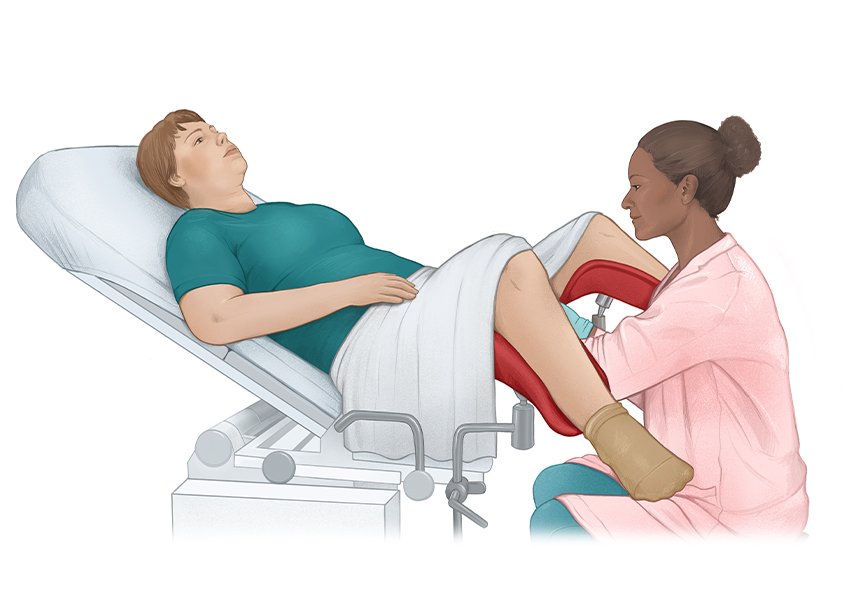
This examination is done with you sitting on a special type of padded reclining chair. The chair has supports on either side that you rest your legs or feet in so that your legs are apart.

The illustration shows a patient (left) being examined on a gynecological chair.

The gynecologist starts by checking your outer genitals (vulva). They can often see abnormalities just by looking – for example, things like red, lumpy, flaky or scaly areas that might be a sign of cancer or pre-cancerous cell changes.

To closely examine the lining of your vagina and your cervix, the gynecologist will use instruments such as a speculum and a colposcope. A speculum looks a bit like a duck’s bill or a pair of pliers. The gynecologist inserts it into your vagina and gently squeezes the handle to spread open the walls of your vagina slightly. Sometimes the speculum consists of two separate metal instruments instead. A colposcope is a special microscope for pelvic exams. The gynecologist places it at the opening of your vagina to get a highly magnified view of the vulva and the lining of the vagina and cervix.

What is a Pap test?

The gynecologist can do something called a Pap test (also known as a Pap smear) to check for things like abnormal cells that could turn into cervical cancer. The test involves collecting cells from the lining of the cervix and the cervical canal, and then examining them under a microscope. This is done because it's not easy to see abnormalities in individual cells using a colposcope.

The Pap test is done while you’re sitting on the gynecological chair. The gynecologist will insert several cotton swab sticks or small soft brushes into your vagina (one after the other) and rub them along the soft tissue to collect cells. This doesn’t usually hurt but you might feel a “pinching” sensation.

Good to know:

In Germany, public health insurers offer a cervical cancer screening test once a year for women between the ages of 20 and 34, and once every three years for women aged 35 and older.

Bacterial and fungal infections can be diagnosed using this procedure, too.

Why does the gynecologist do a manual exam of your pelvic area?

The exam on the gynecological chair includes a thorough manual exam. This is necessary because things like abnormal tissue deeper down in your skin, on your ovaries or in your womb (uterus) can’t be seen in a Pap test or just by looking from the outside. But they can cause swelling or hardening that the gynecologist may be able to feel.

For this reason, gynecologists feel the organs by inserting a finger into your vagina. To make it easier to feel anything abnormal in your pelvic area, they will place their other hand on your lower belly and gently press down towards their inserted finger. If you are over 50, the gynecologist will also check your (bottom) when they do this manual exam.

What happens during a breast exam?

From the age of 30, all women who have public health insurance in Germany can have a yearly breast exam by touch (palpation) at no extra cost. The aim is to discover any signs of breast cancer as early as possible. The gynecologist takes a close look at your breasts and armpits while examining them by touch as well. They check for abnormal changes in the skin, lumps or anything else unusual, such as sore areas. They will explain how you can regularly check your breasts yourself at home, too.

Good to know:

Women between the ages of 50 and 75 can also have a mammogram every two years as part of the German breast cancer program. This is done in specialized centers (not in a gynecology practice).

What other exams are done?

Depending on why you’re seeing the gynecologist, you might need an ultrasound scan too. This allows the gynecologist to examine your internal reproductive organs more closely – either with a special transducer, which they insert into your vagina – or from outside, through your belly. Blood and urine tests can sometimes be helpful too. They can be used to determine whether you’re pregnant, for instance, or whether you have an . Your vaginal pH level can be measured using a simple test. The gynecologist takes a sample of your vaginal discharge and puts it on a test strip. If the pH level is not in the normal range, it’s a sign that you have a vaginal or that the natural balance of and other microbes in your vagina has changed.

Gemeinsamer Bundesausschuss (G-BA). Richtlinie des Gemeinsamen Bundesausschusses für organisierte Krebsfrüherkennungsprogramme (oKFE-Richtlinie/oKFE-RL). 2024.

Gemeinsamer Bundesausschuss (G-BA). Richtlinie über die Früherkennung von Krebserkrankungen (Krebsfrüherkennungsrichtlinie - KFE-RL). 2025.

Gemeinsamer Bundesausschuss (G-BA). Richtlinie über die Gesundheitsuntersuchungen zur Früherkennung von Krankheiten (Gesundheitsuntersuchungs-Richtlinie). 2021.

Pschyrembel Online. 2025.

Seitz S. Gynäkologie und Geburtshilfe. Berlin, Heidelberg: Springer; 2023.

Weyerstahl T, Stauber M. Duale Reihe Gynäkologie und Geburtshilfe. Stuttgart: Thieme; 2013.

IQWiG health information is written with the aim of helping people understand the advantages and disadvantages of the main treatment options and health care services.

Because IQWiG is a German institute, some of the information provided here is specific to the German health care system. The suitability of any of the described options in an individual case can be determined by talking to a doctor. informedhealth.org can provide support for talks with doctors and other medical professionals, but cannot replace them. We do not offer individual consultations.

Our information is based on the results of good-quality studies. It is written by a team of health care professionals, scientists and editors, and reviewed by external experts. You can find a detailed description of how our health information is produced and updated in our methods.

Comment on this page

What would you like to share with us?

We welcome any feedback and ideas - either via our form or by gi-kontakt@iqwig.de. We will review, but not publish, your ratings and comments. Your information will of course be treated confidentially. Fields marked with an asterisk (*) are required fields.

Please note that we do not provide individual advice on matters of health. You can read about where to find help and support in Germany in our information “How can I find self-help groups and information centers?

Über diese Seite

Created on February 4, 2026

Next planned update: 2029

Publisher:

Institute for Quality and Efficiency in Health Care (IQWiG, Germany)

Stay informed

Subscribe to our newsletter or newsfeed. You can find our growing collection of films on YouTube.