
Ears are responsible for your sense of hearing and your sense of balance. You hear sounds because your ears pick up sound waves and turn them into electrical signals which travel along nerves to your brain. Your brain then “decodes” the signals, recognizes that they are sounds, and interprets the sounds. The organ of balance (the vestibular system) in the inner ear also sends signals to the brain, so the brain can track and interpret every movement and change in position.
People who have hearing problems usually have an ear examination. In medicine, there are two main categories of hearing problems: Sensorineural hearing loss, where sounds and noises are not heard at all, or are heard too quietly. And conductive hearing loss, where the sound waves reaching the ear can't be passed on properly. Earache is another common reason for having an ear examination. The pain may be caused by a middle ear infection or an inflammation of the outer ear canal. But it may also come from problems in the jaw or in the neck area of the spine (the cervical spine).
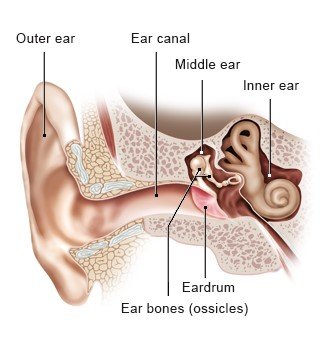
When are ear examinations recommended?
Ear examinations are generally done if you have sudden or gradual hearing loss, ringing in your ears (tinnitus), earache, dizziness or if your doctor thinks you might have a middle ear infection. They are also done if a fluid comes out of your ear or if you’ve injured your lower jaw. This is because lower jaw injuries can damage the ear and ear canal too.
How can you prepare for an ear examination?
There is no need to prepare for an ear examination. But it's useful to know that the ear canal and eardrum are quite sensitive, so you can try to hold your head still during the examination in order to avoid pain. If the doctor touches the back wall of your ear canal with an instrument, it might make you want to cough.
What does the examination involve?
Before examining your ear, your doctor will ask you a few questions – like whether you have earache, ringing in your ears, dizziness or trouble hearing. Information about any previous ear problems or hearing problems in your family could be important too. After talking with you about these things, the doctor will usually first look inside your ear using an instrument called an otoscope. This may be followed by other kinds of examinations or tests if necessary.
Your hearing can be tested in various ways. Doctors typically use a combination of different methods. There are subjective hearing tests, which depend on patients’ own reports of what they can hear. These include whispered and spoken voice tests, tuning fork tests and audiometry tests. And there are objective hearing tests, which measure your hearing using special devices. Examples of these tests include tympanometry, OAE tests and auditory brainstem response tests.
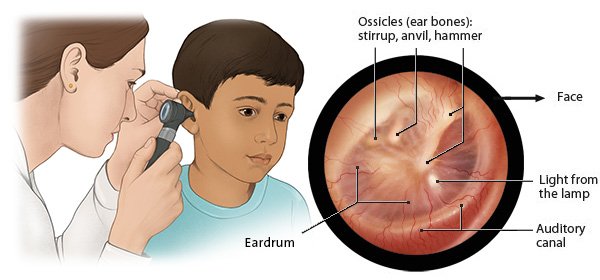
Otoscopy
In this examination, the doctor looks into the ear using an instrument called an otoscope. The otoscope consists of a handle and a cone-shaped attachment called an ear speculum. The speculum is inserted into the outer ear canal, shining a light into it. To see inside the ear canal better, the doctor gently pulls the ear upward and backward. Earwax or dirt can be removed during the examination. The eardrum is usually a shiny gray color and smooth. If it’s red, injured, scarred or has a bulge in it, you might have an ear infection or another kind of ear problem.
Whispered and spoken voice test
In this test, the doctor reads out a combination of letters and numbers while standing six meters away from you – whispering at first and then talking at a normal volume. If you don't understand what the doctor says, they move closer to you. This is done separately for each ear. The doctor will make sure that you can’t simply read their lips during the test. But this test is rarely done nowadays.
Tuning fork test
In tuning fork tests, the doctor first holds a vibrating tuning fork at the entrance to your ear canal and then places it against your head. This tests how well sound passes through the air and through your skull bones. It provides information about the type of hearing problem:
- If you can only hear the tuning fork when it's placed against your head, the root of the hearing problem lies in the ear canal or middle ear.
- If you can’t hear the tuning fork in either of the two positions, you have what's known as sensorineural hearing loss. This means that the hearing issue is being caused by a problem in the inner ear, the hearing nerve (auditory nerve), or the nerve cells in the brain.
Audiometry
In pure-tone audiometry, headphones or loudspeakers are used to play tones at various frequencies (pitches) and increasing volumes. As soon as you can hear the tone, you give the tester a sign.
In speech audiometry, you try to hear spoken syllables and numbers rather than tones. Then the tester sees how many words or numbers you can understand at different volumes. This test is also used when adjusting hearing aids.
Tympanometry
Tympanometry measures how easily the eardrum can move (vibrate). If the eardrum hardly moves at all, it's a sign that fluid has built up in the tympanic cavity behind the eardrum. To do the test, the doctor first inserts an earbud-like probe into your ear canal in order to seal this part of your ear. Although this can sometimes be unpleasant, it generally doesn’t hurt. The probe changes the pressure in your ear (low pressure and high pressure), and then it plays a tone. The tone’s sound waves cause the eardrum to vibrate, which changes the pressure in the ear canal. This change in pressure is measured and recorded.
OAE tests
OAE tests are used to check how well the inner ear works. There are hair-like sensory cells (also called outer hair cells) in the inner ear. Sounds reaching the inner ear make the hair cells vibrate, causing them to produce sound signals themselves – known as otoacoustic emissions (OAE). During OAE tests, quiet clicking sounds are made. The sound waves that "echo" back are then picked up and measured using a special microphone. This procedure doesn’t hurt and is also used for routine hearing tests in newborn babies.
Auditory brainstem response test
The auditory brainstem response (ABR) test measures the electrical activity in the part of the brain that receives signals from the hearing nerve. It works in a similar way to an electroencephalogram (EEG), which measures brain waves. In the ABR test, the hair-like sensory cells in the ear are stimulated by sending clicking sounds through headphones. The sensory cells turn the sound vibrations into electrical signals, which then travel to the brain along the hearing nerve. The electrical signals arriving in the brain are recorded using electrodes that are placed on the scalp. This test is particularly useful for diagnosing hearing loss caused by damage to the hearing nerve.
Caloric testing
Dizziness or balance problems can be diagnosed using various tests, including special ear examinations that focus on the organ of balance (the vestibular system) rather than on hearing. One approach is known as caloric testing. In this examination, the doctor puts warm or cold water in the ear canal, or sometimes warm or cold air instead. This stimulates the organ of balance in the inner ear, making it possible to see whether it’s working properly. The doctor can also test specific parts of the organ of balance by exposing them to certain types of sounds.
Lenarz T, Boenninghaus HG. Hals-Nasen-Ohren-Heilkunde. Berlin: Springer; 2012.
Mrowinski D, Scholz G, Steffens T. Audiometrie: Eine Anleitung für die praktische Hörprüfung. Stuttgart: Thieme; 2023.
Pschyrembel online. 2026.
IQWiG health information is written with the aim of helping people understand the advantages and disadvantages of the main treatment options and health care services.
Because IQWiG is a German institute, some of the information provided here is specific to the German health care system. The suitability of any of the described options in an individual case can be determined by talking to a doctor. informedhealth.org can provide support for talks with doctors and other medical professionals, but cannot replace them. We do not offer individual consultations.
Our information is based on the results of good-quality studies. It is written by a team of health care professionals, scientists and editors, and reviewed by external experts. You can find a detailed description of how our health information is produced and updated in our methods.
Über diese Seite

Stay informed
Subscribe to our newsletter or newsfeed. You can find our growing collection of films on YouTube.