How are genes passed on?

When people talk about inherited genes in biology, they mean genetic material that is passed on from parents to children.

When an egg cell and a sperm cell combine, the first complete human cell is formed. It contains half of the genetic material from each parent, and is a blueprint for future humanity. From now on, every time a cell divides, a complete copy of this genetic information is passed on to the two new (“daughter”) cells.

What carries the genetic information?

"Genetic material" refers to DNA, the thread-like molecule .

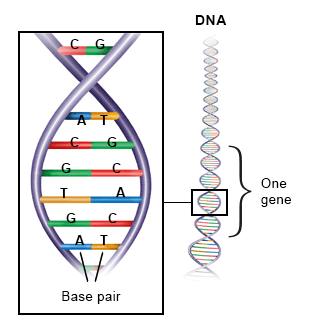
The strands of DNA look like a twisted ladder, known as a double helix. Each step of this ladder is made up of two bases. There are four different bases:

  • Adenine (A)
  • Thymine (T)
  • Guanine (G)
  • Cytosine (C)

The different types of bases result in different kinds of "ladder steps."

This illustration shows DNA, which resembles a rope ladder with different steps.

The order (sequence) of the different steps produces a code of letters. The cell uses this as a blueprint, mainly for producing proteins. The section of genetic material that contains specific information – such as the blueprint for a particular protein – is called a gene.

The DNA typically has sections before each gene that act as switches. These sections are responsible for the fact that certain genes are only activated in muscle cells while others are only activated in liver cells, for example.

When different genes are “read,” different proteins are made – each with their own function. As enzymes or , they regulate certain processes in the body. Other proteins are used as building blocks in the body or serve to transport things in the bloodstream. The cell nucleus contains a lot of proteins, too: Some help to read the DNA code, while others help to support the structure of the DNA.

What are chromosomes?

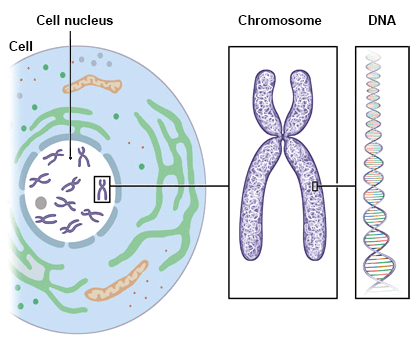
Human genetic information isn’t encoded on just one strand of DNA. A cell nucleus contains a number of strands. The DNA strands tightly wound around proteins are called chromosomes. During cell division, the chromosomes coil up tightly and become visible under a light microscope.

The illustration shows the genetic material in the cell nucleus on the left and a detailed view of a chromosome and the DNA, which resembles a rope ladder on the right.

Humans typically have 46 chromosomes – 23 from each parent. These include the two sex chromosomes. Women usually have two X chromosomes, whereas men typically have one X chromosome and one Y chromosome.

There are also variations in the number of chromosomes. For example, if there are three copies of the same chromosome in the body's cells, it is called trisomy. This can happen if the egg cell or sperm cell has one extra chromosome. This extra chromosome is then passed on to the daughter cells during cell division.

What influence do genes have?

What we look like and how our body functions is determined by a combination of our genes, our lifestyle and our environment.

So it’s usually not possible to say that a particular characteristic or trait is due to a specific gene. Also, many traits are influenced by different genes working together – like your height or skin tone. Some genes affect several traits as well.

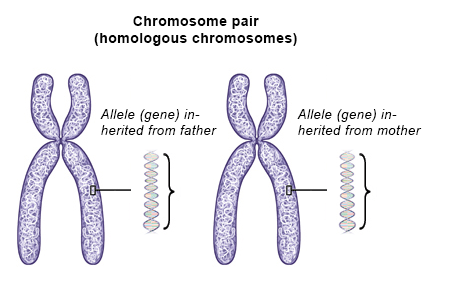
Another complicating factor is that the genes come in pairs. That means that there are two copies of most genes. Even if both versions of the gene have the same task, they may be slightly different from each other.

This illustration shows a matching pair of chromosomes.

Sometimes these different versions of genes (alleles) result in different traits. The blood groups are one example:

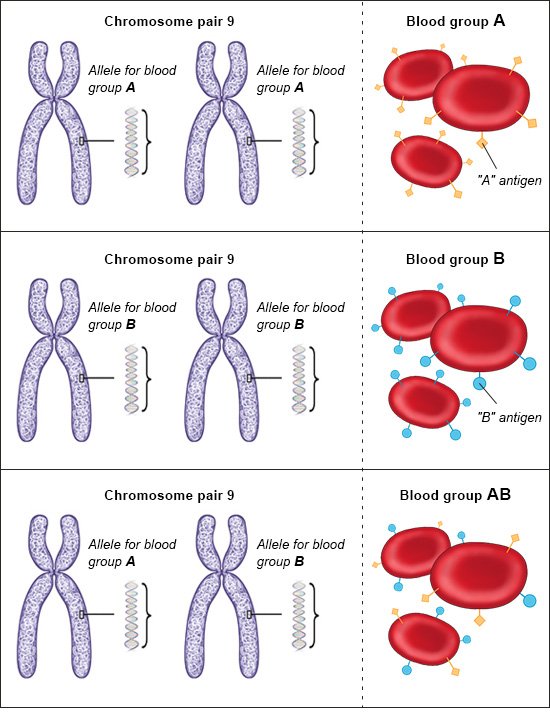
Some of the blood group traits are determined by genes on chromosome 9. If someone has the allele for blood group A on both chromosomes, then a certain protein called the A antigen is produced on the surface of their red blood cells. If the allele for blood group B is on both chromosomes, then the B antigen is produced on the blood cells. If one chromosome has the allele for blood group A and the other chromosome has the allele for blood group B, both of the antigens are produced, and the person has the blood group AB.

Illustration: Alleles in people with the blood groups A, B and AB – as described in the article

This example describes how blood groups are formed when both alleles for the blood groups A and B are equally likely. But sometimes one allele of a gene is “stronger” than the other and determines what trait is expressed, overriding the other allele – the stronger allele is known as the “dominant” allele. The weaker allele is referred to as “recessive.”

What do the terms “dominant” and “recessive” mean?

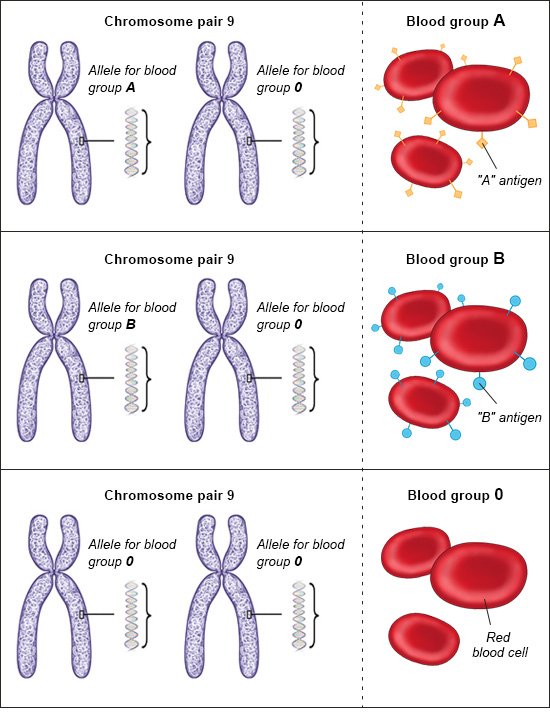
In addition to blood types A, B, and AB, there is also blood type O. While the alleles for A and B are dominant, the allele for O is recessive. If the allele for O is on one chromosome and the allele for A is on the other, the person will have blood type A. Only if both chromosomes have the allele for O will the blood cells not have the antigens, and the person has blood type O.

This illustration shows alleles in people with the blood groups A, B and O

This blood group example also shows that the same traits and characteristics don’t necessarily come from identical genetic information: Some people who have blood group A have the allele for A antigens on both chromosomes, and others have the allele for A antigens on one and the allele for no antigens on the other.

Why do we have two versions of most genes?

There are several advantages to most chromosomes having duplicates: For instance, if one of the chromosomes has an allele that causes a disease, the healthy allele on the other chromosome may be able to reduce the severity of the disease or even prevent it. Also, mixing the genes can create completely new combinations of genes, which may help future generations to better adapt to environmental conditions or play a role in protecting them from diseases.

Alberts B. Lehrbuch der Molekularen Zellbiologie. Weinheim: Wiley-VCH; 2021.

Brandes R, Lang F, Schmidt R. Physiologie des Menschen: mit Pathophysiologie. Berlin: Springer; 2019.

IQWiG health information is written with the aim of helping people understand the advantages and disadvantages of the main treatment options and health care services.

Because IQWiG is a German institute, some of the information provided here is specific to the German health care system. The suitability of any of the described options in an individual case can be determined by talking to a doctor. informedhealth.org can provide support for talks with doctors and other medical professionals, but cannot replace them. We do not offer individual consultations.

Our information is based on the results of good-quality studies. It is written by a team of health care professionals, scientists and editors, and reviewed by external experts. You can find a detailed description of how our health information is produced and updated in our methods.

Comment on this page

What would you like to share with us?

We welcome any feedback and ideas - either via our form or by gi-kontakt@iqwig.de. We will review, but not publish, your ratings and comments. Your information will of course be treated confidentially. Fields marked with an asterisk (*) are required fields.

Please note that we do not provide individual advice on matters of health. You can read about where to find help and support in Germany in our information “How can I find self-help groups and information centers?”

Über diese Seite

Updated on November 10, 2026

Next planned update: 2029

Publisher:

Institute for Quality and Efficiency in Health Care (IQWiG, Germany)

Stay informed

Subscribe to our newsletter or newsfeed. You can find our growing collection of films on YouTube.