How does the brain work?

The brain works like a big computer. It processes information that it receives from the senses and body, and sends messages back to the body. But the brain can do much more than a machine can: We think and experience emotions with our brain, and it is the root of human intelligence.

The human brain is roughly the size of two clenched fists and weighs about 1.5 kilograms. From the outside it looks a bit like a large walnut, with folds and crevices. Brain tissue is made up of about 100 billion nerve cells (neurons) and one trillion supporting cells that stabilize the tissue.

The brain is made up of various parts, each with its own functions:

  • Cerebrum
  • Diencephalon – including the thalamus, hypothalamus and pituitary gland
  • Brain stem – including the midbrain, pons and medulla
  • Cerebellum
This illustration shows the side view of a head with the various parts of the brain: the cerebrum, the diencephalon, the brain stem and the cerebellum.

What jobs does the cerebrum have?

The cerebrum controls movement and processes sensory information. Conscious and unconscious actions and feelings are produced here. It is also responsible for speech, hearing, intelligence and memory. The cerebrum has a right half and a left half, known as the right and left hemispheres. The two hemispheres are connected via a thick bundle of nerve fibers called the corpus callosum. Each hemisphere is made up of several areas (lobes) that have different functions.

The jobs of the two hemispheres are mostly different: In most people the left half is responsible for language and abstract thought. The right half is usually used for spatial reasoning and imagery. The outer layer (cerebral cortex) of the right half of the brain supplies spatial information, such as where your foot is at the moment.

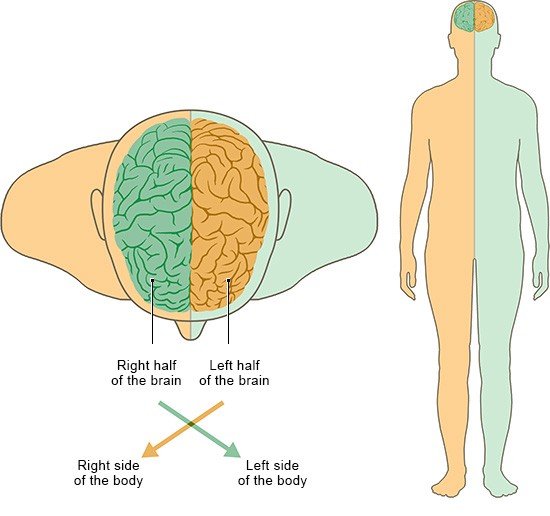
The right side of the brain controls the left side of the body, and the left side of the brain controls the right side of the body. This means that damage to the left hemisphere due to a stroke, for example, can lead to paralysis on the right side of the body.

This illustration shows the two hemispheres of the brain: the right half controls the left side of the body, and the left half controls the right side.

What happens in the other parts of the brain?

The thalamus, hypothalamus, and pituitary gland are located in the diencephalon. The thalamus gives the cerebrum sensory information from the skin, eyes and ears, as well as other information. The hypothalamus regulates hunger, thirst, and sleep, for example. Together with the pituitary gland, it regulates the body's hormone levels.

The brain stem passes information from the brain on to the cerebellum and the spinal cord. It controls eye movements and facial expressions. It also regulates vital functions like breathing, blood pressure and heartbeat.

The cerebellum coordinates movement and is responsible for balance.

How is the brain supplied with blood?

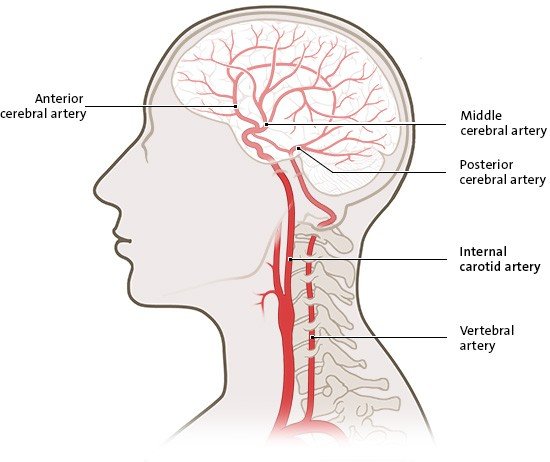
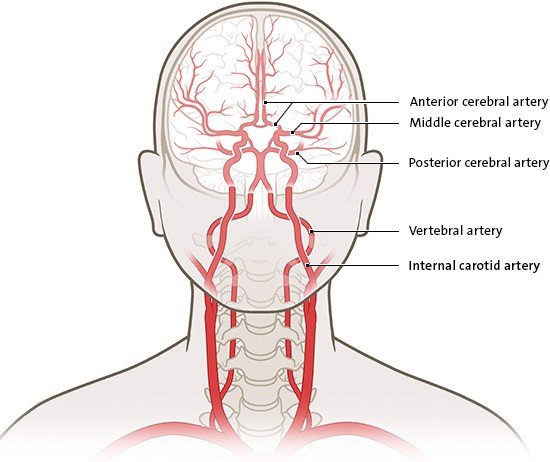
The brain needs a steady flow of enough oxygen, glucose, and other nutrients. For that reason, it has a particularly good blood supply. Each side of the brain receives blood through three arteries:

  • In the front, the anterior cerebral artery supplies the tissue behind the forehead and under the crown (the top of the head).
  • The middle cerebral artery is important for the sides and areas that are further inside the brain. The anterior and middle cerebral artery split off from the internal carotid artery (a major blood vessel in the neck).
  • The posterior cerebral artery supplies the back of the head, the lower part of the brain, and the cerebellum. It is supplied with blood from the vertebral arteries, which are also major blood vessels in the neck.
Die vereinfachte anatomische Grafik zeigt die Durchblutung im Gehirn in Frontalsicht.

Before the three arteries reach “their” brain region, where they split into smaller branches, they are close together below the brain. In this area, they are connected to each other by smaller blood vessels – forming a structure similar to a traffic circle. There are connections between the arteries in other areas of the brain too. The advantage of these connections is that they can partly make up for blood supply problems in the brain: For example, if a branch of an artery gradually becomes narrower, blood can still flow to the part of the brain it supplies through these alternative routes (collateral blood flow).

The smallest branches (capillaries) of the arteries in the brain supply the brain cells with oxygen and nutrients from the blood – but they do not let other substances pass as easily as similar capillaries in the rest of the body do. The medical term for this phenomenon is the “blood-brain barrier.” It can protect the sensitive brain from toxic substances in the blood, for instance.

After oxygen has passed into the cells, the oxygen-poor blood flows away through the veins of the brain (cerebral veins). The veins carry the blood to larger blood vessels known as sinuses. The sinus walls are strengthened by a tough membrane (dura mater), which helps them keep their shape too. This keeps them permanently open and makes it easy for the blood to flow into the veins in the neck.

Brandes R, Lang F, Schmidt R. Physiologie des Menschen: mit Pathophysiologie. Berlin: Springer; 2019.

Hacke W. Neurologie. Berlin: Springer; 2016.

Lippert H. Lehrbuch Anatomie. Munich: Urban und Fischer; 2017.

Menche N. Biologie Anatomie Physiologie. Munich: Urban und Fischer; 2023.

Pschyrembel online. 2026.

IQWiG health information is written with the aim of helping people understand the advantages and disadvantages of the main treatment options and health care services.

Because IQWiG is a German institute, some of the information provided here is specific to the German health care system. The suitability of any of the described options in an individual case can be determined by talking to a doctor. informedhealth.org can provide support for talks with doctors and other medical professionals, but cannot replace them. We do not offer individual consultations.

Our information is based on the results of good-quality studies. It is written by a team of health care professionals, scientists and editors, and reviewed by external experts. You can find a detailed description of how our health information is produced and updated in our methods.

Comment on this page

What would you like to share with us?

We welcome any feedback and ideas - either via our form or by gi-kontakt@iqwig.de. We will review, but not publish, your ratings and comments. Your information will of course be treated confidentially. Fields marked with an asterisk (*) are required fields.

Please note that we do not provide individual advice on matters of health. You can read about where to find help and support in Germany in our information “How can I find self-help groups and information centers?

Über diese Seite

Updated on April 22, 2026

Next planned update: 2029

Publisher:

Institute for Quality and Efficiency in Health Care (IQWiG, Germany)

Stay informed

Subscribe to our newsletter or newsfeed. You can find our growing collection of films on YouTube.