
How is acute diverticulitis treated?

Photo of doctor examining a patient’s lower belly

Uncomplicated diverticulitis usually goes away within a week – often without the need for treatment with . But it's important to have regular check-ups to detect potential abscess-related complications early on. Complicated diverticulitis is usually treated with . Surgery is sometimes needed.

Diverticula are small sac-like pouches in the wall of the bowel. They are often harmless and may go unnoticed. Sometimes one or more diverticula become inflamed or infected, leading to diverticulitis. This causes symptoms such as pain in the lower left part of the abdomen (belly), fever and digestive problems. There are two forms of diverticulitis:

  • Uncomplicated diverticulitis: Diverticula and the surrounding lining of the bowel are inflamed or infected but there are no signs of pus building up (abscesses) or anything spreading. About 80% of people who have diverticulitis have the uncomplicated form.
  • Complicated diverticulitis: Abscesses have developed. Sometimes the or has already spread or the wall of the bowel has torn (intestinal perforation). The bowel may also become blocked, or the membrane surrounding the organs in the belly may become inflamed (peritonitis). About 20% of people with diverticulitis have complicated diverticulitis.

Acute diverticulitis that has been successfully treated may come back again after some time. The risk of this happening is greater after having the complicated form.
Important:

Painkillers like ibuprofen or diclofenac (NSAIDs: non-steroidal anti-inflammatory drugs) shouldn’t be used to treat diverticulitis because they can increase the likelihood of complications such as an intestinal perforation. If necessary, other painkillers can be used.

How is uncomplicated diverticulitis treated?

Uncomplicated diverticulitis is always treated conservatively – in other words, without surgery. In the past, doctors tended to prescribe for the treatment of acute diverticulitis. Nowadays clinical guidelines have shifted away from the routine use of here. But it's important to have regular check-ups. Sometimes a temporary change in diet is recommended.

Antibiotics

The use of can sometimes be avoided in uncomplicated diverticulitis – but only if an ultrasound or CT scan has been done and no abscesses were found. Then probably wouldn’t reduce the risk of complications. About 1 out of 100 people in studies had an abscess or an intestinal perforation, regardless of whether or not they had taken . In rare cases, though, these scans may fail to discover abscesses or perforations.

Antibiotics are generally only recommended for the treatment of uncomplicated diverticulitis if there’s an increased risk of complications – for instance, if someone has chronic kidney disease, a weakened , high blood pressure or allergies. But there's a lack of research on treatment with in high-risk patients so it’s not yet possible to say how effective really are in those cases.

Check-ups at the doctor's

In uncomplicated diverticulitis, it’s important to see a doctor regularly – particularly in the first few days – in order to detect any complications early on. Your blood can be tested to check for signs of or , for instance. This is often possible on an outpatient basis (without a hospital stay).

Serious complications like an intestinal perforation are rare in uncomplicated diverticulitis, but still possible. So it’s important to look out for warning signs anyway, such as severe belly pain, fever, a hard and tense belly, and nausea. Symptoms like this should be checked out by a doctor as soon as possible.

Diet

Some doctors advise people to try to carry on eating normally – or to eat easily digestible foods for a while. Others recommend mainly eating soups or other non-solid foods, having a low-fiber diet, and drinking enough fluids, in the first few days. But it's not clear whether it really is better to avoid solid foods for a while. There is a lack of good research in this area.

What is the typical course of uncomplicated diverticulitis?

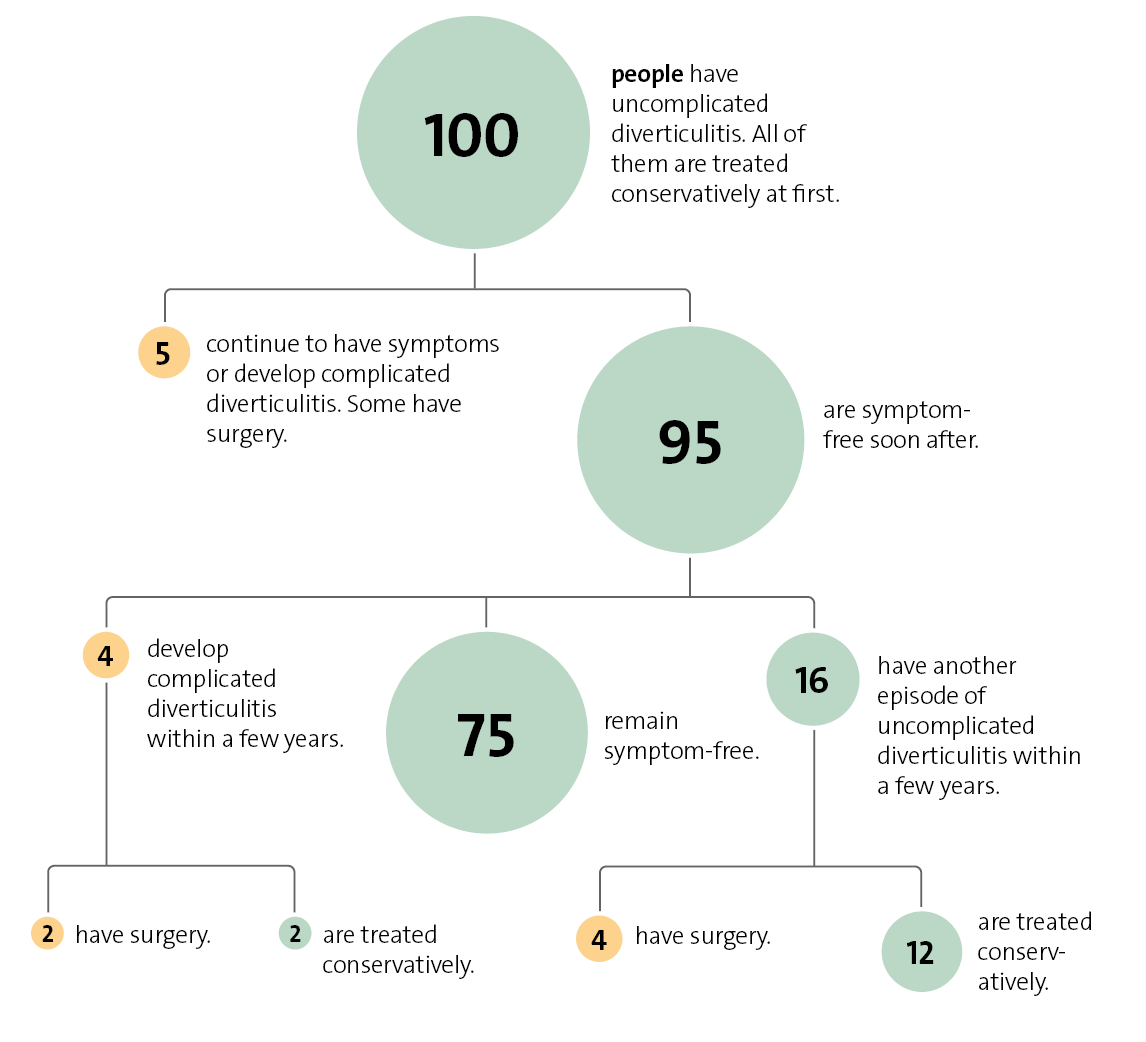
In about 95 out of 100 people, uncomplicated diverticulitis goes away on its own within a week. In about 5 out of 100 people, the symptoms stay and treatment is needed. Surgery is only rarely necessary.

This simplified diagram shows the course of uncomplicated diverticulitis in 100 people with the disease

How is complicated diverticulitis treated?

Complicated diverticulitis is treated with . People often switch to a liquid diet for a while, too. Sometimes surgery is needed.

Antibiotics

Complicated diverticulitis is treated in the hospital. Antibiotics are needed in order to stop the from spreading further. They can be used in the form of a syrup, tablets, or an infusion (drip).

Diet

Whether or not people with complicated diverticulitis should avoid solid foods will depend on their symptoms and the results of diagnostic tests. They are often given water, tea and soup for a few days, and then gradually start eating normally again. If they aren’t able to drink enough, they are given fluids through a drip.

Draining

People who have complicated diverticulitis have an abscess with pus in it. If the abscess is quite big, the pus can be drained out of it through a thin tube that is inserted into the belly.

Surgery

If the symptoms don’t improve within a few days, the risk of serious complications increases. Surgery is then recommended. People who have an intestinal perforation or peritonitis need to have surgery immediately. Both of these conditions are medical emergencies.

Even if a long-lasting with pus goes away after treatment with , doctors still often recommend operating on the bowel. The aim of this surgery is to prevent people from developing complicated diverticulitis again. Research has shown that almost 1 in 3 people who have previously had successful treatment with go on to develop diverticulitis again within a few years – and new episodes sometimes lead to serious complications. People who have a weakened or chronic kidney disease are also at higher risk of serious complications.

What is the typical course of complicated diverticulitis?

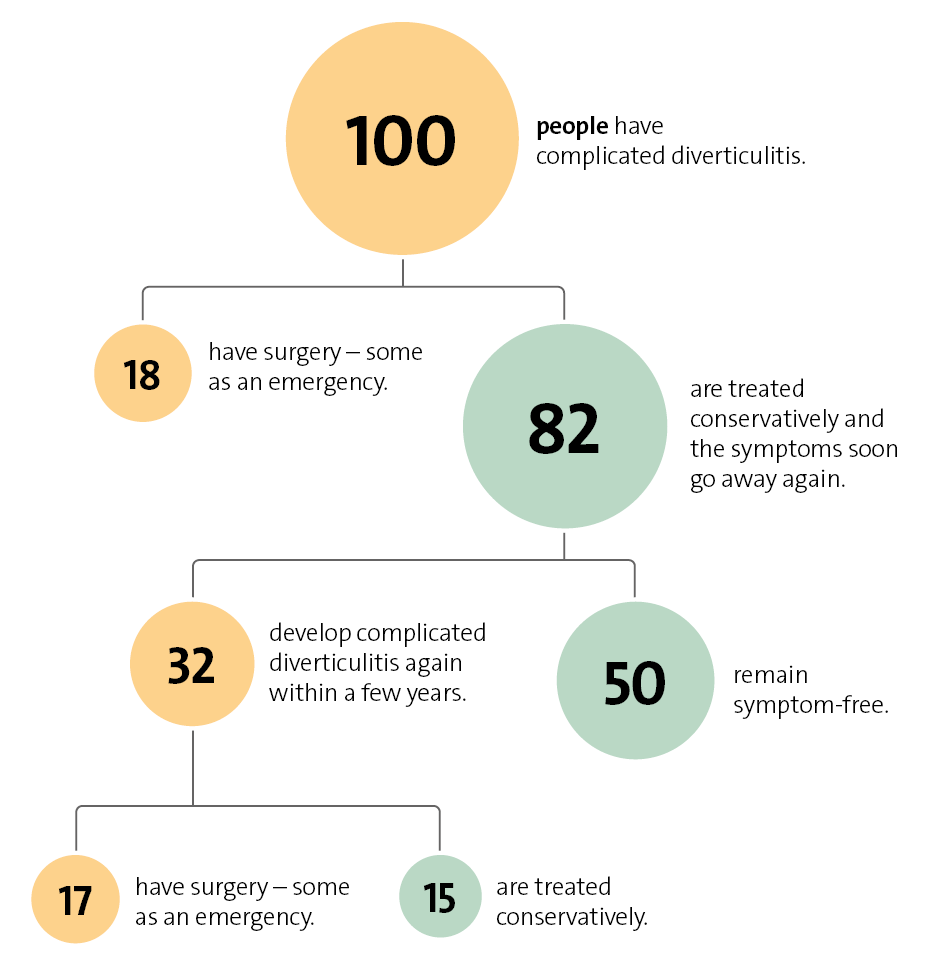
In about 80 out of 100 people, complicated diverticulitis clears up within a few weeks of having treatment with . About 20 out of 100 people have surgery.

This simplified diagram shows the course of complicated diverticulitis in 100 people with the disease

Balasubramanian I, Fleming C, Mohan HM et al. Out-Patient Management of Mild or Uncomplicated Diverticulitis: A Systematic Review. Dig Surg 2017; 34(2): 151-160.

Balk EM, Adam GP, Cao W et al. Management of Colonic Diverticulitis. (AHRQ Comparative Effectiveness Reviews; No. 233). 2020.

Brown RF, Lopez K, Smith CB et al. Diverticulitis: A Review. JAMA 2025 [Epub ahead of print].

Correa Bonito A, Cerdán Santacruz C, Di Martino M et al. Treatment for acute uncomplicated diverticulitis without antibiotherapy: systematic review and meta-analysis of randomized clinical trials. Int J Surg 2023; 109(5): 1412-1419.

Dichman ML, Rosenstock SJ, Shabanzadeh DM. Antibiotics for uncomplicated diverticulitis. Cochrane Database Syst Rev 2022; (6): CD009092.

Jackson JD, Hammond T. Systematic review: outpatient management of acute uncomplicated diverticulitis. Int J Colorectal Dis 2014; 29(7): 775-781.

Leifeld L, Germer CT, Bohm S et al. S3-Leitlinie Divertikelkrankheit / Divertikulitis. Gemeinsame Leitlinie der Deutschen Gesellschaft für Gastroenterologie, Verdauungs- und Stoffwechselkrankheiten (DGVS) und der Deutschen Gesellschaft für Allgemein- und Viszeralchirurgie (DGAV). AWMF register no.: 021-020. 2021.

Morris AM, Regenbogen SE, Hardiman KM et al. Sigmoid diverticulitis: a systematic review. JAMA 2014; 311(3): 287-297.

IQWiG health information is written with the aim of helping people understand the advantages and disadvantages of the main treatment options and health care services.

Because IQWiG is a German institute, some of the information provided here is specific to the German health care system. The suitability of any of the described options in an individual case can be determined by talking to a doctor. informedhealth.org can provide support for talks with doctors and other medical professionals, but cannot replace them. We do not offer individual consultations.

Our information is based on the results of good-quality studies. It is written by a team of health care professionals, scientists and editors, and reviewed by external experts. You can find a detailed description of how our health information is produced and updated in our methods.

Comment on this page

What would you like to share with us?

We welcome any feedback and ideas - either via our form or by gi-kontakt@iqwig.de. We will review, but not publish, your ratings and comments. Your information will of course be treated confidentially. Fields marked with an asterisk (*) are required fields.

Please note that we do not provide individual advice on matters of health. You can read about where to find help and support in Germany in our information “How can I find self-help groups and information centers?

Über diese Seite

Updated on February 9, 2026

Next planned update: 2029

Publisher:

Institute for Quality and Efficiency in Health Care (IQWiG, Germany)

Stay informed

Subscribe to our newsletter or newsfeed. You can find our growing collection of films on YouTube.