Brain aneurysm

At a glance

  • A brain aneurysm is a bulge in a blood vessel in the brain.
  • It often goes unnoticed.
  • Most aneurysms never cause any problems.
  • If an aneurysm ruptures (bursts), it can lead to life-threatening bleeding.
  • Surgery can prevent ruptures, but is itself associated with risks.

Introduction

Photo of an elderly woman sitting on a bench

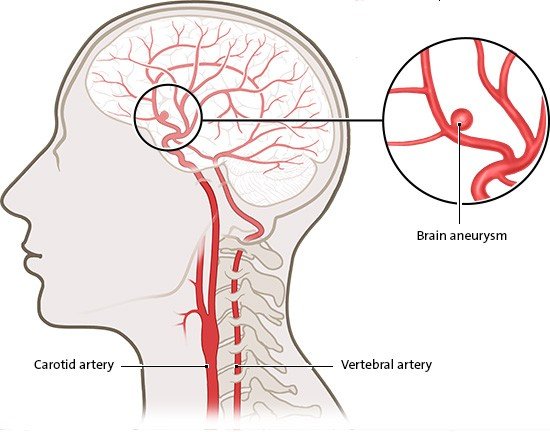
A brain aneurysm is a berry-shaped bulge in an artery in or near the brain. Normally, arteries are firm and elastic, like hoses. They carry oxygen-rich blood from the heart to the rest of the body. But sometimes the wall of an artery becomes weaker in one area and bulges outward. It is then known as an aneurysm. Once a bulge has developed, it doesn't go away again.

Aneurysms can develop in various parts of the body – for instance, in the largest artery in the belly (abdominal aortic aneurysm) or an artery in the head (brain aneurysm). Brain aneurysms often form at points where the arteries that supply the brain with blood split and branch off.

Most brain aneurysms don't ever cause any symptoms or problems. In some people, though, the aneurysm is more likely to eventually rupture (burst) and lead to life-threatening bleeding in the brain (a brain hemorrhage). This is a medical emergency that needs to be treated immediately in a hospital. To prevent a rupture, preventive surgery can be a good idea.

The illustration shows the location of a brain aneurysm in the middle of the brain. There is also an enlarged image of this berry-shaped bulge.

Symptoms

Aneurysms often don't cause any symptoms at all.

Symptoms can arise if an aneurysm is particularly large or located in certain parts of the brain. Then they may press against brain tissue or nerves – for instance, on the optic (eye) nerve. That causes symptoms such as:

  • Headaches
  • Vision problems
  • Eye muscle paralysis

Less common symptoms include seizures, unusual sensations, speech problems or hearing problems.

Causes

Brain aneurysms typically develop because the affected part of the blood vessel wall becomes less elastic. This can happen as a result of

In rare cases, aneurysms are caused by genetic diseases such as Ehlers-Danlos syndrome, which leads to weak connective tissue and – as a result – weak blood vessel walls.

Risk factors

People with high blood pressure and people who smoke are more likely to develop brain aneurysms.

The risk is greater in women than in men – and also in people who have a parent or sibling with a brain aneurysm. The risk increases with age, too.

All of these risk factors make the aneurysm more likely to eventually rupture as well.

Prevalence and outlook

About 3 in 100 adults have a brain aneurysm. Some people have several brain aneurysms.

Most brain aneurysms don’t change and never cause any problems, so they remain unnoticed. But some aneurysms get bigger and cause symptoms. Larger aneurysms are also more likely to rupture.

In about 3 out of every 100 people with a brain aneurysm, it ruptures within 5 years. But this is only a rough estimate because the risk of a rupture is influenced by many factors – for example, the size, location and shape of the aneurysm. Half of the people whose aneurysm ruptures are under 50 years old when it happens.

Effects

When a brain aneurysm ruptures, it causes a specific type of bleeding in the brain known as a subarachnoid hemorrhage (SAH). This is a life-threatening emergency that needs to be treated as quickly as possible.

Bleeding increases the pressure inside the skull and damages the delicate brain tissue. It typically leads to a sudden, extremely severe headache. Many patients say that the headache is the worst they have ever experienced. The pain often starts at the back of the head and neck. It then spreads across the entire head and often down into the back, too.

Other signs of a subarachnoid hemorrhage include:

  • A stiff neck
  • Nausea, vomiting
  • Confusion or loss of consciousness

About 40 out of every 100 people with a ruptured aneurysm die as a result of the hemorrhage within a few weeks. In about 30 out of 100 people, the bleeding causes such severe nerve damage that they need help from others to get by in daily life. Many people are left with a permanent disability – for example, difficulty walking. Their sense of smell may also be impaired.

In rare cases, a brain aneurysm can lead to the blockage of an artery in the brain: Blood clots often form inside aneurysms, but they generally don’t cause any problems. If one of these blood clots moves back into the brain artery, the clot may be carried to a smaller branch of the artery and block it (embolism). This causes a stroke.

Diagnosis

Many people with a brain aneurysm find out about it by chance when they have a brain scan for a different reason.

Sometimes brain aneurysms are also discovered due to symptoms such as headaches or vision problems. The doctor may then recommend a (MRI) scan or (CT) scan to find out what's causing the symptoms. Aneurysms are particularly easy to see with a rarely used technique known as digital subtraction angiography (DSA). This is an x-ray examination performed using a and a contrast agent. An x-ray is taken with and without injecting the contrast agent. Then a computer uses this data to generate an image that shows only the blood vessels.

Treatment

Brain aneurysms that do not cause any symptoms and are not likely to rupture are usually monitored: Here, a type of MRI known as magnetic resonance angiography (MRA) is used to check whether the shape or size of the aneurysm has changed. This helps to predict the risk of the aneurysm rupturing. To get a clearer view of the blood vessels in your brain, you may be given a contrast agent (gadolinium) through a vein in your hand or arm. But you might need to have a CT angiogram or a digital subtraction angiogram (DSA) too.

If you smoke, doctors will advise you to quit. People with high blood pressure should have treatment to reduce it.

If there's a high risk that the brain aneurysm will rupture, or if it is causing symptoms, surgery may be considered. There are two main surgical approaches:

  • Microsurgery, where a small opening is made in the skull and the aneurysm is closed off using a small metal clip. This approach is known as clipping.
  • An endovascular procedure, where a is used to guide fine metal coils (usually platinum) through your bloodstream and into the brain aneurysm. The coils cause the blood in the aneurysm to clot, closing the aneurysm off. This procedure is also known as coiling.

Both approaches aim to stop blood from flowing into the aneurysm and prevent ruptures in that way. But these surgical procedures come with a risk of serious complications, such as a stroke or paralysis.

Deciding

It is not always easy to decide whether to have brain aneurysm surgery to prevent a rupture: The surgery carries risks, but the aneurysm may be more likely to rupture without it. Both of these risks depend on many individual factors.

The decision is easier if you have enough information about all the options. A decision aid can help you make the right choice for you.

Brain aneurysm: What are your treatment options?

When deciding whether or not to have a surgical procedure, it's a good idea to find out about the pros and cons first. This decision aid can help here.

Further information

When people are ill or need medical advice, they usually go to see their family doctor first. If you have a brain aneurysm, you should see a specialist in neurology, neurosurgery or neuroradiology who is experienced in the treatment of brain aneurysms.

Information about health care in Germany can help you to navigate the German healthcare system and find a suitable doctor. You can use this list of questions to prepare for your appointment. Various websites offer search features to help you look for a suitable hospital. You can search for hospitals in Germany here.

Quiz: The brain

The brain is our body's "central processing unit." Do you know what tasks it has to carry out? Find out in this quiz.

Backes D, Rinkel GJ, Laban KG et al. Patient- and Aneurysm-Specific Risk Factors for Intracranial Aneurysm Growth: A Systematic Review and Meta-Analysis. Stroke 2016; 47(4): 951-957.

Balik V, Yamada Y, Talari S et al. State-of-Art Surgical Treatment of Dissecting Anterior Circulation Intracranial Aneurysms. J Neurol Surg A Cent Eur Neurosurg 2017; 78(1): 67-77.

Etminan N, de Sousa DA, Tiseo C et al. European Stroke Organisation (ESO) guidelines on management of unruptured intracranial aneurysms. Eur Stroke J 2022; 7(3): V.

Hacke W. Neurologie. Berlin: Springer; 2016.

Kleinloog R, de Mul N, Verweij BH et al. Risk Factors for Intracranial Aneurysm Rupture: A Systematic Review. Neurosurgery 2018; 82(4): 431-440.

Malhotra A, Wu X, Forman HP et al. Growth and Rupture Risk of Small Unruptured Intracranial Aneurysms: A Systematic Review. Ann Intern Med 2017; 167(1): 26-33.

National Institute for Health and Care Excellence (NICE). Subarachnoid haemorrhage caused by a ruptured aneurysm: diagnosis and management (NICE guidelines; No. NG228). 2022.

Pontes FG, da Silva EM, Baptista-Silva JC et al. Treatments for unruptured intracranial aneurysms. Cochrane Database Syst Rev 2021; (5): CD013312.

Pschyrembel Online. 2026.

IQWiG health information is written with the aim of helping people understand the advantages and disadvantages of the main treatment options and health care services.

Because IQWiG is a German institute, some of the information provided here is specific to the German health care system. The suitability of any of the described options in an individual case can be determined by talking to a doctor. informedhealth.org can provide support for talks with doctors and other medical professionals, but cannot replace them. We do not offer individual consultations.

Our information is based on the results of good-quality studies. It is written by a team of health care professionals, scientists and editors, and reviewed by external experts. You can find a detailed description of how our health information is produced and updated in our methods.


Comment on this page

What would you like to share with us?

We welcome any feedback and ideas - either via our form or by gi-kontakt@iqwig.de. We will review, but not publish, your ratings and comments. Your information will of course be treated confidentially. Fields marked with an asterisk (*) are required fields.

Please note that we do not provide individual advice on matters of health. You can read about where to find help and support in Germany in our information “How can I find self-help groups and information centers?

Print page

Über diese Seite

Updated on April 27, 2026

Next planned update: 2029

Publisher:

Institute for Quality and Efficiency in Health Care (IQWiG, Germany)

Stay informed

Subscribe to our newsletter or newsfeed. You can find our growing collection of films on YouTube.