
Passive treatments for chronic back pain: Acupuncture, electrotherapy and manual therapy
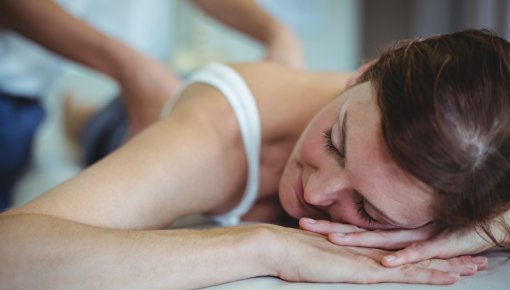
Photo of a woman receiving a massage

Passive treatments such as massages or can only relieve chronic back pain for a short time, if at all. They can be used in addition to other treatments, but are not suitable on their own.

Research has shown that active treatments provide the most effective relief for back pain that isn't clearly caused by one specific thing (non-specific back pain). "Active" treatments are those that you actively participate in and learn to carry out yourself. These include movement-based activities such as pilates, yoga, and targeted exercises to strengthen and stabilize your back. One advantage of active treatments is that they help you trust your body more. Realizing that you can become active and stay active despite the pain is an important part of the treatment.

Passive treatments, on the other hand, do not involve any active participation on your part. They include:

  • Acupuncture
  • Electrotherapy
  • Mobilization and manipulation of the spine (manual therapy)
  • Massages
  • Osteopathy

Because low back pain often gets better after a while without treatment, and often comes and goes anyway, the only way to find out whether these treatments really work is by doing comparative studies. But a lot of passive treatments haven't been properly tested in good studies. So far, the research has found that they only help in the short term, or not at all. For this reason, specialists recommend that passive treatments should only be used as a possible addition to active treatments, if at all.

Good to know:

Most of the passive treatments are classed as individual health care services in Germany (individuelle Gesundheitsleistungen, or IGeL for short), which means they aren't paid for by German public health insurers.

Acupuncture

Acupuncture is a traditional Chinese medicine treatment that involves inserting thin needles into specific points on the skin. According to traditional beliefs, the needles influence the flow of energy through the body when they are placed at certain points along the energy pathways (meridians). This is thought to activate the body’s own healing powers. But there's no scientific proof that these energy pathways exist. Research has shown that it doesn't matter where exactly you insert the needles and whether they actually enter the skin or not. For example, traditional Chinese hardly worked any better than "sham" (fake) , where the needles were inserted in the wrong places.

Inserting the needles sometimes causes minor bleeding or bruising, especially in people who are taking anticoagulant medication (to prevent blood clots). To avoid , it's important to use sterile disposable needles. The risk of serious side effects is low.

Electrotherapy

Transcutaneous electrical nerve stimulation (TENS) and electrical nerve stimulation (PENS) are types of electrotherapy. In these treatments, special equipment is used to trigger electrical impulses in the nervous system. This is done to stop pain signals being sent to the brain and to stimulate the production of endorphins (the body's own pain-relieving ). TENS involves placing electrodes on the skin to send electrical impulses through the skin (transcutaneously). In PENS, the electrical impulses are sent through needles inserted into the skin (percutaneously). Inferential current therapy is another technique that works in a similar way to TENS.

There is no scientific proof that electrotherapy can relieve chronic back pain. Previous studies in this area were not very conclusive and only looked at the effect over a short period of time. In PENS, the small punctures in the skin may lead to minor bleeding or an .

Mobilization and manipulation of the spine

Mobilization and manipulation are two types of manual therapy. In mobilization, the therapist slowly moves the joint within its normal range of movement. Manipulation therapy, on the other hand, involves using short, sharp movements to push a joint beyond its normal range of movement.

Popping or cracking sounds may be heard during the procedure. These sounds occur when small bubbles of gas in the joints burst, just like when people crack their knuckles. It is not exactly clear how these approaches are meant to work. Some of the current theories involve the release of muscle tension, the "unsticking" of tissue that is stuck together, and the re-alignment of certain joint structures.

There are only a few studies on the manipulation and mobilization of the spine for the treatment of chronic back pain. Further research is needed in order to properly assess the effectiveness of these treatments.

Manual therapy can sometimes lead to side effects such as muscle soreness and cramps, as well as short-term joint stiffness or temporary pain. More serious complications of joint manipulation, such as bone fractures or signs of paralysis, are very rare. They could occur if, for instance, someone has osteoporosis or if the manipulation leads to a slipped disc or makes an existing slipped disc worse.

Massages

Massages are a traditional treatment for back pain. They are meant to relax your muscles, reduce painful muscle tension, and increase your general sense of wellbeing.

There are different types of massage. Common techniques include traditional (Swedish) massage, Thai massage, and acupressure. The methods differ in terms of the type of hand movements that are used and which parts of the body are massaged. They also vary in the amount of pressure applied, and whether the massage therapist uses their hands, fingertips or special tools.

There is a lack of good-quality research on the effects of massage in the treatment of chronic back pain. It seems that massage can temporarily relieve the pain, but there is no proof of a longer-term effect.

Depending on how much pressure is applied to the affected area, the massage might be painful or you might feel sore shortly afterwards. Some people are allergic to massage oil, which can cause things like rashes.

Osteopathy

Osteopathy is a type of alternative treatment. It is based on the idea that all of the body's structures and functions influence each other. This means, for example, that problems and diseases in one joint or organ are thought to have an effect on other parts of the body. Connective tissue is considered to be particularly important in osteopathy because it connects the body's different physical structures and organs. There is no scientific proof that this theory is true, though.

In osteopathy, therapists use nothing but their hands when performing physical examinations and treatments. The therapist first feels for areas that you can't move very well, hard tissue, tension in the body, and other kinds of changes in the tissue. Then they apply various stretching techniques, massage approaches and hand movements to help with these problems. One type of osteopathic treatments are known as "muscle energy techniques." The aim of these approaches is to release areas of physical tension by tensing the muscles and stretching them. Research on osteopathic treatments for back pain have produced contradictory results. There is no proof that muscle energy techniques work.

In Germany, the job title "osteopath" isn't protected and doesn't require specific training.

Other treatments

A wide range of other treatments are offered for back pain, including traction therapy, kinesiology tape, short-wave diathermy, laser therapy, electromagnetic therapy and ultrasound therapy. There is no scientific proof that these and similar treatment approaches can help to reduce back pain.

When it comes to most of the complementary or alternative medicine approaches, there is no scientifically plausible explanation for how they might work either. The claimed mechanisms of action often contradict the basic principles of science.

Chenot JF, Greitemann B, Kladny B et al. Nichtspezifischer Kreuzschmerz. Dtsch Arztebl Int 2017; 114(51-52): 883-890.

Skelly AC, Chou R, Dettori JR et al. Noninvasive Nonpharmacological Treatment for Chronic Pain: A Systematic Review Update. (AHRQ Comparative Effectiveness Reviews; No. 227). 2020.

World Health Organization (WHO). WHO guideline for non-surgical management of chronic primary low back pain in adults in primary and community care settings. In: WHO Guidelines Approved by the Guidelines Review Committee. Geneva: WHO; 2023.

IQWiG health information is written with the aim of helping people understand the advantages and disadvantages of the main treatment options and health care services.

Because IQWiG is a German institute, some of the information provided here is specific to the German health care system. The suitability of any of the described options in an individual case can be determined by talking to a doctor. informedhealth.org can provide support for talks with doctors and other medical professionals, but cannot replace them. We do not offer individual consultations.

Our information is based on the results of good-quality studies. It is written by a team of health care professionals, scientists and editors, and reviewed by external experts. You can find a detailed description of how our health information is produced and updated in our methods.

Comment on this page

What would you like to share with us?

We welcome any feedback and ideas - either via our form or by gi-kontakt@iqwig.de. We will review, but not publish, your ratings and comments. Your information will of course be treated confidentially. Fields marked with an asterisk (*) are required fields.

Please note that we do not provide individual advice on matters of health. You can read about where to find help and support in Germany in our information “How can I find self-help groups and information centers?

Über diese Seite

Updated on December 16, 2025

Next planned update: 2028

Publisher:

Institute for Quality and Efficiency in Health Care (IQWiG, Germany)

Stay informed

Subscribe to our newsletter or newsfeed. You can find our growing collection of films on YouTube.